University of Liverpool.
School of Public Health, Imperial College London.
Milbank Q. 2019 Sep;97(3):858-880. doi: 10.1111/1468-0009.12402. Epub 2019 Jul 22.
Policy Points The World Health Organization has recommended sodium reduction as a "best buy" to prevent cardiovascular disease (CVD). Despite this, Congress has temporarily blocked the US Food and Drug Administration (FDA) from implementing voluntary industry targets for sodium reduction in processed foods, the implementation of which could cost the industry around $16 billion over 10 years. We modeled the health and economic impact of meeting the two-year and ten-year FDA targets, from the perspective of people working in the food system itself, over 20 years, from 2017 to 2036. Benefits of implementing the FDA voluntary sodium targets extend to food companies and food system workers, and the value of CVD-related health gains and cost savings are together greater than the government and industry costs of reformulation.
The US Food and Drug Administration (FDA) set draft voluntary targets to reduce sodium levels in processed foods. We aimed to determine cost effectiveness of meeting these draft sodium targets, from the perspective of US food system workers.
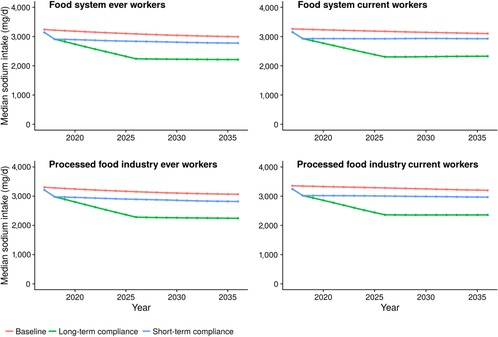
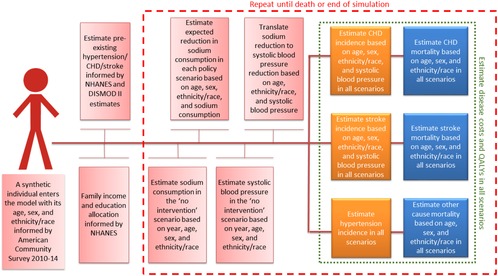
We employed a microsimulation cost-effectiveness analysis using the US IMPACT Food Policy model with two scenarios: (1) short term, achieving two-year FDA reformulation targets only, and (2) long term, achieving 10-year FDA reformulation targets. We modeled four close-to-reality populations: food system "ever" workers; food system "current" workers in 2017; and subsets of processed food "ever" and "current" workers. Outcomes included cardiovascular disease cases prevented and postponed as well as incremental cost-effectiveness ratio per quality-adjusted life year (QALY) gained from 2017 to 2036.
Among food system ever workers, achieving long-term sodium reduction targets could produce 20-year health gains of approximately 180,000 QALYs (95% uncertainty interval [UI]: 150,000 to 209,000) and health cost savings of approximately $5.2 billion (95% UI: $3.5 billion to $8.3 billion), with an incremental cost-effectiveness ratio (ICER) of $62,000 (95% UI: $1,000 to $171,000) per QALY gained. For the subset of processed food industry workers, health gains would be approximately 32,000 QALYs (95% UI: 27,000 to 37,000); cost savings, $1.0 billion (95% UI: $0.7bn to $1.6bn); and ICER, $486,000 (95% UI: $148,000 to $1,094,000) per QALY gained. Because many health benefits may occur in individuals older than 65 or the uninsured, these health savings would be shared among individuals, industry, and government.
The benefits of implementing the FDA voluntary sodium targets extend to food companies and food system workers, with the value of health gains and health care cost savings outweighing the costs of reformulation, although not for the processed food industry.
目的:从食品系统自身工作人员的角度出发,模拟实现美国食品和药物管理局(FDA)两年和十年内加工食品中钠含量目标的健康和经济效益,时间跨度为 2017 年至 2036 年。
发现:在食品系统的所有工人中,实现长期减少钠含量的目标可以带来大约 20 年 18 万质量调整生命年(QALY)的健康收益(95%置信区间[UI]:15 万至 20.9 万)和大约 52 亿美元(95% UI:35 亿至 83 亿美元)的健康成本节省,增量成本效益比(ICER)为每获得一个 QALY 增加 62000 美元(95% UI:1000 美元至 171000 美元)。对于加工食品行业工人的子集中,健康收益将约为 32000 个 QALY(95% UI:27000 至 37000);成本节省为 10 亿美元(95% UI:70 亿至 160 亿美元);每获得一个 QALY 的 ICER 为 486000 美元(95% UI:148000 美元至 1094000 美元)。由于许多健康益处可能发生在 65 岁以上或没有保险的个体中,因此这些健康储蓄将在个人、行业和政府之间共享。
结论:实施 FDA 自愿钠含量目标的好处不仅延伸到食品公司和食品系统工人,而且健康收益和医疗保健成本节省的价值超过了配方改革的成本,尽管对加工食品行业来说并非如此。