Department of Gastroenterology and Hepatology, Erasmus MC University Medical Center, Rotterdam, The Netherlands.
Department of Medical Microbiology and Infectious diseases, Erasmus MC University Medical Center, Rotterdam, The Netherlands.
Gut. 2018 Sep;67(9):1637-1645. doi: 10.1136/gutjnl-2017-315082. Epub 2018 Apr 10.
Increasing numbers of outbreaks caused by contaminated duodenoscopes used for Endoscopic Retrograde Cholangiopancreatography (ERCP) procedures have been reported, some with fatal outcomes. We conducted a nationwide cross-sectional study to determine the prevalence of bacterial contamination of reprocessed duodenoscopes in The Netherlands.
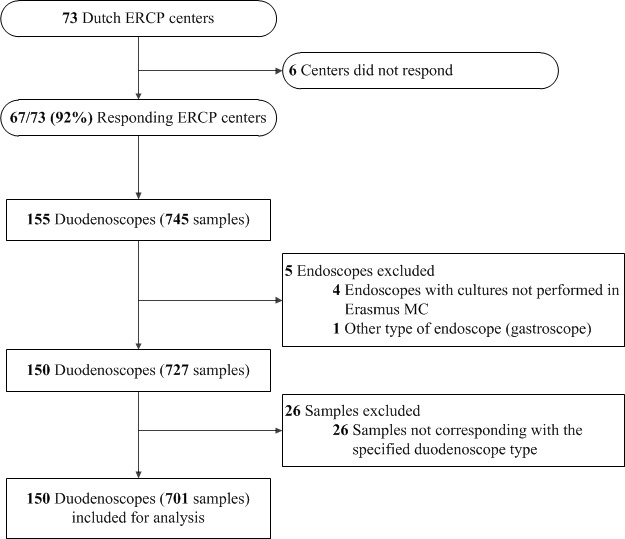
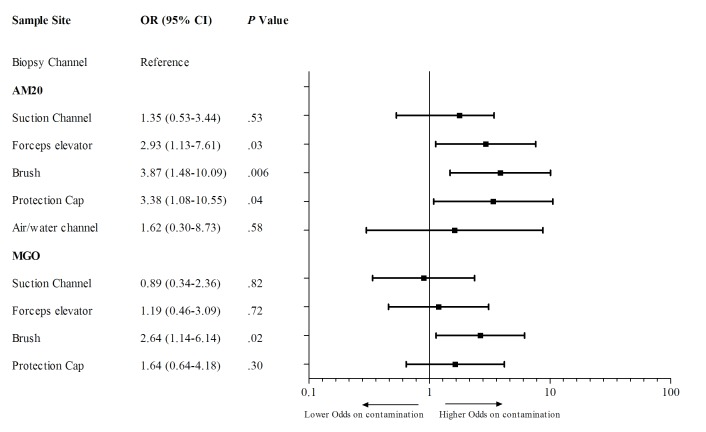
All 73 Dutch ERCP centres were invited to sample ≥2 duodenoscopes using centrally distributed kits according to uniform sampling methods, explained by video instructions. Depending on duodenoscope type, four to six sites were sampled and centrally cultured. Contamination was defined as (1) any microorganism with ≥20 colony forming units (CFU)/20 mL (AM20) and (2) presence of microorganisms with gastrointestinal or oral origin, independent of CFU count (MGO).
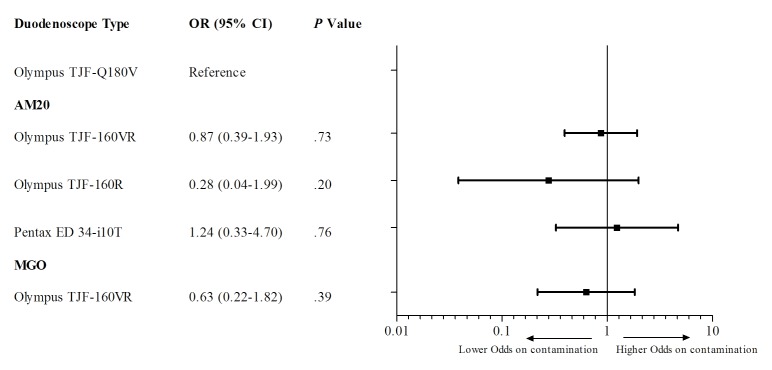
Sixty-seven out of 73 centres (92%) sampled 745 sites of 155 duodenoscopes. Ten different duodenoscope types from three distinct manufacturers were sampled including 69 (46%) Olympus TJF-Q180V, 43 (29%) Olympus TJF-160VR, 11 (7%) Pentax ED34-i10T, 8 (5%) Pentax ED-3490TK and 5 (3%) Fujifilm ED-530XT8. Thirty-three (22%) duodenoscopes from 26 (39%) centres were contaminated (AM20). On 23 (15%) duodenoscopes MGO were detected, including and yeasts. For both definitions, contamination was not duodenoscope type dependent (p values: 0.20 and higher).
In 39% of all Dutch ERCP centres, at least one AM20-contaminated patient-ready duodenoscope was identified. Fifteen per cent of the duodenoscopes harboured MGO, indicating residual organic material of previous patients, that is, failing of disinfection. These results suggest that the present reprocessing and process control procedures are not adequate and safe.
越来越多的由用于内镜逆行胰胆管造影术(ERCP)的污染十二指肠镜引起的暴发事件被报道,其中一些导致了致命后果。我们进行了一项全国性的横断面研究,以确定荷兰再处理十二指肠镜细菌污染的流行率。
根据统一的采样方法,使用中央分发的试剂盒邀请所有 73 个荷兰 ERCP 中心对至少 2 个十二指肠镜进行采样,并通过视频说明进行解释。根据十二指肠镜的类型,从四个到六个部位进行采样并进行中央培养。污染定义为:(1)任何微生物≥20 个菌落形成单位(CFU)/20ml(AM20)和(2)存在胃肠道或口腔来源的微生物,无论 CFU 计数如何(MGO)。
73 个中心中的 67 个(92%)对 155 个十二指肠镜的 745 个部位进行了采样。采样的十二指肠镜来自三个不同制造商的十种不同类型,包括 69 个(46%)奥林巴斯 TJF-Q180V、43 个(29%)奥林巴斯 TJF-160VR、11 个(7%)宾得 ED34-i10T、8 个(5%)宾得 ED-3490TK 和 5 个(3%)富士通 ED-530XT8。26 个(39%)中心中的 33 个(22%)十二指肠镜被污染(AM20)。在 23 个(15%)十二指肠镜上检测到 MGO,包括细菌和酵母菌。对于这两种定义,污染与十二指肠镜类型无关(p 值:0.20 及以上)。
在所有荷兰 ERCP 中心中,至少有 39%的中心发现了一个 AM20 污染的准备好供患者使用的十二指肠镜。15%的十二指肠镜存在 MGO,表明存在前一个患者的残留有机物质,即消毒失败。这些结果表明,目前的再处理和过程控制程序不够充分和安全。