Department of Medical Microbiology and Parasitology, Zhejiang University School of Medicine, Hangzhou, Zhejiang, China.
Department of Biochemistry, University of Illinois at Urbana-Champaign, Urbana, Illinois, USA.
mBio. 2018 Apr 10;9(2):e02317-17. doi: 10.1128/mBio.02317-17.
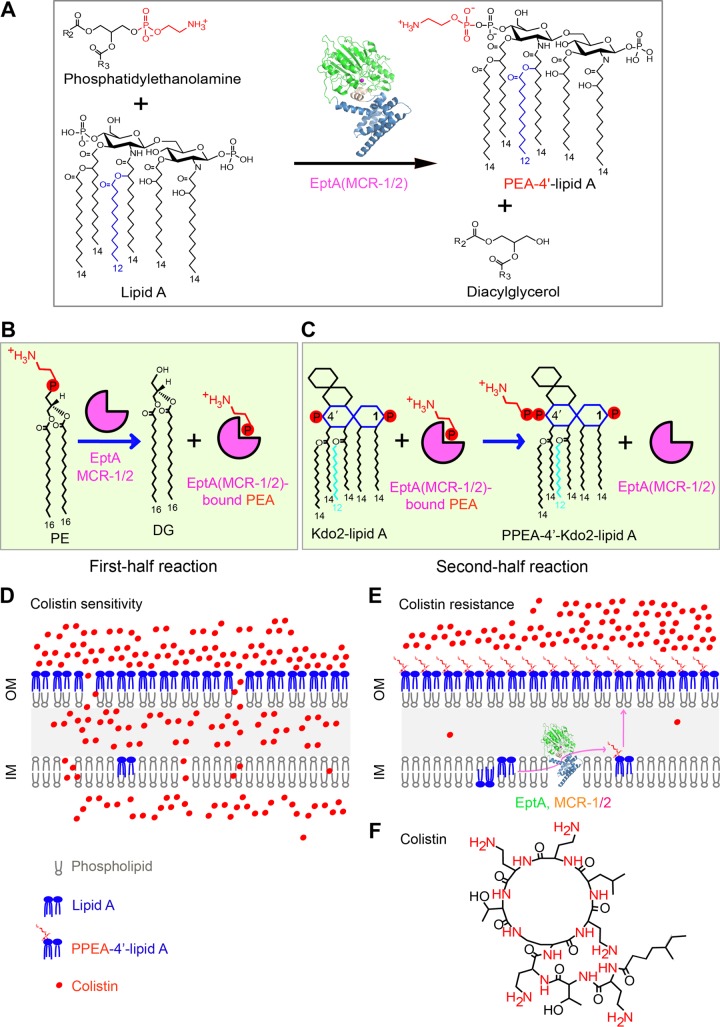
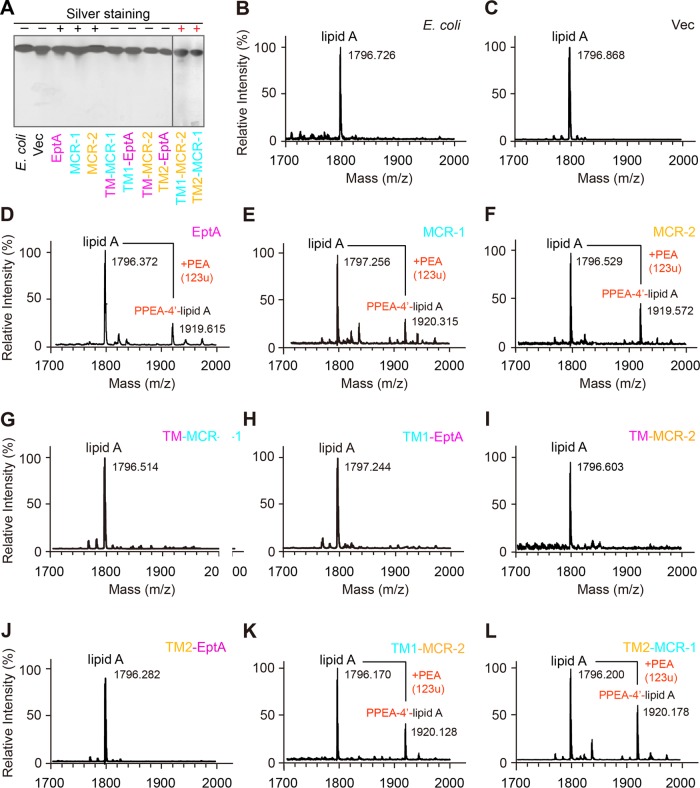
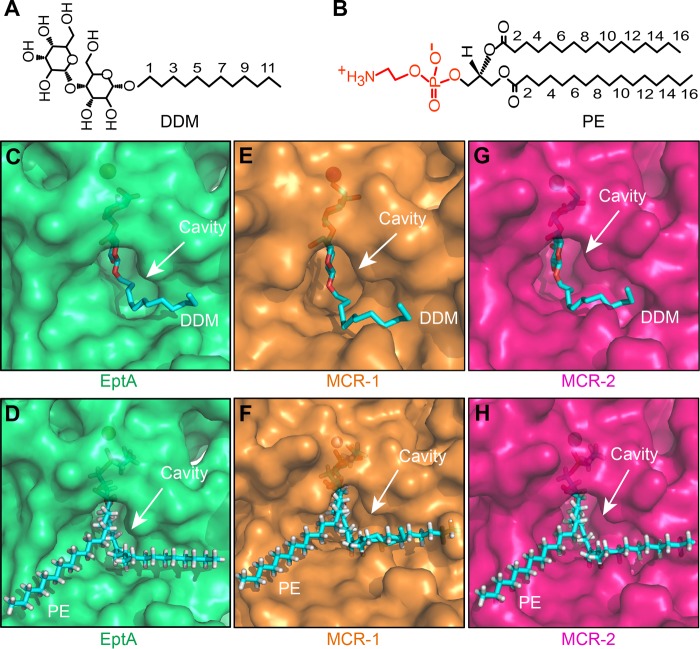
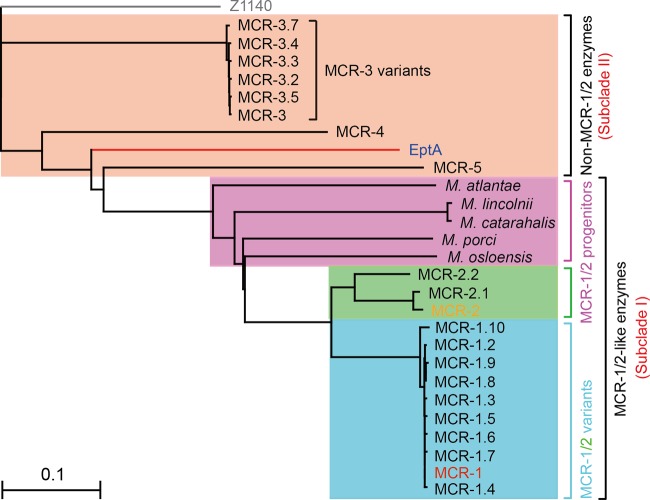
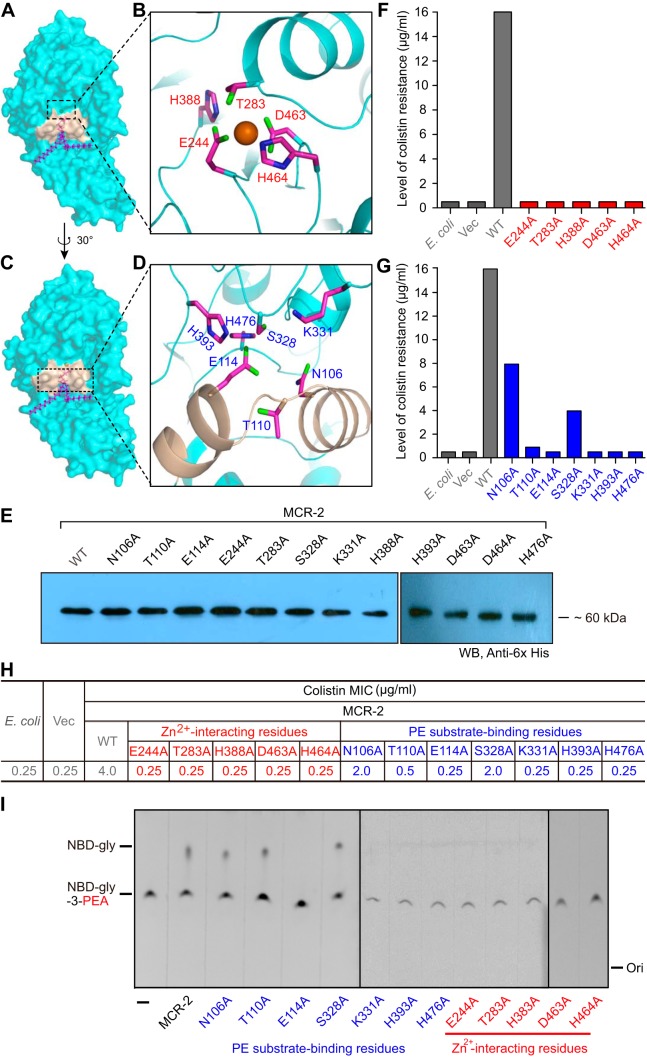
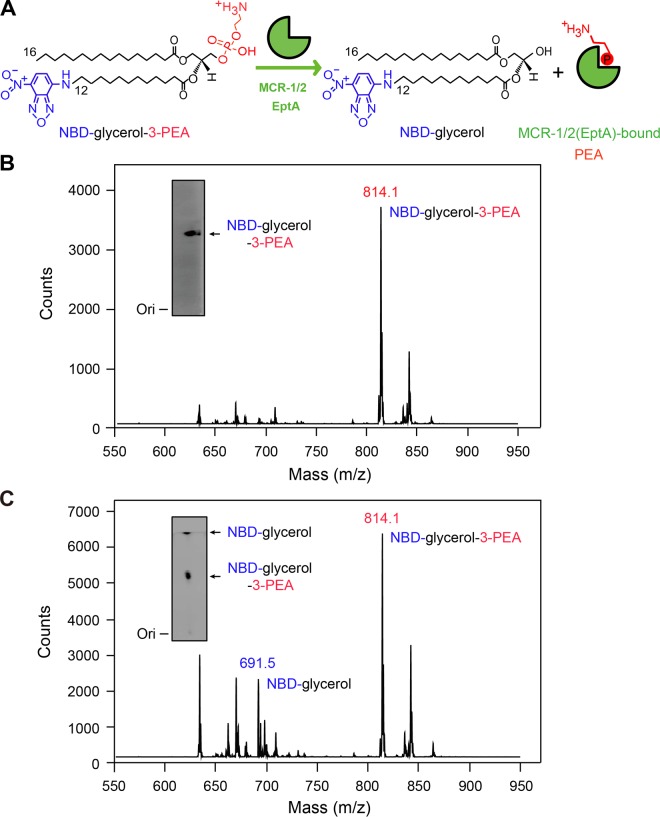
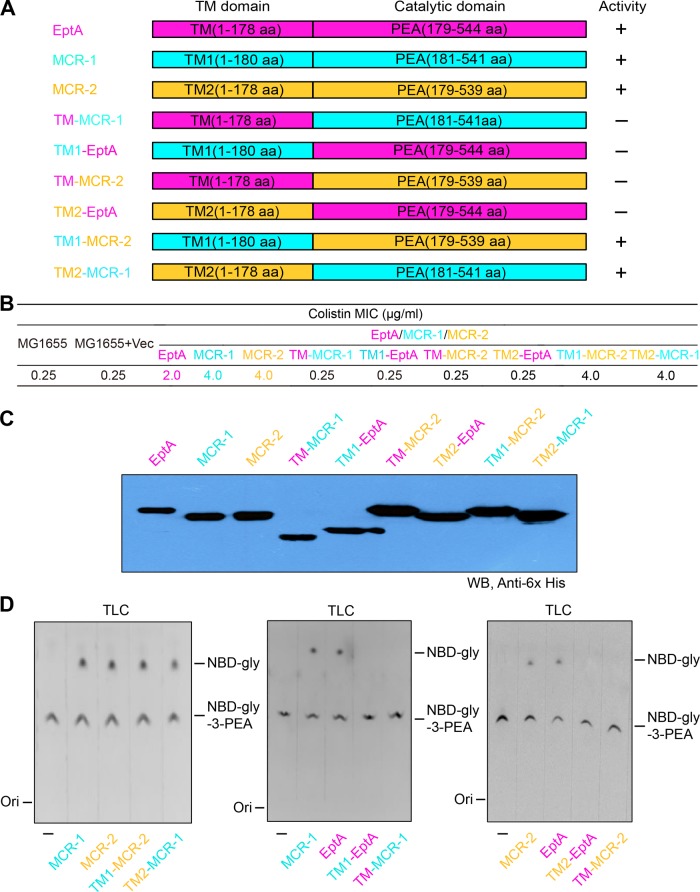
Polymyxins, a family of cationic antimicrobial cyclic peptides, act as a last line of defense against severe infections by Gram-negative pathogens with carbapenem resistance. In addition to the intrinsic resistance to polymyxin E (colistin) conferred by , the plasmid-borne mobilized colistin resistance gene has been disseminated globally since the first discovery in Southern China, in late 2015. However, the molecular mechanisms for both intrinsic and transferable resistance to colistin remain largely unknown. Here, we aim to address this gap in the knowledge of these proteins. Structural and functional analyses of EptA and MCR-1 and -2 have defined a conserved 12-residue cavity that is required for the entry of the lipid substrate, phosphatidylethanolamine (PE). The and data together have allowed us to visualize the similarities in catalytic activity shared by EptA and MCR-1 and -2. The expression of either EptA or MCR-1 or -2 is shown to remodel the surface of enteric bacteria (e.g., , , , etc.), rendering them resistant to colistin. The parallels in the PE substrate-binding cavities among EptA, MCR-1, and MCR-2 provide a comprehensive understanding of both intrinsic and transferable colistin resistance. Domain swapping between EptA and MCR-1 and -2 reveals that the two domains (transmembrane [TM] region and hosphothanolmine [PEA] transferase) are not functionally exchangeable. Taken together, the results represent a common mechanism for intrinsic and transferable PEA resistance to polymyxin, a last-resort antibiotic against multidrug-resistant pathogens. EptA and MCR-1 and -2 remodel the outer membrane, rendering bacteria resistant to colistin, a final resort against carbapenem-resistant pathogens. Structural and functional analyses of EptA and MCR-1 and -2 reveal parallel PE lipid substrate-recognizing cavities, which explains intrinsic and transferable colistin resistance in gut bacteria. A similar mechanism is proposed for the catalytic activities of EptA and MCR-1 and -2. Together, they constitute a common mechanism for intrinsic and transferable polymyxin resistance.
多黏菌素是一类阳离子型抗菌环肽,是应对耐碳青霉烯类革兰氏阴性病原体严重感染的最后一道防线。除了由 mcr-1 赋予的对黏菌素 e(多黏菌素 b)的固有耐药性外,自 2015 年底在中国南方首次发现以来,可移动的黏菌素耐药基因 mcr-1 已经在全球传播。然而,对于黏菌素的固有和可转移耐药性的分子机制在很大程度上仍然未知。在这里,我们旨在解决这些蛋白质知识空白。EptA 和 MCR-1 和 -2 的结构和功能分析定义了一个保守的 12 残基腔,该腔是脂质底物磷脂酰乙醇胺(PE)进入所必需的。EptA 和 MCR-1 和 -2 的 和 数据一起使我们能够可视化 EptA 和 MCR-1 和 -2 之间共享的催化活性的相似性。表达 EptA 或 MCR-1 或 -2 之一被显示重塑肠细菌(例如, , , 等)的表面,使它们对黏菌素产生耐药性。EptA、MCR-1 和 MCR-2 之间在 PE 底物结合腔中的相似性提供了对固有和可转移黏菌素耐药性的全面理解。EptA 和 MCR-1 和 -2 之间的结构域交换表明两个结构域(跨膜[TM]区和磷酸乙醇胺[PEA]转移酶)在功能上不能互换。总之,结果代表了多黏菌素固有和可转移 PEA 耐药的共同机制,多黏菌素是对抗多药耐药病原体的最后一道抗生素。EptA 和 MCR-1 和 -2 重塑外膜,使细菌对黏菌素产生耐药性,而黏菌素是对抗耐碳青霉烯类病原体的最后手段。EptA 和 MCR-1 和 -2 的结构和功能分析揭示了平行的 PE 脂质底物识别腔,这解释了肠道细菌中固有和可转移的黏菌素耐药性。拟议了 EptA 和 MCR-1 和 -2 的催化活性的类似机制。它们共同构成了固有和可转移多黏菌素耐药的共同机制。