Mao Yufeng, Li Guiying, Chang Zhishuai, Tao Ran, Cui Zhenzhen, Wang Zhiwen, Tang Ya-Jie, Chen Tao, Zhao Xueming
1Key Laboratory of Systems Bioengineering (Ministry of Education), SynBio Research Platform, Collaborative Innovation Center of Chemical Science and Engineering (Tianjin), School of Chemical Engineering and Technology, Tianjin University, Tianjin, 300072 China.
2Key Laboratory of Fermentation Engineering, Ministry of Education, Hubei University of Technology, Wuhan, 430068 China.
Biotechnol Biofuels. 2018 Apr 4;11:95. doi: 10.1186/s13068-018-1094-z. eCollection 2018.
Succinate has been recognized as one of the most important bio-based building block chemicals due to its numerous potential applications. However, efficient methods for the production of succinate from lignocellulosic feedstock were rarely reported. Nevertheless, was engineered to efficiently produce succinate from glucose in our previous study.
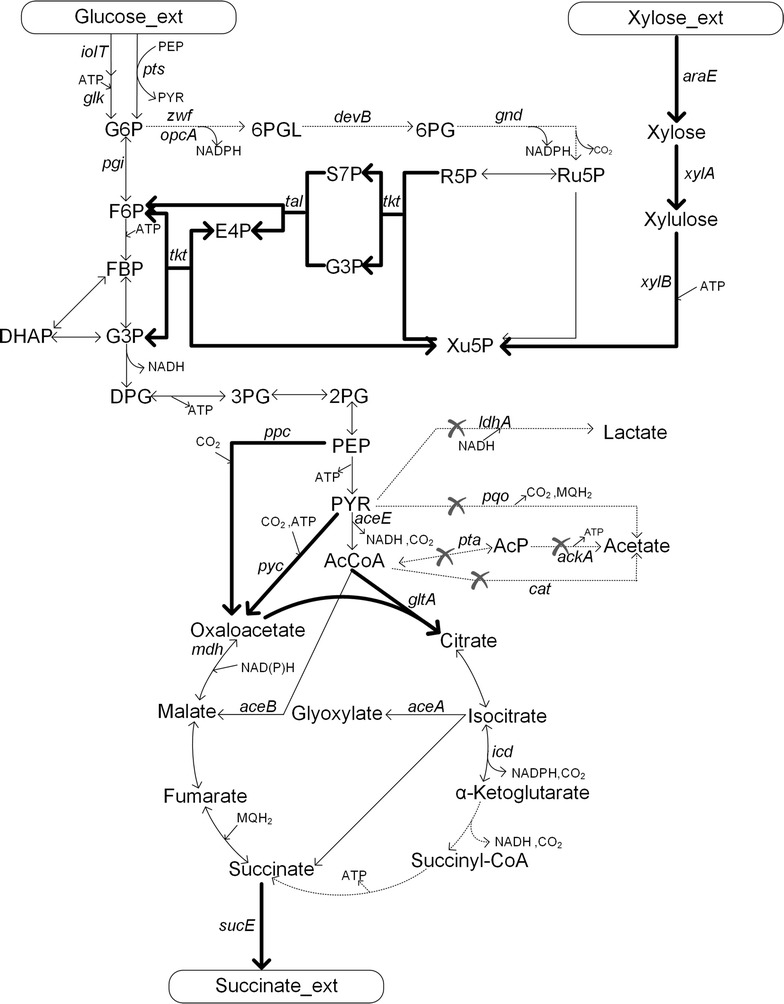
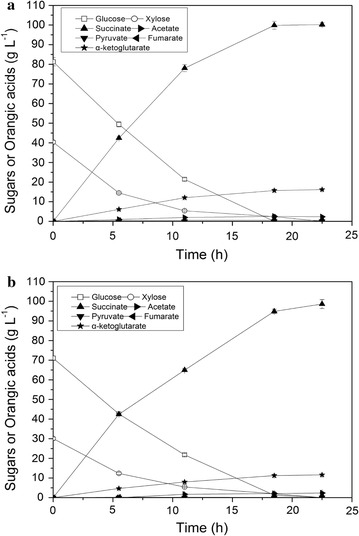
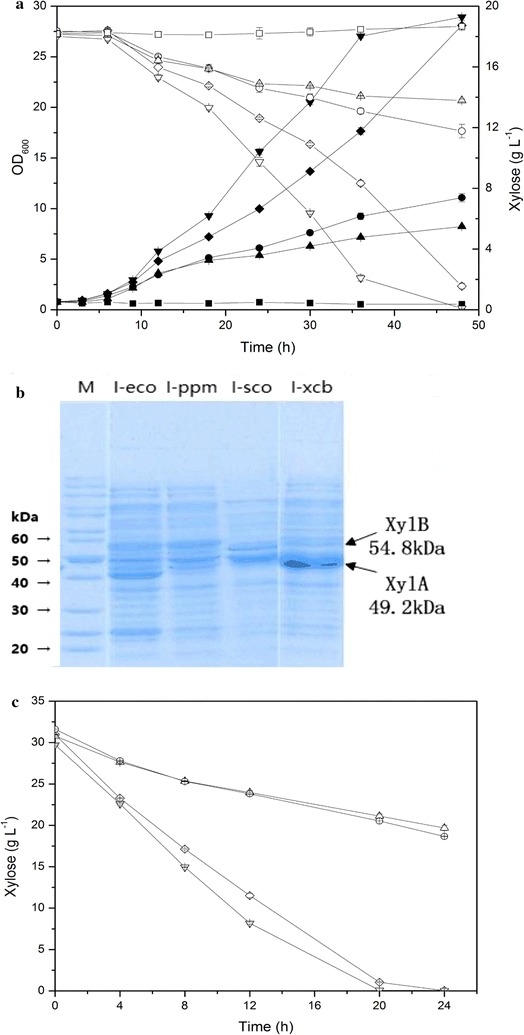
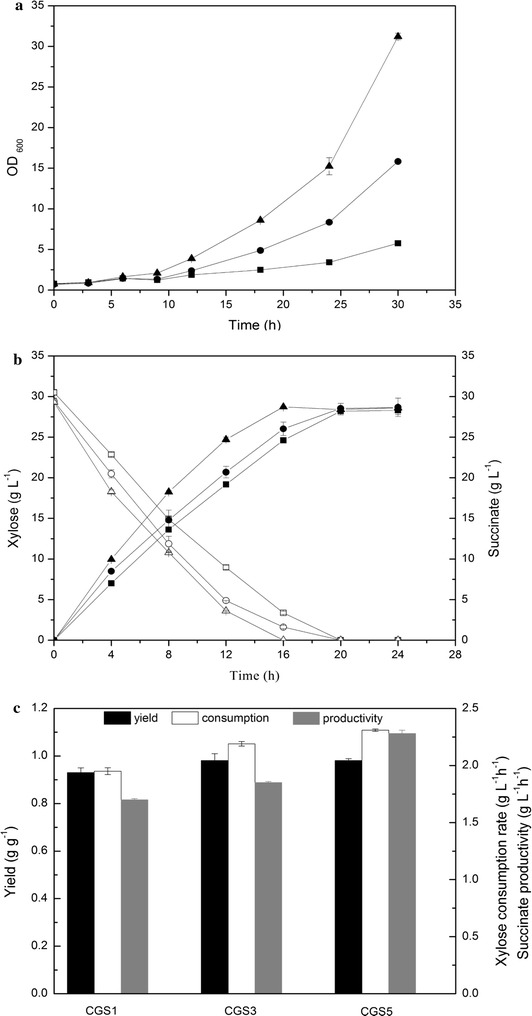
In this work, was engineered for efficient succinate production from lignocellulosic hydrolysate. First, xylose utilization of was optimized by heterologous expression of and genes from different sources. Next, and from were selected among four candidates to accelerate xylose consumption and cell growth. Subsequently, the optimal and were co-expressed in strain SAZ3 (ΔΔΔΔP-P-) along with genes encoding pyruvate carboxylase, citrate synthase, and a succinate exporter to achieve succinate production from xylose in a two-stage fermentation process. Xylose utilization and succinate production were further improved by overexpressing the endogenous and genes and introducing from The final strain CGS5 showed an excellent ability to produce succinate in two-stage fermentations by co-utilizing a glucose-xylose mixture under anaerobic conditions. A succinate titer of 98.6 g L was produced from corn stalk hydrolysate with a yield of 0.87 g/g total substrates and a productivity of 4.29 g L h during the anaerobic stage.
This work introduces an efficient process for the bioconversion of biomass into succinate using a thoroughly engineered strain of . To the best of our knowledge, this is the highest titer of succinate produced from non-food lignocellulosic feedstock, which highlights that the biosafety level 1 microorganism is a promising platform for the envisioned lignocellulosic biorefinery.
由于琥珀酸有众多潜在应用,它已被公认为最重要的生物基基础化学品之一。然而,从木质纤维素原料生产琥珀酸的高效方法鲜有报道。尽管如此,在我们之前的研究中已对[具体菌株名称]进行工程改造,使其能从葡萄糖高效生产琥珀酸。
在本研究中,对[具体菌株名称]进行工程改造以从木质纤维素水解产物高效生产琥珀酸。首先,通过异源表达来自不同来源的[相关基因名称1]和[相关基因名称2]基因优化了[具体菌株名称]对木糖的利用。接下来,从四个候选基因中选择了来自[具体来源]的[相关基因名称3]和[相关基因名称4]以加速木糖消耗和细胞生长。随后,将最佳的[相关基因名称3]和[相关基因名称4]与编码丙酮酸羧化酶、柠檬酸合酶和琥珀酸输出蛋白的基因共表达于[具体菌株名称]SAZ3(ΔΔΔΔP - P -)中,以在两阶段发酵过程中实现从木糖生产琥珀酸。通过过表达内源性[相关基因名称5]和[相关基因名称6]基因并引入来自[具体来源]的[相关基因名称7]进一步提高了木糖利用和琥珀酸生产。最终菌株[具体菌株名称]CGS5在厌氧条件下通过共利用葡萄糖 - 木糖混合物在两阶段发酵中显示出优异的琥珀酸生产能力。从玉米秸秆水解产物中在厌氧阶段产生了98.6 g/L的琥珀酸滴度,总底物产率为0.87 g/g,生产率为4.29 g/L·h。
本研究介绍了一种使用经过全面工程改造的[具体菌株名称]菌株将生物质生物转化为琥珀酸的高效工艺。据我们所知,这是从非粮木质纤维素原料生产琥珀酸的最高滴度,这突出表明生物安全1级微生物[具体菌株名称]是设想的木质纤维素生物精炼厂的一个有前景的平台。