Lourenço José, de Lourdes Monteiro Maria, Valdez Tomás, Monteiro Rodrigues Júlio, Pybus Oliver, Rodrigues Faria Nuno
Department of Zoology, University of Oxford, Oxford, United Kingdom.
National Epidemiological Surveillance, Ministry of Health, Praia, Cabo Verde.
PLoS Curr. 2018 Mar 15;10:ecurrents.outbreaks.19433b1e4d007451c691f138e1e67e8c. doi: 10.1371/currents.outbreaks.19433b1e4d007451c691f138e1e67e8c.
The Zika virus (ZIKV) outbreak in the island nation of Cabo Verde was of unprecedented magnitude in Africa and the first to be associated with microcephaly in the continent.
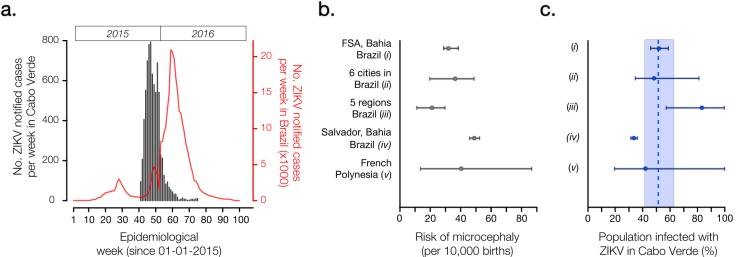
Using a simple mathematical framework we present a first epidemiological assessment of attack and observation rates from 7,580 ZIKV notified cases and 18 microcephaly reports between July 2015 and May 2016.
In line with observations from the Americas and elsewhere, the single-wave Cabo Verdean ZIKV epidemic was characterized by a basic reproductive number of 1.85 (95% CI, 1.5 - 2.2), with overall the attack rate of 51.1% (range 42.1 - 61.1) and observation rate of 2.7% (range 2.29 - 3.33).
Current herd-immunity may not be sufficient to prevent future small-to-medium epidemics in Cabo Verde. Together with a small observation rate, these results highlight the need for rapid and integrated epidemiological, molecular and genomic surveillance to tackle forthcoming outbreaks of ZIKV and other arboviruses.
佛得角这个岛国爆发的寨卡病毒疫情在非洲规模空前,也是非洲首例与小头畸形相关的疫情。
我们运用一个简单的数学框架,对2015年7月至2016年5月间报告的7580例寨卡病毒病例和18例小头畸形报告的发病率和观察率进行了首次流行病学评估。
与美洲及其他地区的观察结果一致,佛得角的寨卡病毒单波疫情的基本再生数为1.85(95%置信区间,1.5 - 2.2),总体发病率为51.1%(范围42.1 - 61.1),观察率为2.7%(范围2.29 - 3.33)。
当前的群体免疫可能不足以预防佛得角未来发生的中小型疫情。这些结果连同较低的观察率,凸显了开展快速、综合的流行病学、分子和基因组监测以应对即将爆发的寨卡病毒及其他虫媒病毒疫情的必要性。