Holzinger Group, Institute for Medical Informatics, Statistics and Documentation, Medical University Graz, Graz, Austria.
Institute of Interactive Systems and Data Science, Graz University of Technology, Graz, Austria.
BMC Cancer. 2018 Apr 12;18(1):408. doi: 10.1186/s12885-018-4302-0.
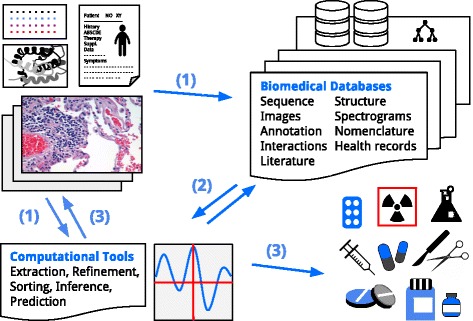
Improving our understanding of cancer and other complex diseases requires integrating diverse data sets and algorithms. Intertwining in vivo and in vitro data and in silico models are paramount to overcome intrinsic difficulties given by data complexity. Importantly, this approach also helps to uncover underlying molecular mechanisms. Over the years, research has introduced multiple biochemical and computational methods to study the disease, many of which require animal experiments. However, modeling systems and the comparison of cellular processes in both eukaryotes and prokaryotes help to understand specific aspects of uncontrolled cell growth, eventually leading to improved planning of future experiments. According to the principles for humane techniques milestones in alternative animal testing involve in vitro methods such as cell-based models and microfluidic chips, as well as clinical tests of microdosing and imaging. Up-to-date, the range of alternative methods has expanded towards computational approaches, based on the use of information from past in vitro and in vivo experiments. In fact, in silico techniques are often underrated but can be vital to understanding fundamental processes in cancer. They can rival accuracy of biological assays, and they can provide essential focus and direction to reduce experimental cost.
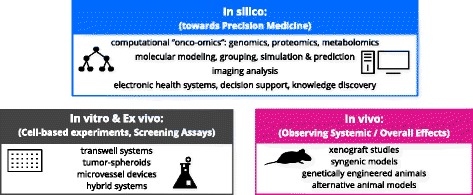
We give an overview on in vivo, in vitro and in silico methods used in cancer research. Common models as cell-lines, xenografts, or genetically modified rodents reflect relevant pathological processes to a different degree, but can not replicate the full spectrum of human disease. There is an increasing importance of computational biology, advancing from the task of assisting biological analysis with network biology approaches as the basis for understanding a cell's functional organization up to model building for predictive systems.
Underlining and extending the in silico approach with respect to the 3Rs for replacement, reduction and refinement will lead cancer research towards efficient and effective precision medicine. Therefore, we suggest refined translational models and testing methods based on integrative analyses and the incorporation of computational biology within cancer research.
要提高对癌症和其他复杂疾病的认识,就需要整合不同的数据组和算法。将体内和体外数据以及计算模型交织在一起对于克服数据复杂性带来的固有困难至关重要。重要的是,这种方法还有助于揭示潜在的分子机制。多年来,研究已经引入了多种生化和计算方法来研究这种疾病,其中许多方法需要动物实验。然而,建模系统和真核生物与原核生物中细胞过程的比较有助于理解不受控制的细胞生长的特定方面,最终有助于更好地规划未来的实验。根据替代动物测试的人性化技术里程碑原则,涉及体外方法,如基于细胞的模型和微流控芯片,以及微剂量和成像的临床测试。最新的替代方法范围已经扩展到基于过去的体外和体内实验信息的计算方法。事实上,计算技术往往被低估,但对于理解癌症的基本过程可能至关重要。它们可以与生物测定的准确性相媲美,并且可以为减少实验成本提供必要的重点和方向。
我们概述了癌症研究中使用的体内、体外和计算方法。常见的模型,如细胞系、异种移植物或基因修饰的啮齿动物,在不同程度上反映了相关的病理过程,但不能复制人类疾病的全貌。计算生物学的重要性日益增加,从基于网络生物学方法的辅助生物分析的任务推进到用于预测系统的建模构建,为理解细胞的功能组织提供了基础。
在替代、减少和优化的 3R 原则下,强调并扩展计算方法将使癌症研究朝着高效、有效的精准医学方向发展。因此,我们建议基于整合分析和将计算生物学纳入癌症研究,提出更精细的转化模型和测试方法。