Karimi Afarin, Karbasi Saeed, Razavi Shahnaz, Zargar Elham Naghash
Department of Biomaterials and Tissue Engineering, School of Advance Technology in Medicine, Isfahan University of Medical Sciences, Isfahan, Iran.
Department of Anatomical Sciences and Molecular Biology, School of Medicine, Isfahan University of Medical Sciences, Isfahan, Iran.
Adv Biomed Res. 2018 Mar 27;7:44. doi: 10.4103/abr.abr_277_16. eCollection 2018.
Reconstruction of nervous system is a great challenge in the therapeutic medical field. Nerve tissue engineering is a novel method to regenerate nervous system in human health care. Tissue engineering has introduced novel approaches to promote and guide peripheral nerve regeneration using submicron and nanoscale fibrous scaffolds.
In this study, 9 wt% poly(3-hydroxybutyrate) (PHB) solutions with two different ratios of chitosan (CTS) (15%, and 20%) were mixed in trifluoroacetic acid as a cosolvent. Thereafter, random and aligned PHB/CTS scaffolds were fabricated by electrospinning method in an appropriate condition.
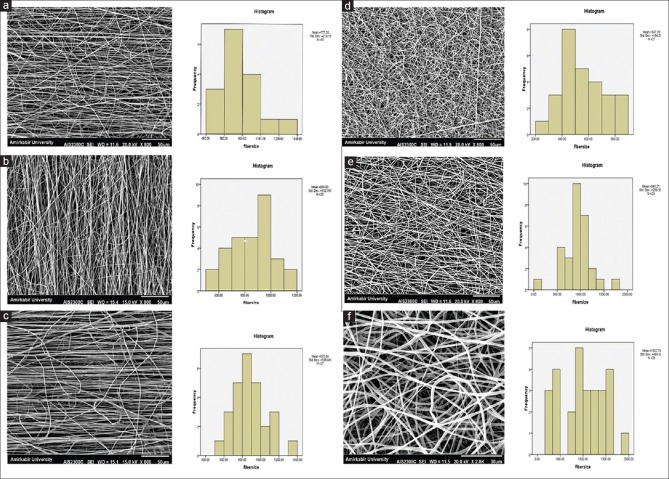
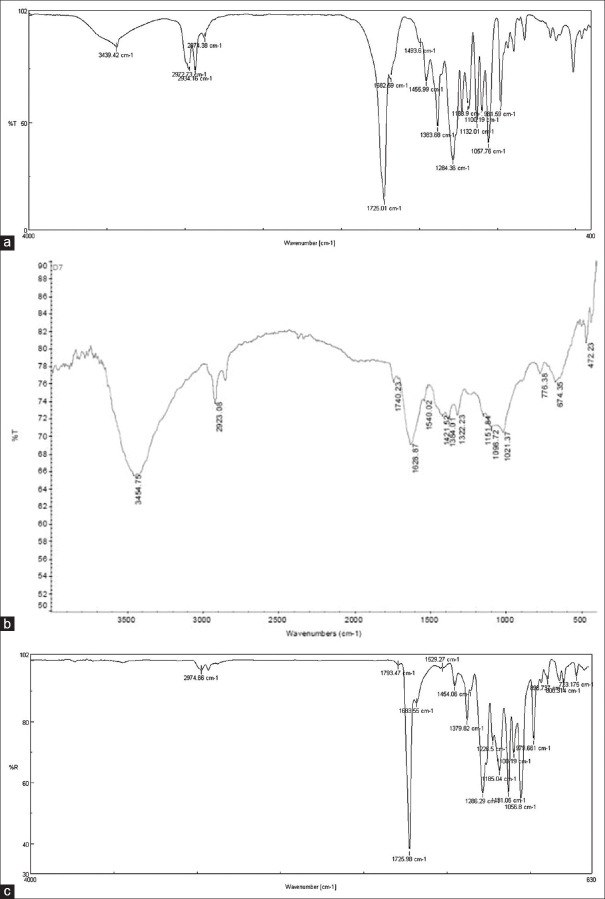
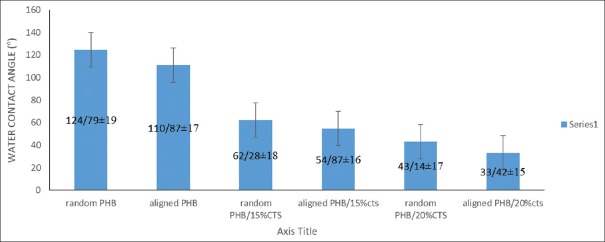
Average diameters for aligned PHB, PHB/CTS 85:15 and PHB/CTS 80:20 were obtained as 675 nm, 740.3 nm, and 870.74 nm, which was lesser than random fibers. The solution components entity authenticity was approved by Fourier transform infrared. The addition of CTS decreased both water droplet contact angle from 124.79° to 43.14° in random and 110.87° to 33.49° in aligned PHB/CTS fibrous scaffold. Moreover, alignment of fibers causes tremendous increase in hydrophilicity of fibrous PHB/CTS substrate. Tensile strength increased from 6.41 MPa for random to 8.73 MPa for aligned PHB/CTS 85:15.
Our results indicated that aligned PHB/CTS 85:15 nanofibers are the desired scaffold than the random PHB/CTS nanofibers for application in nerve tissue regeneration.
神经系统重建是治疗医学领域的一项巨大挑战。神经组织工程是人类医疗保健中使神经系统再生的一种新方法。组织工程引入了利用亚微米和纳米级纤维支架促进和引导周围神经再生的新方法。
在本研究中,将含有两种不同壳聚糖(CTS)比例(15%和20%)的9 wt%聚(3-羟基丁酸酯)(PHB)溶液在作为共溶剂的三氟乙酸中混合。此后,在适当条件下通过静电纺丝法制备随机排列和定向排列的PHB/CTS支架。
定向排列的PHB、PHB/CTS 85:15和PHB/CTS 80:20的平均直径分别为675 nm、740.3 nm和870.74 nm,小于随机纤维。通过傅里叶变换红外光谱验证了溶液成分的真实性。CTS的添加使随机排列的PHB/CTS纤维支架的水滴接触角从124.79°降至43.14°,定向排列的从110.87°降至33.49°。此外,纤维的排列导致纤维状PHB/CTS基质的亲水性大幅增加。拉伸强度从随机排列的PHB的6.41 MPa增加到定向排列的PHB/CTS 85:15的8.73 MPa。
我们的结果表明,对于神经组织再生应用,定向排列的PHB/CTS 85:15纳米纤维比随机排列的PHB/CTS纳米纤维更适合作为支架。