Centre for Clinical Research Uppsala University Västmanland County Hospital Västerås Sweden.
Brain Behav. 2018 Mar 12;8(4):e00949. doi: 10.1002/brb3.949. eCollection 2018 Apr.
The aims of this study were to investigate the long-term stability of problematic gaming among adolescents and whether problematic gaming at wave 1 (W1) was associated with problem gambling at wave 2 (W2), three years later.
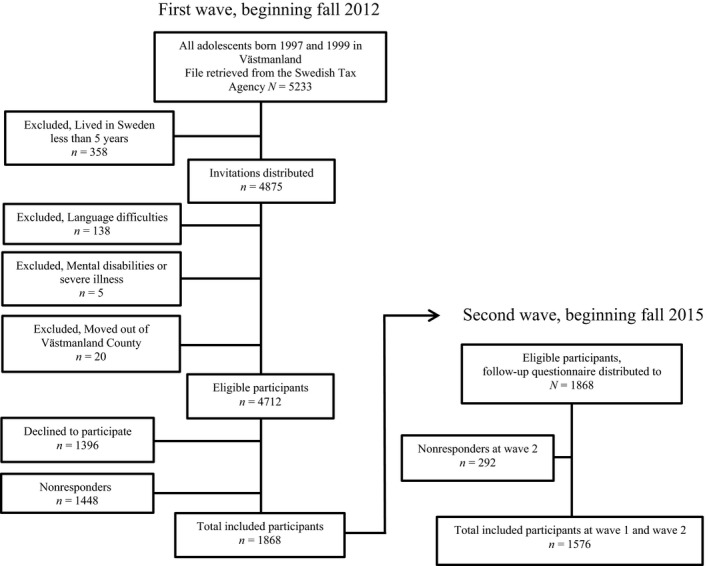
Data from the SALVe cohort, including adolescents in Västmanland born in 1997 and 1999, were accessed and analyzed in two waves W2, =1576; 914 (58%) girls). At W1, the adolescents were 13 and 15 years old, and at W2, they were 16 and 18 years old. Adolescents self-rated on the Gaming Addiction Identification Test (GAIT), Problem Gambling Severity Index (PGSI), and gambling frequencies. Stability of gaming was determined using Gamma correlation, Spearman's rho, and McNemar. Logistic regression analysis and general linear model (GLM) analysis were performed and adjusted for sex, age, and ethnicity, frequency of gambling activities and gaming time at W1, with PGSI as the dependent variable, and GAIT as the independent variable, to investigate associations between problematic gaming and problem gambling.
Problematic gaming was relative stable over time, γ = 0.739, ≤.001, ρ = 0.555, ≤.001, and McNemar ≤.001. Furthermore, problematic gaming at W1 increased the probability of having problem gambling three years later, logistic regression OR = 1.886 (95% CI 1.125-3.161), =.016, GLM = 10.588, η = 0.007, .001.
Problematic gaming seems to be relatively stable over time. Although associations between problematic gaming and later problem gambling were found, the low explained variance indicates that problematic gaming in an unlikely predictor for problem gambling within this sample.
本研究旨在探讨青少年中游戏障碍的长期稳定性,以及 1 年前(W1)的游戏障碍是否与 3 年后的 2 年前(W2)的问题赌博相关。
本研究利用 SALVe 队列的数据进行分析,队列纳入了 1997 年和 1999 年出生于瑞典西曼兰省的青少年,共包括 2 个波次的数据(W2:n=1576;其中 914 名女孩,占 58%)。在 W1 时,青少年的年龄为 13 至 15 岁,而在 W2 时,他们的年龄为 16 至 18 岁。青少年自我评估了游戏成瘾识别测试(GAIT)、问题赌博严重程度指数(PGSI)和赌博频率。使用 Gamma 相关系数、Spearman rho 和 McNemar 检验来确定游戏的稳定性。进行了逻辑回归分析和一般线性模型(GLM)分析,并调整了性别、年龄和种族、W1 时的赌博活动频率和游戏时间,以 PGSI 为因变量,GAIT 为自变量,探讨了游戏障碍与问题赌博之间的关联。
游戏障碍在时间上具有相对稳定性,γ=0.739,P≤0.001,ρ=0.555,P≤0.001,McNemar P≤0.001。此外,W1 时的游戏障碍增加了 3 年后出现问题赌博的可能性,逻辑回归 OR=1.886(95%CI 1.125-3.161),P=0.016,GLM=10.588,η=0.007,P=0.001。
游戏障碍似乎具有相对稳定性。虽然在本研究样本中发现了游戏障碍与后来的问题赌博之间的关联,但由于解释方差较低,表明在该样本中,游戏障碍不太可能是问题赌博的预测因素。