Fernando Luwishennadige Madhawee N, Sim Wan Hua, Jorm Anthony F, Rapee Ron, Lawrence Katherine A, Yap Marie B H
Monash Institute of Cognitive and Clinical Neurosciences, Monash University, Clayton, VIC, Australia.
Melbourne School of Population and Global Health, University of Melbourne, Melbourne, VIC, Australia.
Trials. 2018 Apr 19;19(1):236. doi: 10.1186/s13063-018-2605-8.
Preventive efforts targeting childhood anxiety and depression symptoms have the potential to alter the developmental trajectory of depression and anxiety disorders across the lifespan. Substantial previous research suggests that modifiable parenting factors such as parental aversiveness and over-involvement are associated with childhood anxiety, depressive and internalising symptoms, indicating that parents can play a critical role in prevention. The Parenting Resilient Kids study is a new evidence-based online parenting program designed to prevent anxiety and depression problems in primary school-aged children by reducing family-based risk factors and enhancing protective factors through increased positive interactions between parent and child.
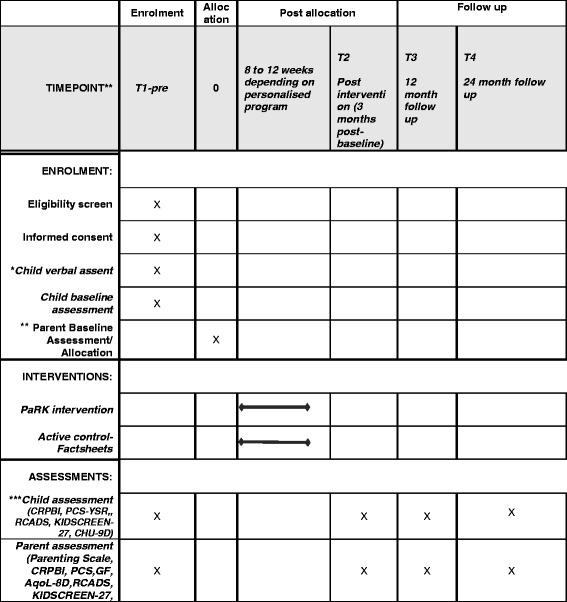
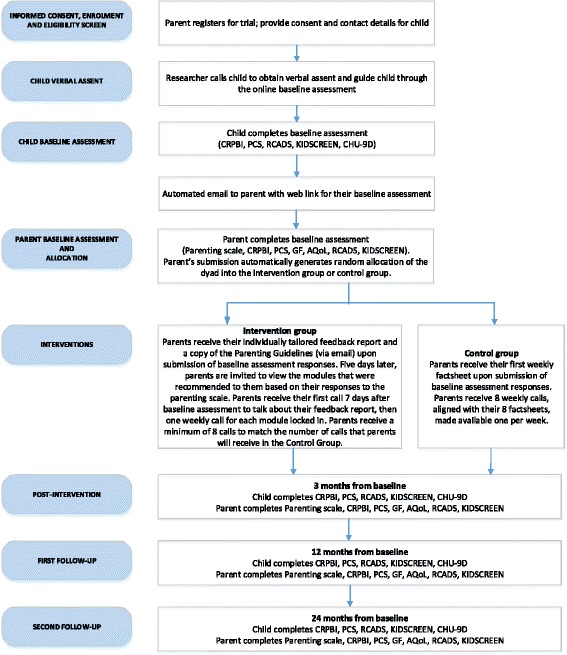
METHODS/DESIGN: The current study is a parallel group superiority randomised controlled trial with parent-child dyads randomised to the intervention or active-control group in a 1:1 ratio. The intervention group will receive the Parenting Resilient Kids program consisting of a feedback report on parenting behaviours and up to 12 interactive online modules personalised based on responses to the parent survey. The active-control group will receive a standardised package of online educational materials about child development and wellbeing. The trial website is programmed to run a stratified random allocation sequence (based on parent gender) to determine group membership. We aim to recruit 340 parent-child dyads (170 dyads per group). We hypothesise that the intervention group will show greater improvement in parenting risk and protective factors from baseline to 3-month follow-up (primary outcome), which will in turn mediate changes in child depressive and anxiety symptoms from baseline to 12 and 24 months (co-primary outcomes). We also hypothesise that the intervention group will show greater benefits from baseline to 3-, 12- and 24-month follow-up, with regard to: child depressive and anxiety symptoms (co-primary outcomes); and child and parent health-related quality of life, and overall family functioning (secondary outcomes).
This randomised controlled trial will examine the efficacy of the Parenting Resilient Kids program as a preventive intervention for anxiety and depression symptoms in primary school-aged children, as well as changes in child and parent health-related quality of life. Findings from this study will examine design features that render web-based prevention programs effective and the extent to which parents can be engaged and motivated to change through a minimally guided parenting program.
Australian New Zealand Clinical Trials Registry (ANZCTR): Trial ID ACTRN12616000621415 Registered on 13 May 2016. Updated on 3 March 2017.
针对儿童焦虑和抑郁症状的预防措施有可能改变抑郁和焦虑症在整个生命周期中的发展轨迹。此前大量研究表明,可改变的养育因素,如父母的厌恶情绪和过度参与,与儿童焦虑、抑郁及内化症状有关,这表明父母在预防中可发挥关键作用。“培养有适应力的孩子”研究是一项新的基于证据的在线养育计划,旨在通过减少家庭风险因素并通过增加亲子间积极互动来增强保护因素,从而预防小学年龄段儿童的焦虑和抑郁问题。
方法/设计:本研究是一项平行组优势随机对照试验,亲子二元组按1:1的比例随机分配至干预组或积极对照组。干预组将接受“培养有适应力的孩子”计划,该计划包括一份关于养育行为的反馈报告以及最多12个基于对家长调查问卷的回答而个性化定制的互动在线模块。积极对照组将收到一套关于儿童发育和幸福的标准化在线教育材料。试验网站经编程运行分层随机分配序列(基于家长性别)以确定分组。我们的目标是招募340个亲子二元组(每组170个二元组)。我们假设干预组从基线到3个月随访(主要结局)在养育风险和保护因素方面将有更大改善,这反过来又将介导从基线到12个月和24个月儿童抑郁和焦虑症状的变化(共同主要结局)。我们还假设干预组从基线到3个月、12个月和24个月随访在以下方面将有更大益处:儿童抑郁和焦虑症状(共同主要结局);以及儿童和家长与健康相关的生活质量和整体家庭功能(次要结局)。
这项随机对照试验将检验“培养有适应力的孩子”计划作为预防小学年龄段儿童焦虑和抑郁症状的干预措施的有效性,以及儿童和家长与健康相关的生活质量的变化。本研究的结果将检验使基于网络的预防计划有效的设计特征,以及通过一个极少指导的养育计划能在多大程度上促使家长参与并激发他们做出改变。
澳大利亚新西兰临床试验注册中心(ANZCTR):试验编号ACTRN12616000621415 于2016年5月13日注册。于2017年3月3日更新。