de Melo-Marins Denise, Souza-Silva Ana Angélica, da Silva-Santos Gabriel Lucas Leite, Freire-Júnior Francisco de Assis, Lee Jason Kai Wei, Laitano Orlando
College of Physical Education, Federal University of Vale do São Francisco (UNIVASF), Petrolina, Brazil.
Defence Medical and Environmental Research Institute, DSO National Laboratories, Singapore, Singapore.
Front Nutr. 2018 Apr 12;5:22. doi: 10.3389/fnut.2018.00022. eCollection 2018.
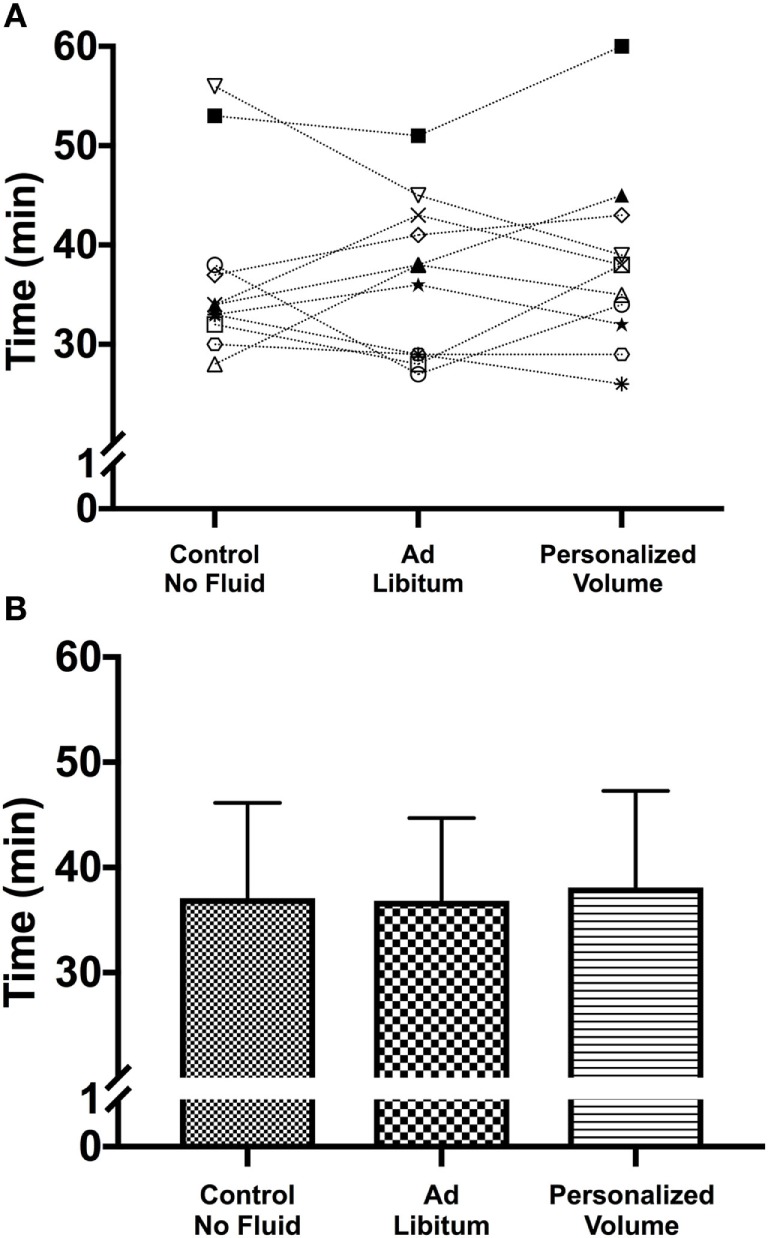
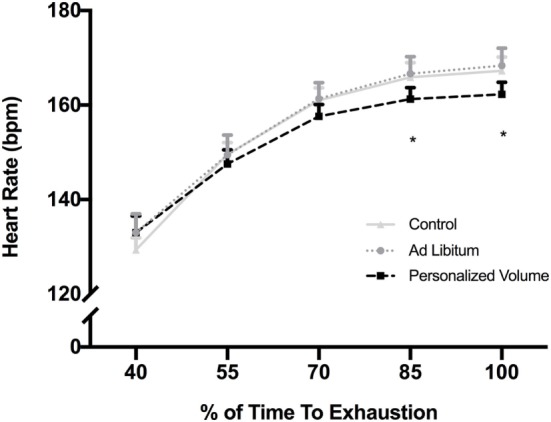
The optimal hydration plan [i.e., drink to thirst, (ADL), or personalized plan] to be adopted during exercise in recreational athletes has recently been a matter of debate and, due to conflicting results, consensus does not exist. In the present investigation, we tested whether a personalized hydration strategy based on sweat rate would affect cardiovascular and thermoregulatory responses and exercise capacity in the heat. Eleven recreational male cyclists underwent two familiarization cycling sessions in the heat (34°C, 40% RH) where sweat rate was also determined. A fan was used to enhance sweat evaporation. Participants then performed three randomized time-to-exhaustion (TTE) trials in the heat with different hydration strategies: personalized volume (PVO), where water was consumed, based on individual sweat rate, every 10 min; ADL, where free access to water was allowed; and a control (CON) trial with no fluids. Blood osmolality and urine-specific gravity were measured before each trial. Heart rate (HR), rectal, and skin temperatures were monitored throughout trials. Time to exhaustion at 70% of maximal workload was used to define exercise capacity in the heat, which was similar in all trials ( = 0.801). Body mass decreased after ADL ( = 0.008) and CON ( < 0.001) and was maintained in PVO trials ( = 0.171). Participants consumed 0 ml in CON, 166 ± 167 ml in ADL, and 1,080 ± 166 ml in PVO trials. The increase in mean body temperature was similar among trials despite a lower increase in skin temperature during PVO trial in comparison with CON (2.1 ± 0.6 vs. 2.9 ± 0.5°C, = 0.0038). HR was lower toward the end of TTE in PVO (162 ± 8 bpm) in comparison with ADL (168 ± 12 bpm) and CON (167 ± 10 bpm), < 0.001. In conclusion, a personalized hydration strategy can reduce HR during a moderate to high intensity exercise session in the heat and halt the increase in skin temperature. Despite these advantages, cycling capacity in the heat remained unchanged.
休闲运动员在运动期间应采用的最佳补水方案[即口渴时饮水、按日常活动量(ADL)饮水或个性化方案]最近一直是一个争论的话题,而且由于结果相互矛盾,目前尚未达成共识。在本研究中,我们测试了基于出汗率的个性化补水策略是否会影响在炎热环境中的心血管和体温调节反应以及运动能力。11名休闲男性自行车运动员在炎热环境(34°C,相对湿度40%)中进行了两次适应性骑行训练,同时还测定了出汗率。使用风扇来增强汗液蒸发。然后,参与者在炎热环境中采用不同的补水策略进行了三次随机的力竭时间(TTE)试验:个性化补液量(PVO),即根据个人出汗率每10分钟饮用一次水;ADL,即允许自由饮水;以及不摄入液体的对照(CON)试验。在每次试验前测量血渗透压和尿比重。在整个试验过程中监测心率(HR)、直肠温度和皮肤温度。以最大工作量的70%时的力竭时间来定义在炎热环境中的运动能力,在所有试验中该时间相似(=0.801)。ADL(=0.008)和CON(<0.001)试验后体重下降,而PVO试验中体重保持不变(=0.171)。CON试验中参与者饮水量为0毫升,ADL试验中为166±167毫升,PVO试验中为1080±166毫升。尽管与CON试验相比,PVO试验期间皮肤温度升高幅度较小(2.1±0.6 vs. 2.9±0.5°C,=0.0038),但各试验中平均体温的升高幅度相似。与ADL(168±12次/分钟)和CON(167±10次/分钟)试验相比,PVO试验在TTE接近结束时HR较低(162±8次/分钟),<0.001。总之,个性化补水策略可以在炎热环境中进行中高强度运动期间降低心率并阻止皮肤温度升高。尽管有这些优点,但在炎热环境中的骑行能力保持不变。