Dutuze M Fausta, Nzayirambaho Manassé, Mores Christopher N, Christofferson Rebecca C
School of Veterinary Medicine, Louisiana State University, Baton Rouge, LA, United States.
College of Agriculture and Animal Sciences and Veterinary Medicine, University of Rwanda, Kigali, Rwanda.
Front Vet Sci. 2018 Apr 12;5:69. doi: 10.3389/fvets.2018.00069. eCollection 2018.
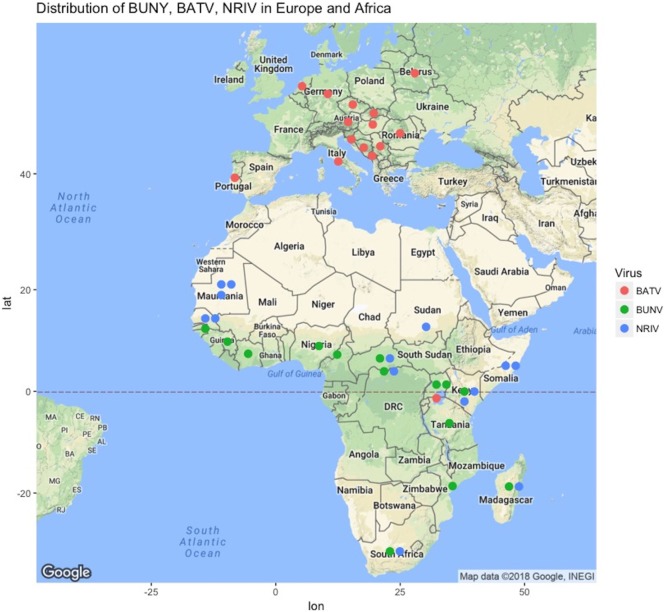
Bunyamwera (BUNV), Batai (BATV), and Ngari (NRIV) are mosquito-borne viruses of the Bunyamwera serogroup in the genus of the Bunyaviridae family. These three viruses have been found to cause disease in both livestock animals, avian species, and humans. Thus, these viruses pose a potential threat to human public health, animal health, and food security. This is especially the case in the developing nations, where BUNV and NRIV are found, mainly in Africa. BUNV and BATV are fairly well characterized, while NRIV is not well characterized owing to only sporadic detection in human and animal populations in Africa. Reassortment is common among bunyaviruses, but NRIV is believed to be the only natural reassortant of the Bunyamwera serogroup. It resulted from a combination of BUNV S and L segments and the BATV M segment. This indicates at least some level co-circulation of BUNV and BATV, which have no historically been reported to overlap in geographic distributions. But as these viruses are undercharacterized, there remains a gap in the understanding of how such reassortment could occur, and the consequences of such. Due to their combined wide range of hosts and vectors, geographic distributions, potential severity of associated diseases, and potential for transmissibility between vertebrate hosts, these viruses represent a significant gap in knowledge with important One Health implications. The goal of this review is to report available knowledge of and identify potential future directions for study of these viruses. As these are collectively understudied viruses, there is a relative paucity of data; however, we use available studies to discuss different perspectives in an effort to promote a better understanding of these three viruses and the public and One Health threat(s) they may pose.
布尼亚姆韦拉病毒(BUNV)、巴泰病毒(BATV)和恩加里病毒(NRIV)是布尼亚病毒科布尼亚姆韦拉血清群中由蚊子传播的病毒。已发现这三种病毒可在牲畜、禽类和人类中引发疾病。因此,这些病毒对人类公共卫生、动物健康和食品安全构成潜在威胁。在主要位于非洲且发现了BUNV和NRIV的发展中国家,情况尤其如此。BUNV和BATV已得到相当充分的研究,而NRIV由于仅在非洲的人类和动物群体中偶尔被检测到,因此研究较少。基因重配在布尼亚病毒中很常见,但NRIV被认为是布尼亚姆韦拉血清群中唯一的天然重配病毒。它由BUNV的S和L片段与BATV的M片段组合而成。这表明BUNV和BATV至少在一定程度上共同传播,而它们在地理分布上历史上并无重叠的报道。但由于这些病毒研究不足,对于这种重配如何发生以及其后果的理解仍存在空白。由于它们广泛的宿主和传播媒介范围、地理分布、相关疾病的潜在严重性以及在脊椎动物宿主之间传播的可能性,这些病毒代表了知识上的重大空白,具有重要的“同一个健康”意义。本综述的目的是报告关于这些病毒的现有知识,并确定未来潜在的研究方向。由于这些病毒总体上研究较少,数据相对匮乏;然而,我们利用现有研究从不同角度进行讨论,以促进对这三种病毒以及它们可能构成的公共卫生和“同一个健康”威胁的更好理解。