Hewlett Packard Labs, 1501 Page Mill Rd, Palo Alto, CA, 94304, USA.
Nat Commun. 2018 May 23;9(1):2030. doi: 10.1038/s41467-018-04452-w.
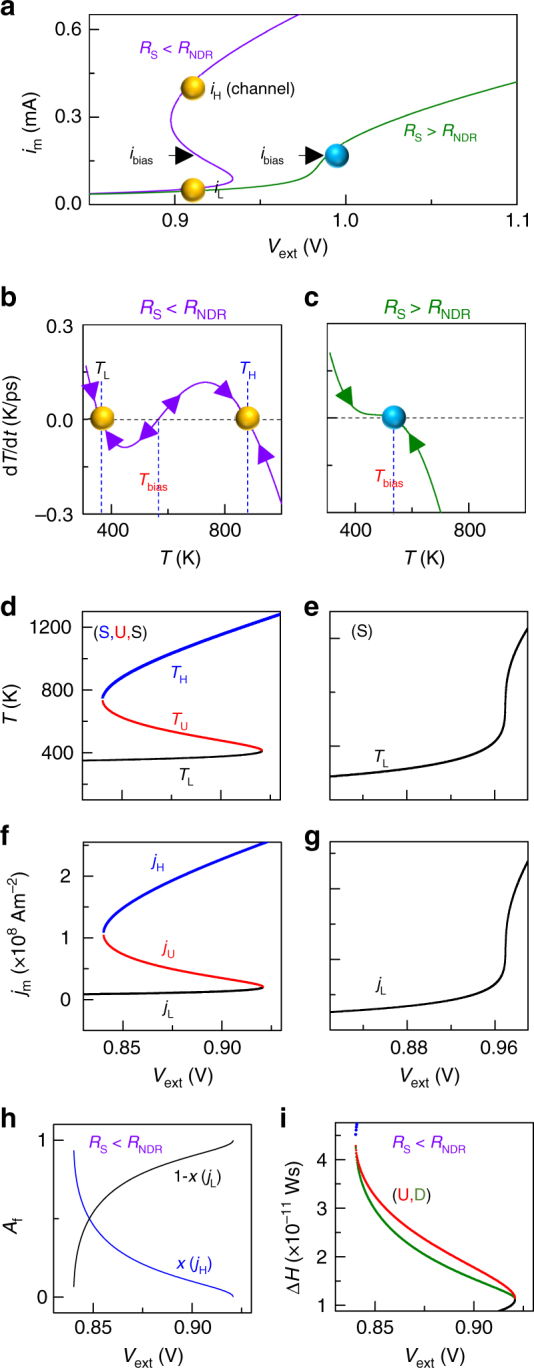
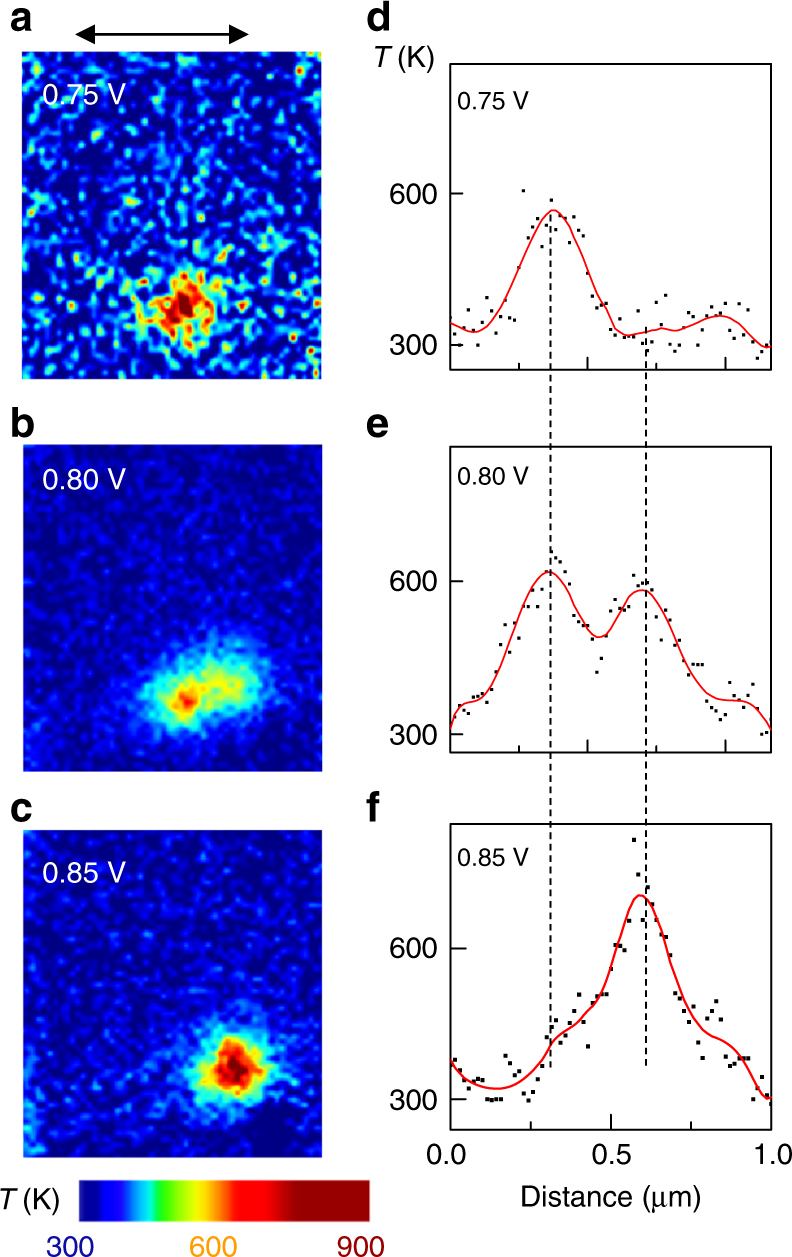
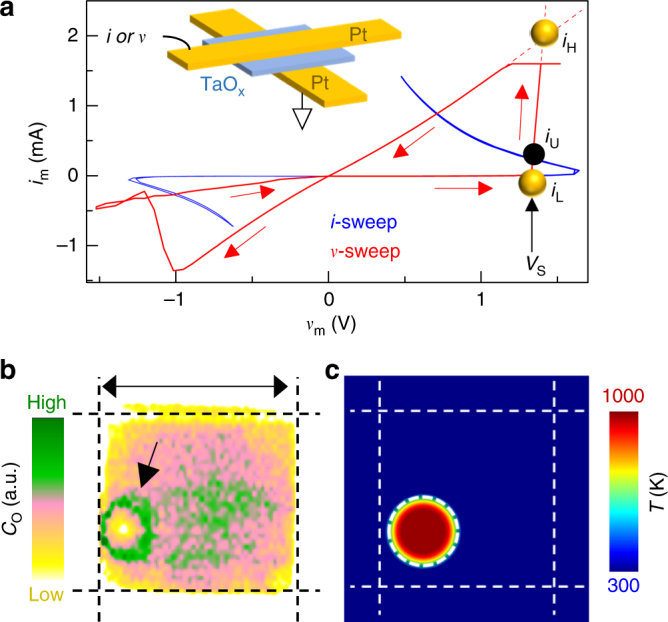
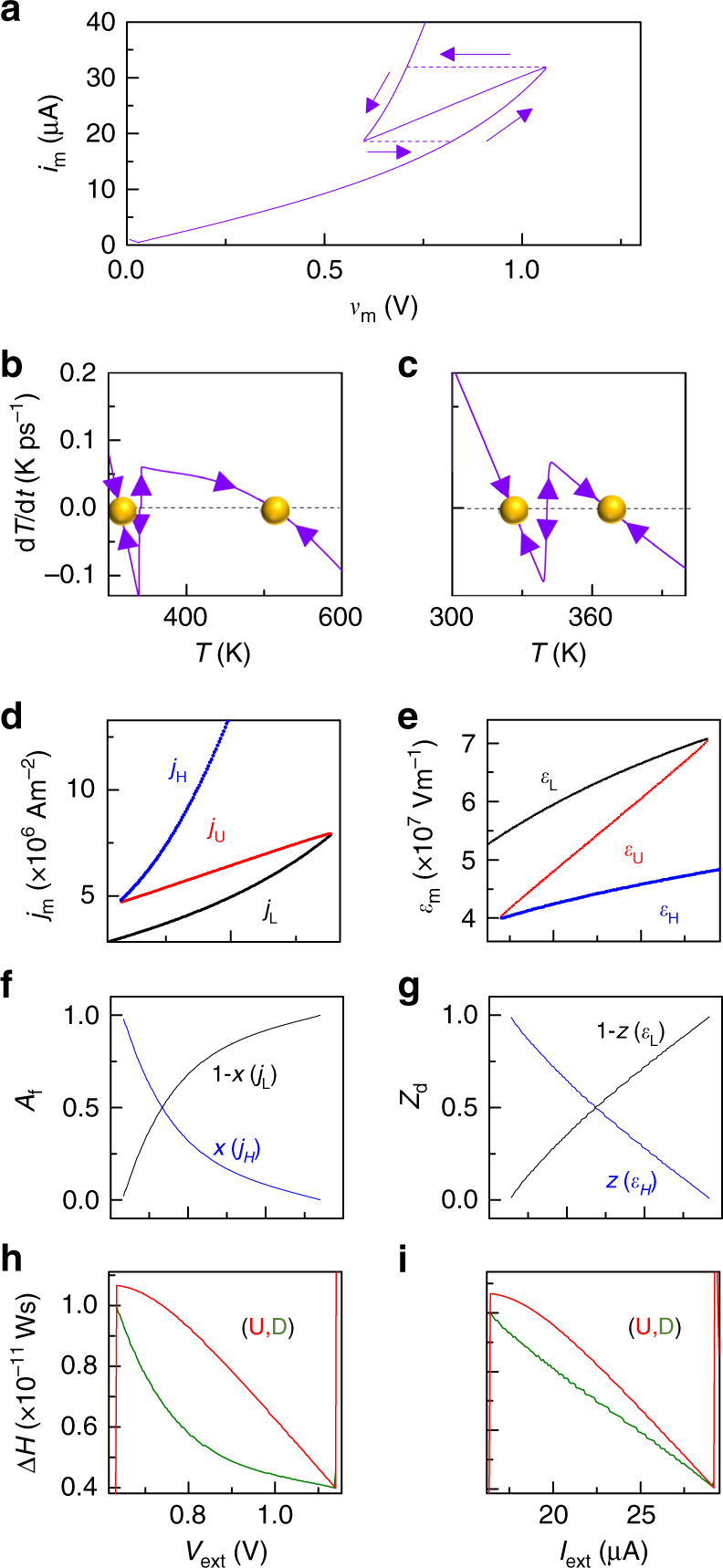
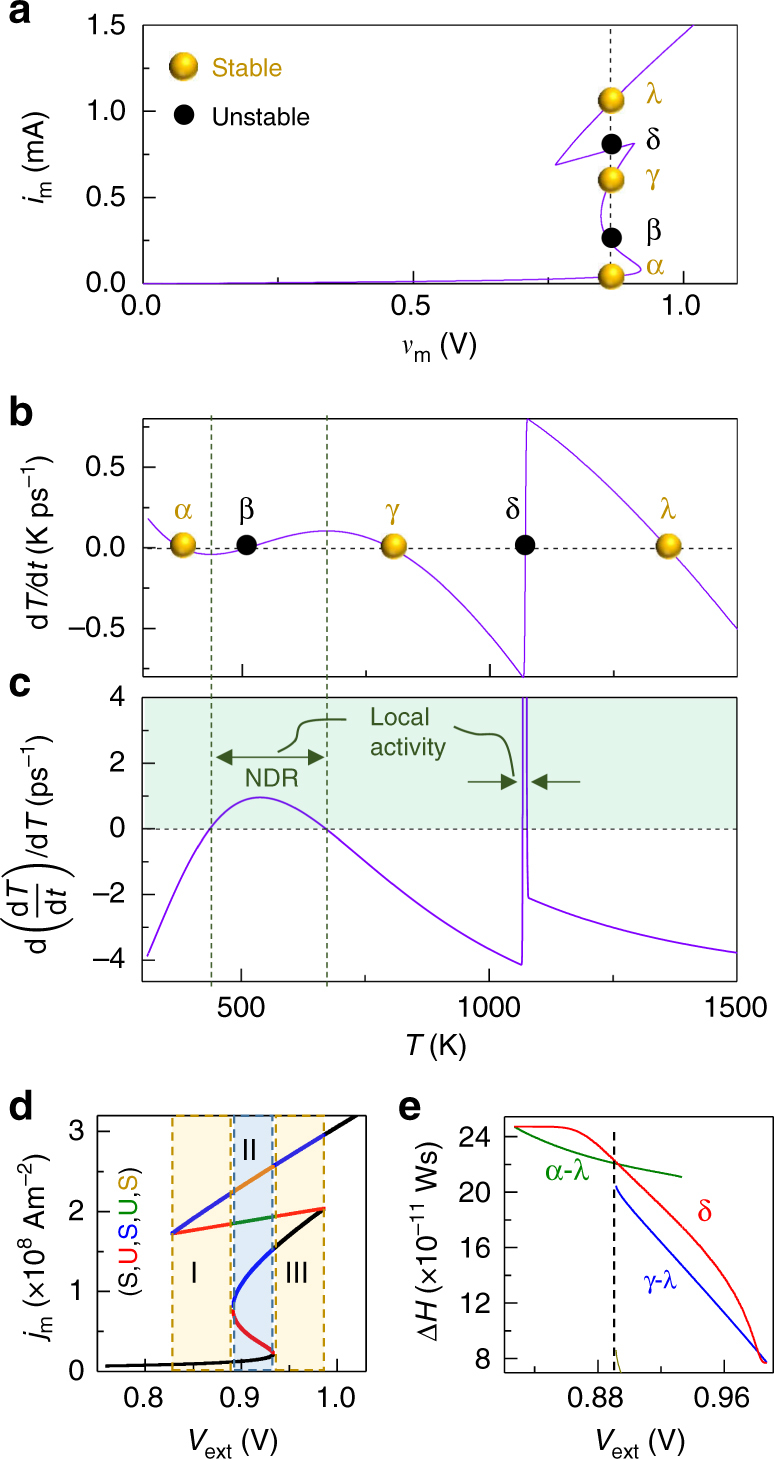
In 1963 Ridley postulated that under certain bias conditions circuit elements exhibiting a current- or voltage-controlled negative differential resistance will separate into coexisting domains with different current densities or electric fields, respectively, in a process similar to spinodal decomposition of a homogeneous liquid or disproportionation of a metastable chemical compound. The ensuing debate, however, failed to agree on the existence or causes of such electronic decomposition. Using thermal and chemical spectro-microscopy, we directly imaged signatures of current-density and electric-field domains in several metal oxides. The concept of local activity successfully predicts initiation and occurrence of spontaneous electronic decomposition, accompanied by a reduction in internal energy, despite unchanged power input and heat output. This reveals a thermodynamic constraint required to properly model nonlinear circuit elements. Our results explain the electroforming process that initiates information storage via resistance switching in metal oxides and has significant implications for improving neuromorphic computing based on nonlinear dynamical devices.
1963 年,里德利(Ridley)推测,在某些偏置条件下,表现出电流或电压控制的负微分电阻的电路元件将分别分离成具有不同电流密度或电场的共存域,类似于均匀液体的旋节分解或亚稳化学化合物的歧化。然而,随后的争论未能就这种电子分解的存在或原因达成一致。我们使用热和化学光谱显微镜,直接观察了几种金属氧化物中电流密度和电场域的特征。局部活性的概念成功地预测了自发电子分解的启动和发生,伴随着内能的降低,尽管功率输入和热输出保持不变。这揭示了适当模拟非线性电路元件所需的热力学约束。我们的结果解释了通过金属氧化物中的电阻开关启动信息存储的电成型过程,这对基于非线性动力学器件的神经形态计算的改进具有重要意义。