Department of Thoracic, Endocrine Surgery and Oncology, Institute of Biomedical Sciences, Tokushima University Graduate School, 3-18-15 Kuramoto-cho, Tokushima, 770-8503, Japan.
Esophagus. 2018 Apr;15(2):75-82. doi: 10.1007/s10388-017-0601-9. Epub 2017 Dec 20.
Daikenchuto (TJ-100), a traditional Japanese herbal medicine, is widely used in Japan. Its effects on gastrointestinal motility and microcirculation and its anti-inflammatory effect are known. The purpose of this prospective randomized controlled trial was to investigate the effect of TJ-100 after esophagectomy in esophageal cancer patients.
Forty patients for whom subtotal esophageal resection for esophageal cancer was planned at our institute from March 2011 to August 2013 were enrolled and divided into two groups at the point of determination of the operation schedule after informed consent was obtained: a TJ-100 (15 g/day)-treated group (n = 20) and a control group (n = 20). The primary efficacy end-points were maintenance of the nutrition condition and the recovery of gastrointestinal function. The secondary efficacy end-points were the serum C-reactive protein (CRP) level and adrenomedullin level during the postoperative course, the incidence of postoperative complications, and the length of hospital stay after surgery.
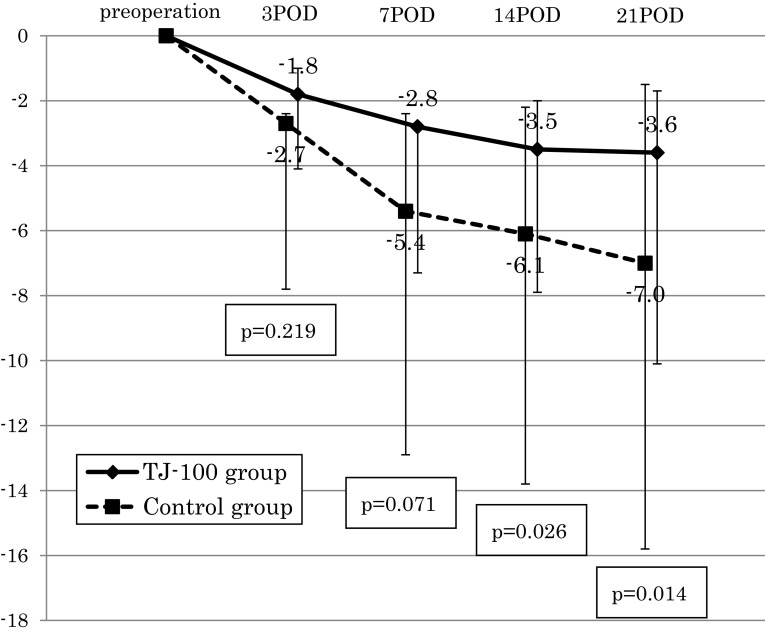
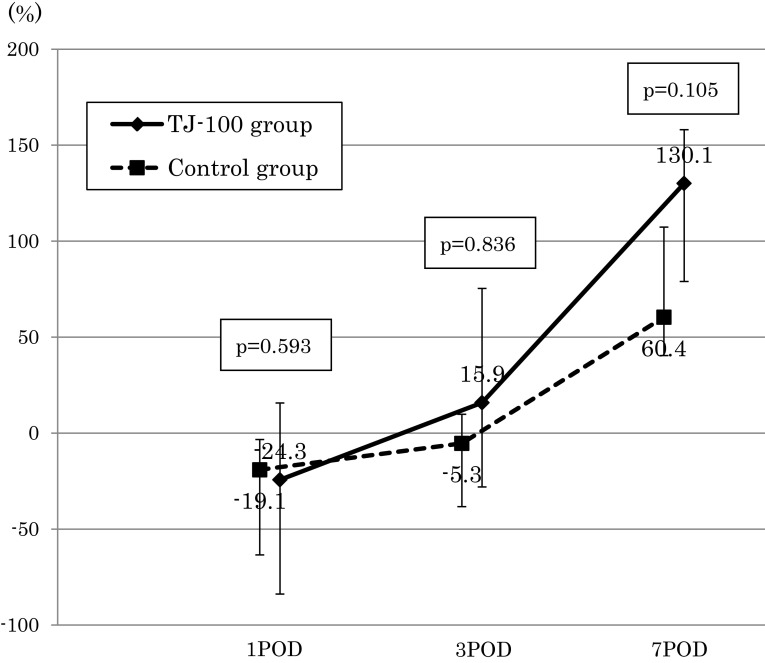
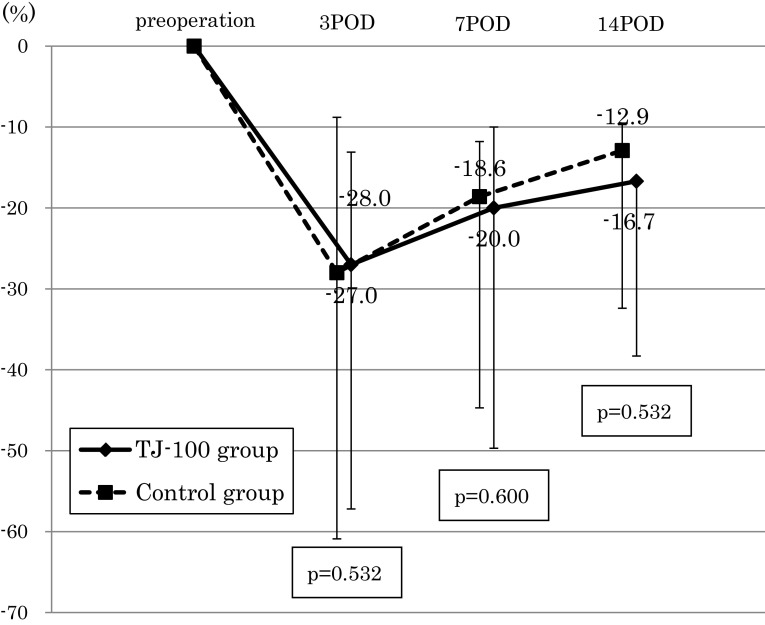
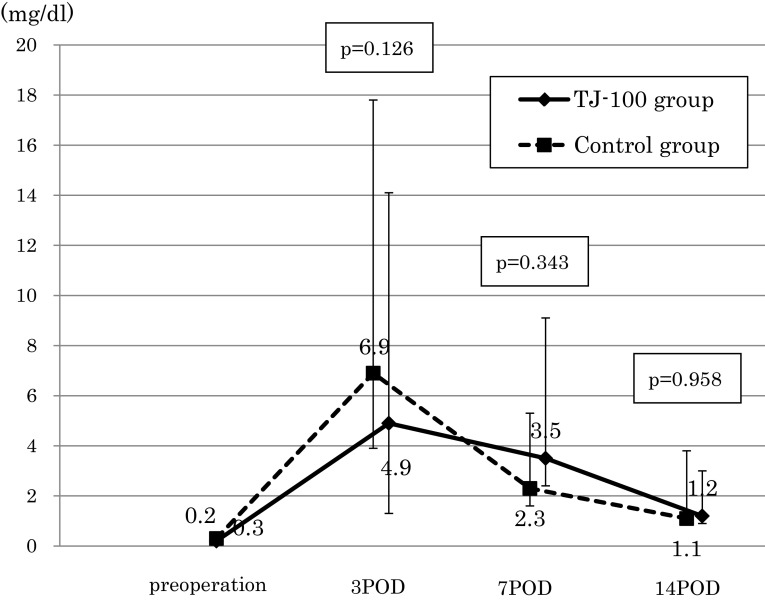
We examined 39 patients because one patient in the TJ-100 group was judged as having unresectable cancer after surgery. The mean age of the TJ-100 group patients was significantly older than that of the control group patients.The rate of body weight decrease at postoperative day 21 was significantly suppressed in the TJ-100 group (3.6% vs. the control group: 7.0%, p = 0.014), but the serum albumin level was not significantly different between the groups. The recovery of gastrointestinal function regarding flatus, defecation, and oral intake showed no significant between-group differences, but postoperative bowel symptoms tended to be rare in the TJ-100 group. There was no significant between-group difference in the length of hospital stay after surgery. The serum CRP level at postoperative day 3 was 4.9 mg/dl in the TJ-100 group and 6.9 mg/dl in the control group, showing a tendency of a suppressed serum CRP level in the TJ-100 group (p = 0.126). The rate of increase in adrenomedullin tended to be high postoperatively, but there was no significant difference between the two groups.
TJ-100 treatment after esophageal cancer resection has the effects of prompting the recovery of gastrointestinal motility and minimizing body weight loss, and it might suppress the excess inflammatory reaction related to surgery.
大建中汤(TJ-100)是一种传统的日本草药,在日本被广泛应用。它对胃肠道蠕动和微循环的作用以及抗炎作用已为人所知。本前瞻性随机对照试验的目的是研究 TJ-100 对食管癌患者食管切除术后的影响。
2011 年 3 月至 2013 年 8 月,我院计划对 40 例食管癌患者行次全食管切除术,在获得知情同意后确定手术计划时将患者分为两组:TJ-100(15g/天)治疗组(n=20)和对照组(n=20)。主要疗效终点是维持营养状况和胃肠道功能恢复。次要疗效终点是术后过程中的血清 C 反应蛋白(CRP)水平和肾上腺髓质素水平、术后并发症发生率和术后住院时间。
由于 TJ-100 组的 1 例患者术后被判定为不可切除,因此我们检查了 39 例患者。TJ-100 组患者的平均年龄明显大于对照组患者。术后第 21 天体重下降率在 TJ-100 组明显受到抑制(3.6% vs. 对照组:7.0%,p=0.014),但两组间血清白蛋白水平无显著差异。胃肠功能恢复方面,放屁、排便和口服摄入无显著组间差异,但 TJ-100 组术后肠道症状倾向于少见。两组术后住院时间无显著差异。术后第 3 天 TJ-100 组的 CRP 水平为 4.9mg/dl,对照组为 6.9mg/dl,TJ-100 组 CRP 水平呈下降趋势(p=0.126)。术后肾上腺髓质素升高率有增高趋势,但两组间无显著差异。
食管癌切除术后 TJ-100 治疗具有促进胃肠动力恢复和减轻体重减轻的作用,并可能抑制与手术相关的过度炎症反应。