Department of Archaeology and Classical Studies, Stockholm University, 10691, Stockholm, Sweden.
University of Oslo, Museum of Cultural History, 0164, Oslo, Norway.
Sci Rep. 2018 Jun 12;8(1):8969. doi: 10.1038/s41598-018-27325-0.
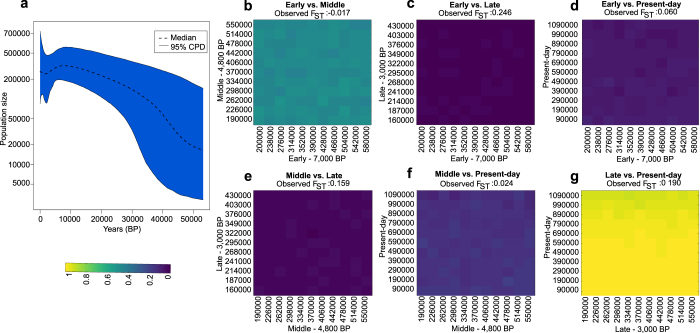
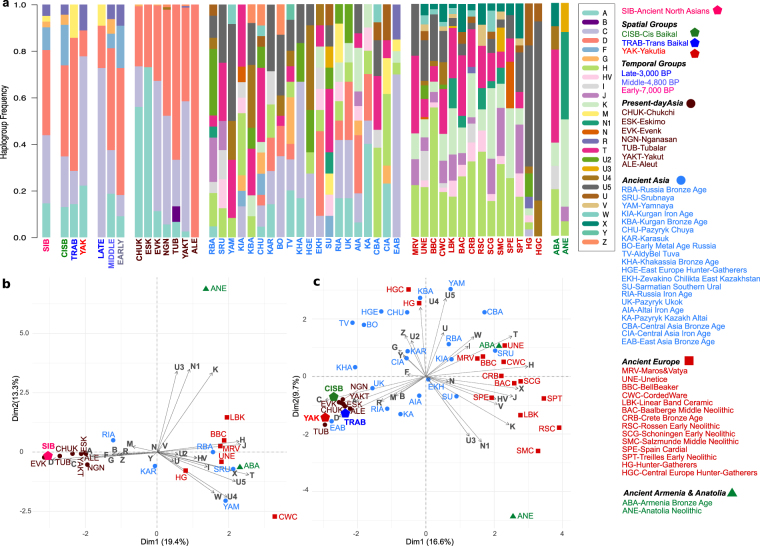
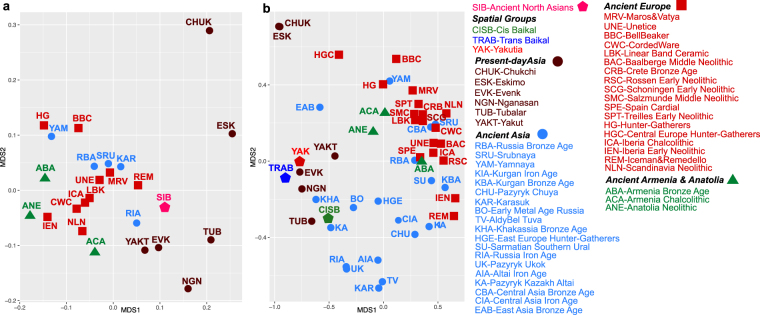
Archaeogenomic studies have largely elucidated human population history in West Eurasia during the Stone Age. However, despite being a broad geographical region of significant cultural and linguistic diversity, little is known about the population history in North Asia. We present complete mitochondrial genome sequences together with stable isotope data for 41 serially sampled ancient individuals from North Asia, dated between c.13,790 BP and c.1,380 BP extending from the Palaeolithic to the Iron Age. Analyses of mitochondrial DNA sequences and haplogroup data of these individuals revealed the highest genetic affinity to present-day North Asian populations of the same geographical region suggesting a possible long-term maternal genetic continuity in the region. We observed a decrease in genetic diversity over time and a reduction of maternal effective population size (N) approximately seven thousand years before present. Coalescent simulations were consistent with genetic continuity between present day individuals and individuals dating to 7,000 BP, 4,800 BP or 3,000 BP. Meanwhile, genetic differences observed between 7,000 BP and 3,000 BP as well as between 4,800 BP and 3,000 BP were inconsistent with genetic drift alone, suggesting gene flow into the region from distant gene pools or structure within the population. These results indicate that despite some level of continuity between ancient groups and present-day populations, the region exhibits a complex demographic history during the Holocene.
考古基因组学研究在很大程度上阐明了旧石器时代西亚人类的人口历史。然而,尽管北亚是一个具有重要文化和语言多样性的广阔地区,但人们对该地区的人口历史知之甚少。我们提供了完整的线粒体基因组序列和 41 个连续采样的古代个体的稳定同位素数据,这些个体的年代从旧石器时代到铁器时代,约为公元前 13790 年至公元前 1380 年。对这些个体的线粒体 DNA 序列和单倍群数据的分析表明,他们与同一地理区域的现代北亚人群具有最高的遗传亲和力,这表明该地区可能存在长期的母系遗传连续性。我们观察到遗传多样性随时间的推移而降低,母系有效种群数量(N)在距今约 7000 年前减少。合并模拟结果与现代个体与距今 7000 年、4800 年或 3000 年前的个体之间的遗传连续性一致。同时,7000 年前和 3000 年前以及 4800 年前和 3000 年前之间观察到的遗传差异与遗传漂变不一致,表明来自遥远基因库的基因流入该地区或群体内的结构。这些结果表明,尽管古代群体和现代人群之间存在一定程度的连续性,但该地区在全新世期间表现出复杂的人口历史。