Department of Chemical and Biological Sciences, Universidad de Sonora, Blvd Encinas y Rosales S/N, Colonia Centro, C.P. 83000, Hermosillo, Sonora, Mexico.
Cochrane Skin Group, The University of Nottingham, Nottingham, England.
Bull World Health Organ. 2018 Jun 1;96(6):402-413D. doi: 10.2471/BLT.17.201541. Epub 2018 Apr 27.
To conduct a systematic review to estimate the prevalence of asymptomatic Zika virus infection in the general population and in specific population groups.
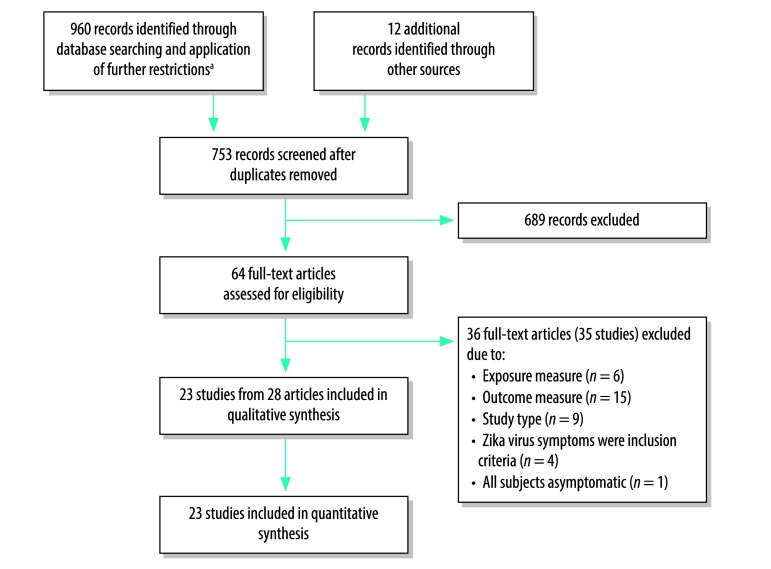
We searched PubMed®, Embase® and LILACS online databases from inception to 26 January 2018. We included observational epidemiological studies where laboratory testing was used to confirm positive exposure of participants to Zika virus and in which Zika virus symptom status was also recorded. We excluded studies in which having symptoms of Zika virus was a criterion for inclusion. The main outcome assessed was percentage of all Zika virus-positive participants who were asymptomatic. We used a quality-effects approach and the double arcsine transformation for the meta-analysis.
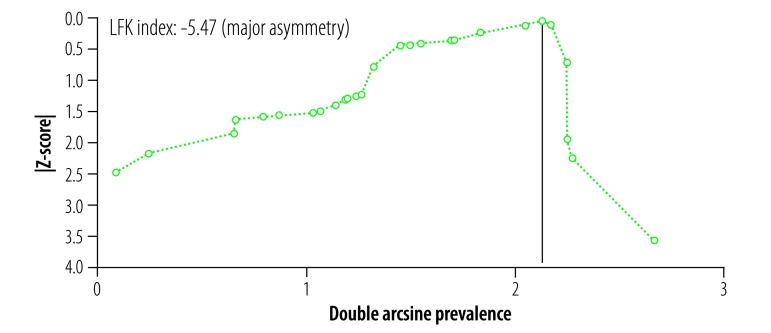
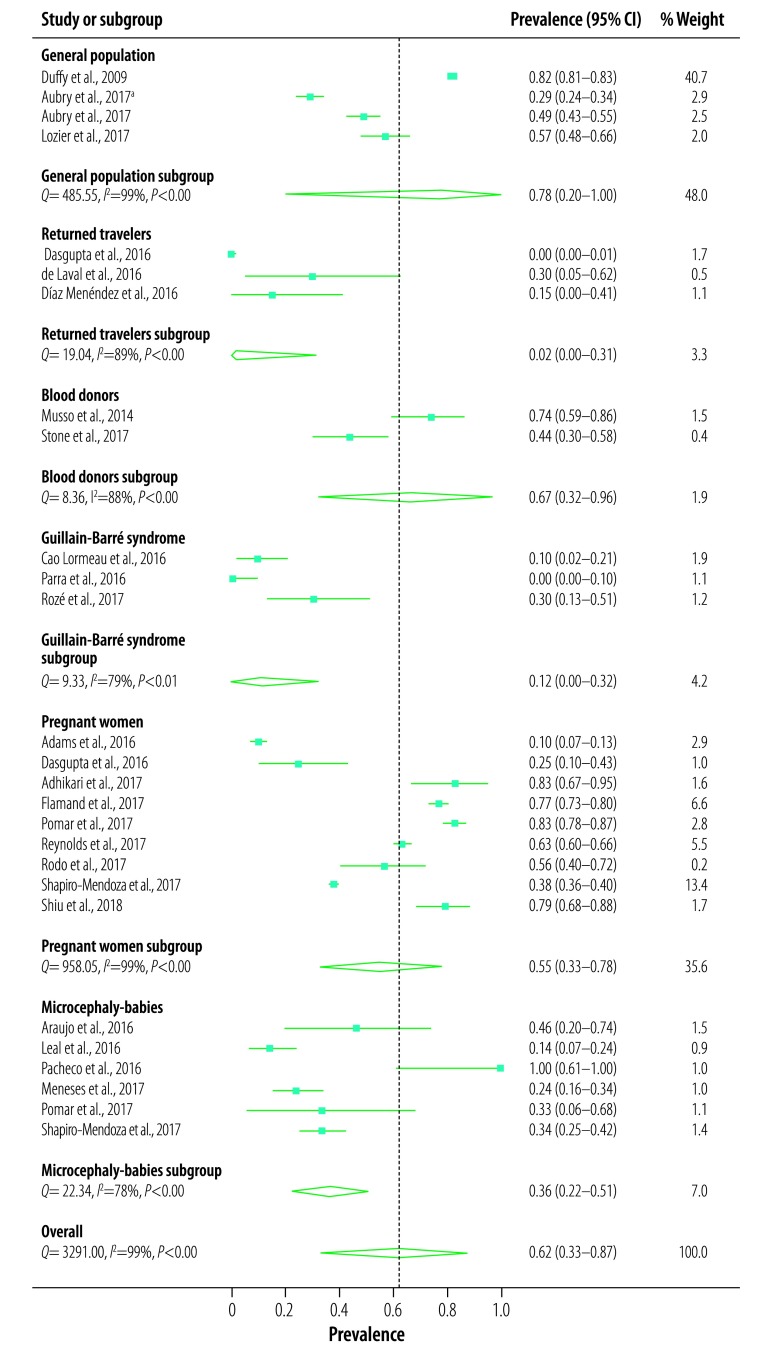
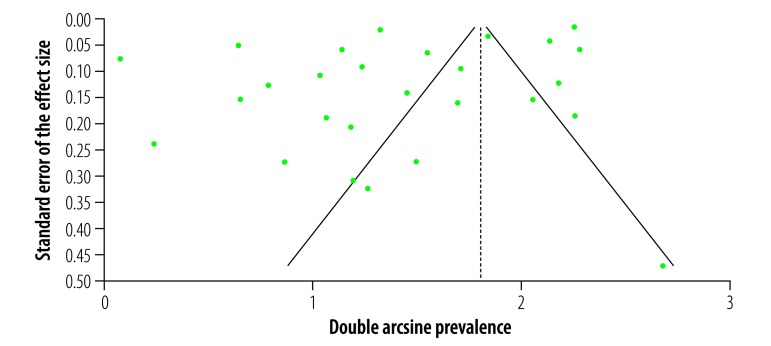
We assessed 753 studies for inclusion, of which 23 were included in the meta-analysis, totalling 11 305 Zika virus-positive participants. The high degree of heterogeneity in the studies ( = 99%) suggests that the pooled prevalence of asymptomatic Zika virus-positive participants was probably not a robust estimate. Analysis based on subgroups of the population (general population, returned travellers, blood donors, adults with Guillain-Barré syndrome, pregnant women and babies with microcephaly) was not able to explain the heterogeneity. Funnel and Doi plots showed major asymmetry, suggesting selection bias or true heterogeneity.
Better-quality research is needed, using standardized methods, to determine the true prevalence of asymptomatic Zika virus and whether it varies between populations or over time.
系统评价估计普通人群和特定人群群体中无症状寨卡病毒感染的流行率。
我们检索了 PubMed®、Embase® 和 LILACS 在线数据库,检索时间截至 2018 年 1 月 26 日。我们纳入了使用实验室检测来证实参与者对寨卡病毒阳性暴露,并记录寨卡病毒症状状态的观察性流行病学研究。我们排除了将出现寨卡病毒症状作为纳入标准的研究。主要评估指标为所有寨卡病毒阳性参与者中无症状者的百分比。我们使用质量效应方法和双反正弦变换进行荟萃分析。
我们评估了 753 项研究的纳入情况,其中 23 项研究纳入荟萃分析,共纳入 11305 例寨卡病毒阳性参与者。研究中存在高度异质性( = 99%),这表明汇总的无症状寨卡病毒阳性参与者的流行率可能不是一个可靠的估计。基于人群亚组(普通人群、归国旅行者、献血者、患有格林-巴利综合征的成年人、孕妇和小头畸形婴儿)的分析无法解释这种异质性。漏斗图和 Doi 图显示存在主要的不对称性,提示存在选择偏倚或真正的异质性。
需要使用标准化方法进行高质量的研究,以确定无症状寨卡病毒的真实流行率,以及它是否在不同人群或随时间变化。