Microbial Biotechnology Research Center, Jeonbuk Branch Institute, Korea Research Institute of Bioscience and Biotechnology (KRIBB), Jeonbuk, Jeongeup, 580-185, Republic of Korea.
Korea Institute of Ocean Science and Technology, Busan, 49111, Republic of Korea.
Microb Cell Fact. 2018 Jun 15;17(1):92. doi: 10.1186/s12934-018-0921-z.
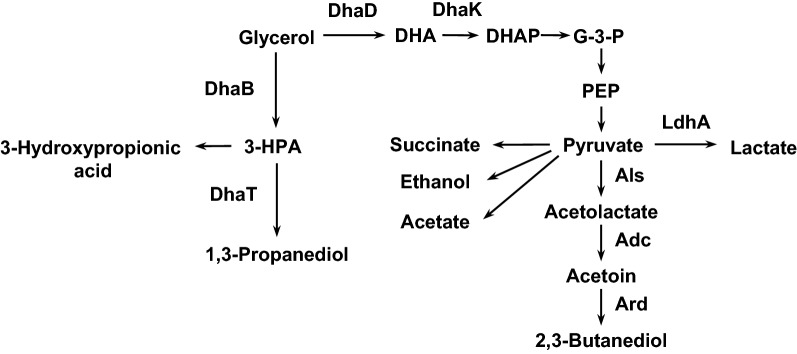
1,3-Propanediol (1,3-PDO) is important building blocks for the bio-based chemical industry, Klebsiella pneumoniae can be an attractive candidate for their production. However, 1,3-PDO production is high but productivity is generally low by K. pneumoniae. In this study, repeated fed-batch cultivation by a lactate and 2,3-butanediol (2,3-BDO) deficient mutant of K. pneumoniae were investigated for efficient 1,3-PDO production from industrial by-products such as crude glycerol.
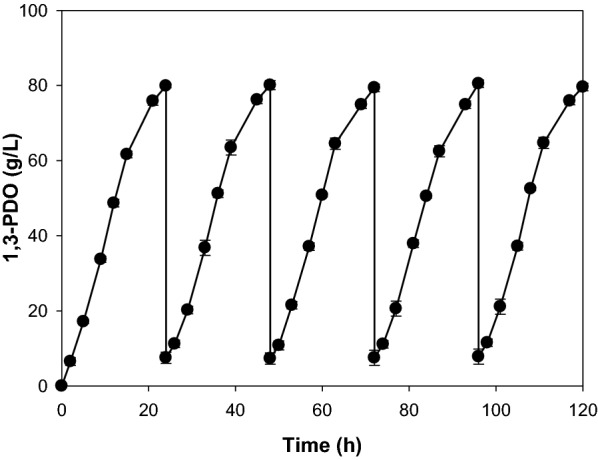
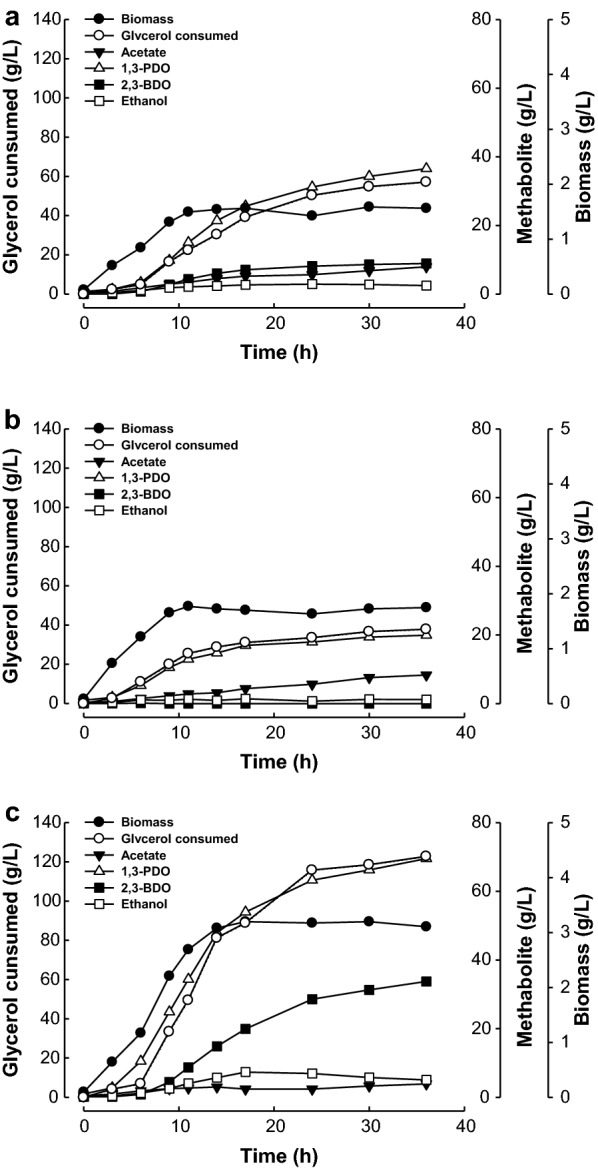
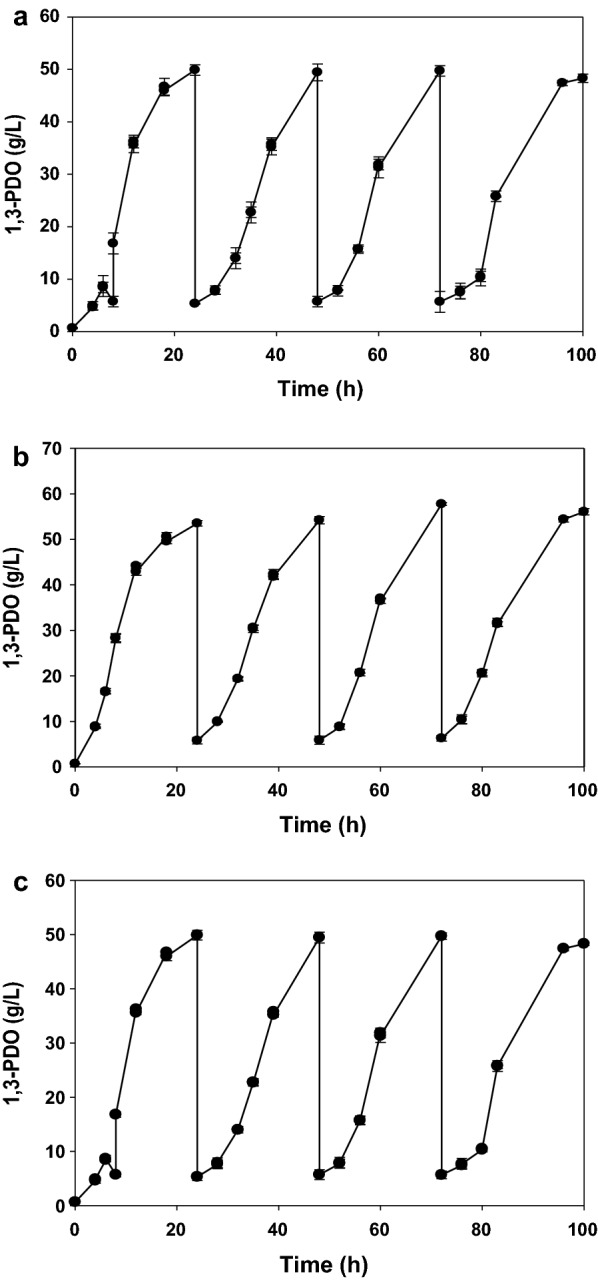
First, optimal conditions for repeated fed-batch fermentation of a ΔldhA mutant defective for lactate formation due to deletion of the lactate dehydrogenase gene (ldhA) were determined. Maximal 1,3-PDO production level and productivity obtained by repeated fed-batch fermentation under optimized conditions were 81.1 g/L and 3.38 g/L/h, respectively, and these values were successfully maintained for five cycles of fermentation without any loss of fermentation capacity. This results were much higher than that of the normal fed-batch fermentation. The levels of 2,3-BDO, which is a major by-product, reaching up to ~ 50% of the level of 1,3-PDO, were reduced using a mutant strain [Δ(ldhA als)] containing an additional mutation in the biosynthetic pathway of 2,3-BDO (deletion of the acetolactate synthase gene). The levels of 2,3-BDO were reduced to about 20% of 1,3-PDO levels by repeated fed-batch fermentation of Δ(ldhA als), although maximal 1,3-PDO production and productivity also decreased owing to a defect in the growth of the 2,3-BDO-defective mutant strain.
This repeated fed-batch fermentation may be useful for reducing the cost of 1,3-PDO production and may be promising industrialization prospect for the 1,3-PDO production.
1,3-丙二醇(1,3-PDO)是生物基化学工业的重要组成部分,肺炎克雷伯氏菌可以成为其生产的有吸引力的候选者。然而,肺炎克雷伯氏菌生产 1,3-PDO 的产量高,但生产力普遍较低。在这项研究中,通过缺乏乳酸和 2,3-丁二醇(2,3-BDO)的肺炎克雷伯氏菌突变体进行反复分批补料培养,以从粗甘油等工业副产物中高效生产 1,3-PDO。
首先,确定了由于缺失乳酸脱氢酶基因(ldhA)而导致乳酸形成缺陷的 ΔldhA 突变体的反复分批发酵的最佳条件。在优化条件下通过反复分批发酵获得的最大 1,3-PDO 产量和生产力水平分别为 81.1 g/L 和 3.38 g/L/h,这些值在没有任何发酵能力损失的情况下成功维持了五个发酵周期。这一结果远高于正常分批发酵的结果。使用在 2,3-BDO 生物合成途径中含有额外突变(缺失乙酰乳酸合酶基因)的突变株 [Δ(ldhA als)],可以将主要副产物 2,3-BDO 的水平降低至 1,3-PDO 水平的约 50%。通过 Δ(ldhA als)的反复分批发酵,2,3-BDO 的水平降低至 1,3-PDO 水平的约 20%,尽管由于 2,3-BDO 缺陷突变株的生长缺陷,最大 1,3-PDO 产量和生产力也有所下降。
这种反复分批发酵可能有助于降低 1,3-PDO 生产成本,并且对于 1,3-PDO 的生产具有有前途的工业化前景。