Co M S, Gaulton G N, Tominaga A, Homcy C J, Fields B N, Greene M I
Proc Natl Acad Sci U S A. 1985 Aug;82(16):5315-8. doi: 10.1073/pnas.82.16.5315.
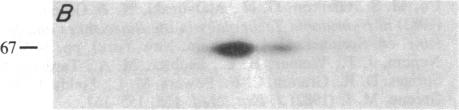
The mechanism by which viruses bind to and infect specific tissues to cause disease has only recently begun to be understood. The mammalian reoviruses provide an especially attractive model for studying the details of cell surface recognition. The cell and tissue tropism of reovirus is determined by a portion of the viral hemagglutinin termed the neutralization domain. We have reported previously on the generation of both monoclonal and polyclonal anti-idiotypic antibodies that mimic the viral hemagglutinin in the specificity of binding to the reovirus receptor. By using these anti-idiotypic antibodies as specific probes, we have successfully isolated the mammalian reovirus receptor from neuronal and lymphoid cells. In the present study, we report that the reovirus receptor is structurally similar to the mammalian beta-adrenergic receptor. This conclusion is based on the following observations: (i) purified beta-adrenergic receptor is immunoprecipitable by anti-reovirus receptor antibody; (ii) purified reovirus receptor obtained from murine thymoma cells and beta-adrenergic receptor obtained from calf lung exhibit identical molecular masses and isoelectric points; (iii) trypsin digests of purified reovirus and beta-adrenergic receptors display indistinguishable fragment patterns; (iv) purified reovirus receptor binds the beta-antagonist [125I]iodohydroxybenzylpindolol and this binding is blocked by the beta-agonist isoproterenol.
病毒结合并感染特定组织从而引发疾病的机制直到最近才开始被理解。哺乳动物呼肠孤病毒为研究细胞表面识别的细节提供了一个特别有吸引力的模型。呼肠孤病毒的细胞和组织嗜性由病毒血凝素中称为中和结构域的部分决定。我们之前报道过产生了在结合呼肠孤病毒受体的特异性方面模拟病毒血凝素的单克隆和多克隆抗独特型抗体。通过使用这些抗独特型抗体作为特异性探针,我们已成功从神经元和淋巴细胞中分离出哺乳动物呼肠孤病毒受体。在本研究中,我们报告呼肠孤病毒受体在结构上与哺乳动物β - 肾上腺素能受体相似。这一结论基于以下观察结果:(i)纯化的β - 肾上腺素能受体可被抗呼肠孤病毒受体抗体免疫沉淀;(ii)从小鼠胸腺瘤细胞获得的纯化呼肠孤病毒受体和从小牛肺获得的β - 肾上腺素能受体表现出相同的分子量和等电点;(iii)纯化的呼肠孤病毒受体和β - 肾上腺素能受体的胰蛋白酶消化产物显示出难以区分的片段模式;(iv)纯化的呼肠孤病毒受体结合β - 拮抗剂[125I]碘羟基苄基吲哚洛尔,并且这种结合被β - 激动剂异丙肾上腺素阻断。