Wang Baoya, Lv Zhi, Zhang Pingping, Su Jianrong
Clinical Laboratory Center, Beijing Friendship Hospital, Capital Medical University, Beijing, China.
Medicine (Baltimore). 2018 Jun;97(25):e11219. doi: 10.1097/MD.0000000000011219.
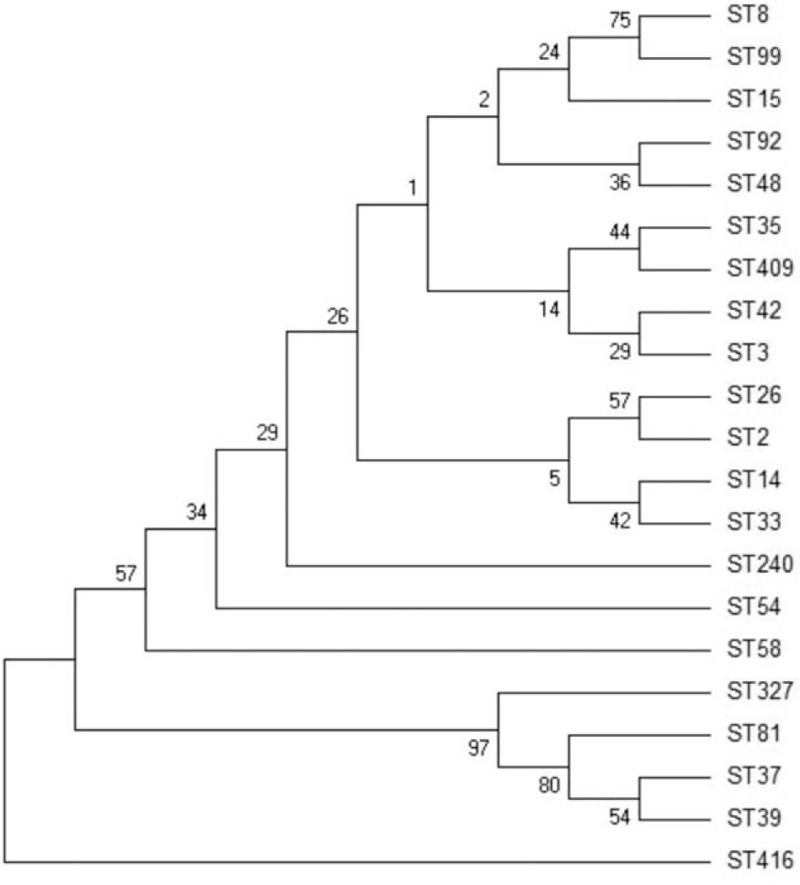
Because the epidemiology of Clostridium difficile infection (CDI) is region-specific, the present study was undertaken to examine the epidemiology of C difficile outbreaks in Beijing, China.Eighty nonduplicate isolates were collected from March, 2016 to December, 2016. The molecular type and phylogenetic analysis were evaluated by multilocus sequence typing (MLST). The minimum inhibitory concentrations (MICs) for 11 antibiotics and the resistance mechanisms were investigated.Sixty-five toxigenic strains (81.25%), including 22 tcdABCDT strains (27.5%) and 43 tcdABCDT strains (53.75%), and also 15 nontoxigenic strains (tcdABCDT; 18.75%) were detected. MLST identified 21 different sequence types (STs), including 2 novel types (ST409 and ST416). All isolates were susceptible to metronidazole, vancomycin, fidaxomicin, piperacillin/tazobactam, and meropenem, and all were effectively inhibited by emodin (MICs 4-8 μg/mL). The resistance rates to rifaximin, ceftriaxone, clindamycin, erythromycin, and ciprofloxacin were 8.75%, 51.25%, 96.25%, 81.25%, and 96.25%, respectively; 81.25% (65/80) of isolates were multidrug-resistant. Amino acid mutations in GyrA and/or GyrB conferred quinolone resistance. One novel amino acid substitution, F86Y in GyrA, was found in 1 CIP-intermediate strain. The erm(B) gene played a key role in mediating macrolide-lincosamide-streptogramin B (MLSB) resistance. Erm(G) was also found in erm(B)-negative strains that were resistant to both erythromycin and clindamycin. RpoB mutations were associated with rifampin resistance, and 2 new amino mutations were identified in 1 intermediate strain (E573A and E603N).Regional diversity and gene heterogeneity exist in both the ST type and resistant patterns of clinical C difficile isolates in Northern China.
由于艰难梭菌感染(CDI)的流行病学具有地区特异性,因此开展了本研究以调查中国北京艰难梭菌暴发的流行病学情况。2016年3月至2016年12月收集了80株非重复分离株。通过多位点序列分型(MLST)评估分子类型和系统发育分析。研究了11种抗生素的最低抑菌浓度(MIC)及耐药机制。检测到65株产毒菌株(81.25%),包括22株tcdABCDT菌株(27.5%)和43株tcdABCDT菌株(53.75%),以及15株非产毒菌株(tcdABCDT;18.75%)。MLST鉴定出21种不同的序列类型(STs),包括2种新类型(ST409和ST416)。所有分离株对甲硝唑、万古霉素、非达霉素、哌拉西林/他唑巴坦和美罗培南均敏感,并且所有分离株均被大黄素有效抑制(MICs为4 - 8μg/mL)。对利福昔明、头孢曲松、克林霉素、红霉素和环丙沙星的耐药率分别为8.75%、51.25%、96.25%、81.25%和96.25%;81.25%(65/80)的分离株为多重耐药。GyrA和/或GyrB中的氨基酸突变赋予喹诺酮耐药性。在1株环丙沙星中介菌株中发现了一种新的氨基酸替代,即GyrA中的F86Y。erm(B)基因在介导大环内酯 - 林可酰胺 - 链阳菌素B(MLSB)耐药中起关键作用。在对红霉素和克林霉素均耐药的erm(B)阴性菌株中也发现了erm(G)。RpoB突变与利福平耐药相关,并且在1株中介菌株中鉴定出2种新的氨基酸突变(E573A和E603N)。中国北方临床艰难梭菌分离株的ST类型和耐药模式均存在地区多样性和基因异质性。