Cecchini Massimo, Bedini Roberto, Mosetti Davide, Marino Sonia, Stasi Serenella
Department of Agriculture and Forestry Sciences, University of Tuscia, Viterbo, Italy.
Integronomia - Ergonomics and Sustainability Research, Rome, Italy.
Saf Health Work. 2018 Jun;9(2):164-171. doi: 10.1016/j.shaw.2017.07.009. Epub 2017 Aug 4.
In recent years, the interest in health and safety in the workplace has increased. Agriculture is one of the human work activities with the highest risk indexes. Studies on risk perception of agricultural workers are often referred to as specific risk factors (especially pesticides), but the risk perception plays an important role in preventing every kind of accident and occupational disease.
The aim of this research is to test a new method for understanding the relation between risk perception among farmers and the main risk factors to which they are exposed. A secondary aim is to investigate the influence of training in risk perception in agriculture. The data collection was realized using a questionnaire designed to investigate the risk perception; the questionnaire was given to a sample of 119 agricultural workers in central Italy. Through the use of the "principal components analysis" it was possible to highlight and verify the latent dimensions underlying the collected data in comparison with scales of attitudes.
Results show that the highest percentage of strong negative attitude is among the people who have worked for more years, while farmers who have worked for fewer years have a marked positive attitude.
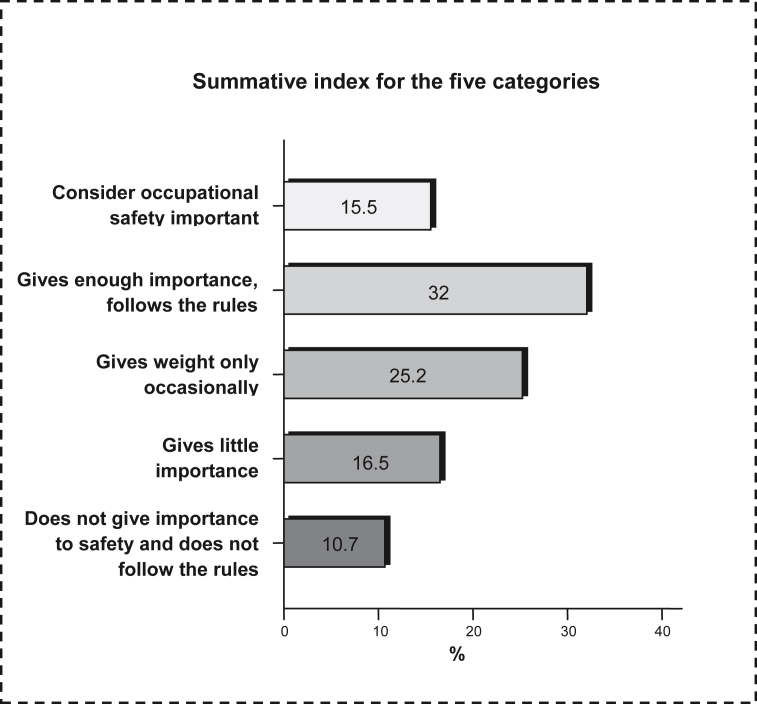
The analysis of the questionnaires through the synthetic index method (Rizzi index) showed that agricultural workers involved, in particular the elderly workers, have a negative attitude towards safety; workers are hostile to safety measures if they have not attended special training courses.
近年来,人们对工作场所健康与安全的关注度有所提高。农业是风险指数最高的人类工作活动之一。关于农业工人风险认知的研究通常涉及特定风险因素(尤其是农药),但风险认知在预防各类事故和职业病方面起着重要作用。
本研究的目的是测试一种新方法,以了解农民的风险认知与他们所面临的主要风险因素之间的关系。次要目的是调查农业风险认知培训的影响。通过一份旨在调查风险认知的问卷进行数据收集;该问卷发放给了意大利中部119名农业工人组成的样本。通过使用“主成分分析”,与态度量表相比,能够突出并验证所收集数据背后的潜在维度。
结果表明,工作年限较长的人群中持强烈负面态度的比例最高,而工作年限较短的农民则有明显的积极态度。
通过综合指数法(里齐指数)对问卷进行分析表明,参与调查的农业工人,尤其是老年工人,对安全持消极态度;如果未参加特殊培训课程,工人们会对安全措施持抵触态度。