Liu Yifan, Wu Tianru, Yin Yuling, Zhang Xuefu, Yu Qingkai, Searles Debra J, Ding Feng, Yuan Qinghong, Xie Xiaoming
State Key Laboratory of Precision Spectroscopy School of Physics and Material Science East China Normal University 3663 N. Zhongshan Road Shanghai 200062 China.
State Key Laboratory of Functional Materials for Informatics Shanghai Institute of Microsystem and information Technology Chinese Academy of Sciences 865 Changning Road Shanghai 200050 China.
Adv Sci (Weinh). 2018 Mar 12;5(6):1700961. doi: 10.1002/advs.201700961. eCollection 2018 Jun.
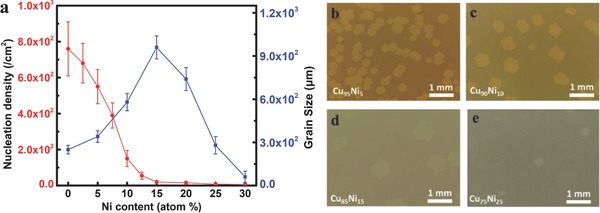
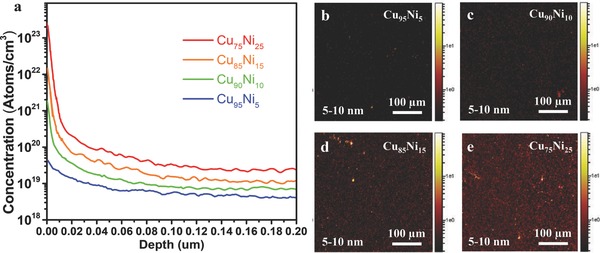
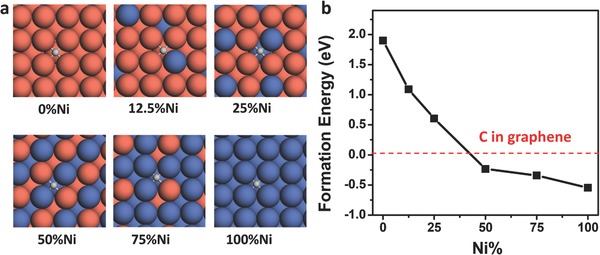
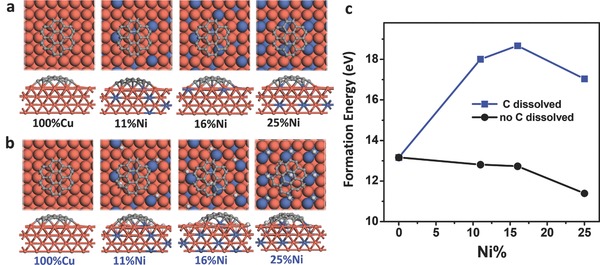
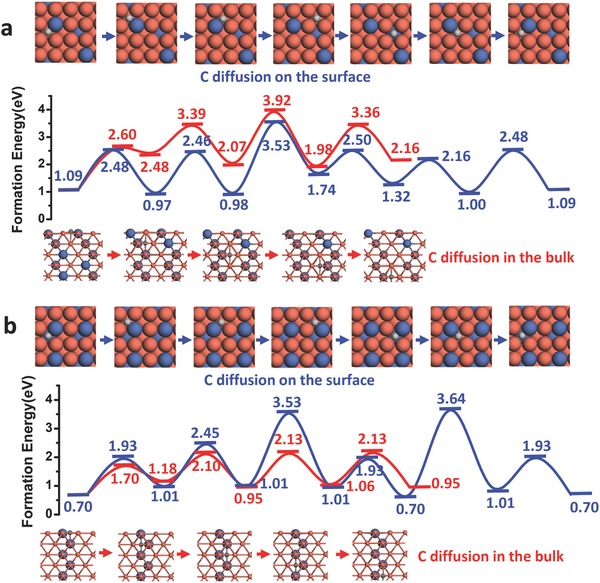
CuNi alloy foils are demonstrated to be one of the best substrates for synthesizing large area single-crystalline graphene because a very fast growth rate and low nucleation density can be simultaneously achieved. The fast growth rate is understood to be due the abundance of carbon precursor supply, as a result of the high catalytic activity of Ni atoms. However, a theoretical understanding of the low nucleation density remains controversial because it is known that a high carbon precursor concentration on the surface normally leads to a high nucleation density. Here, the graphene nucleation on the CuNi alloy surfaces is systematically explored and it is revealed that: i) carbon atom dissolution into the CuNi alloy passivates the alloy surface, thereby drastically increasing the graphene nucleation barrier; ii) carbon atom diffusion on the CuNi alloy surface is greatly suppressed by the inhomogeneous atomic structure of the surface; and iii) a prominent increase in the rate of carbon diffusion into the bulk occurs when the Ni composition is higher than the percolation threshold. This study reveals the key mechanism for graphene nucleation on CuNi alloy surfaces and provides a guideline for the catalyst design for the synthesis of graphene and other 2D materials.
铜镍合金箔被证明是合成大面积单晶石墨烯的最佳衬底之一,因为可以同时实现非常快的生长速率和低成核密度。快速生长速率被认为是由于镍原子的高催化活性导致碳前驱体供应丰富。然而,对低成核密度的理论理解仍存在争议,因为众所周知,表面上高浓度的碳前驱体通常会导致高成核密度。在此,对铜镍合金表面上的石墨烯成核进行了系统研究,结果表明:i)碳原子溶解到铜镍合金中会使合金表面钝化,从而大幅增加石墨烯的成核势垒;ii)表面不均匀的原子结构极大地抑制了碳原子在铜镍合金表面的扩散;iii)当镍成分高于渗流阈值时,碳扩散到块体中的速率会显著增加。这项研究揭示了铜镍合金表面上石墨烯成核的关键机制,并为石墨烯和其他二维材料合成的催化剂设计提供了指导。