Istituto Zooprofilattico Sperimentale dell'Abruzzo e del Molise 'G. Caporale', Campo Boario Teramo, Italy.
PLoS One. 2018 Jun 27;13(6):e0196429. doi: 10.1371/journal.pone.0196429. eCollection 2018.
In the last decades an increasing number of West Nile Disease cases was observed in equines and humans in the Mediterranean basin and surveillance systems are set up in numerous countries to manage and control the disease. The collection, storage and distribution of information on the spread of the disease becomes important for a shared intervention and control strategy. To this end, a Web Geographic Information System has been developed and disease data, climatic and environmental remote sensed data, full genome sequences of selected isolated strains are made available. This paper describes the Disease Monitoring Dashboard (DMD) web system application, the tools available for the preliminary analysis on climatic and environmental factors and the other interactive tools for epidemiological analysis.
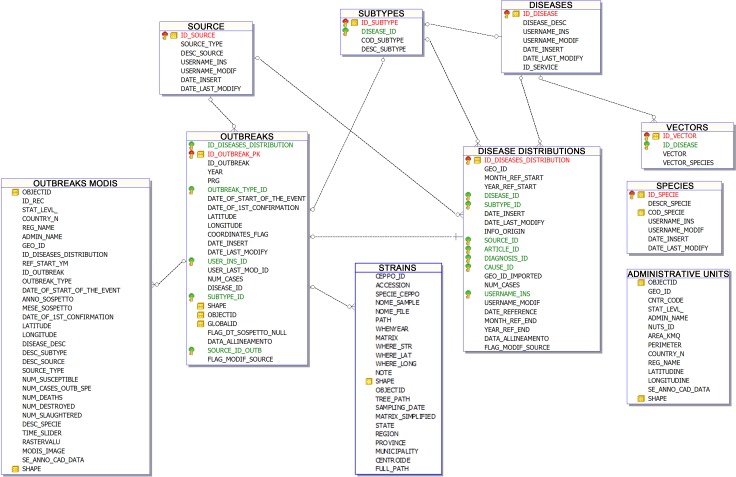
WNV occurrence data are collected from multiple official and unofficial sources. Whole genome sequences and metadata of WNV strains are retrieved from public databases or generated in the framework of the Italian surveillance activities. Climatic and environmental data are provided by NASA website. The Geographical Information System is composed by Oracle 10g Database and ESRI ArcGIS Server 10.03; the web mapping client application is developed with the ArcGIS API for Javascript and Phylocanvas library to facilitate and optimize the mash-up approach. ESRI ArcSDE 10.1 has been used to store spatial data.
The DMD application is accessible through a generic web browser at https://netmed.izs.it/networkMediterraneo/. The system collects data through on-line forms and automated procedures and visualizes data as interactive graphs, maps and tables. The spatial and temporal dynamic visualization of disease events is managed by a time slider that returns results on both map and epidemiological curve. Climatic and environmental data can be associated to cases through python procedures and downloaded as Excel files.
The system compiles multiple datasets through user-friendly web tools; it integrates entomological, veterinary and human surveillance, molecular information on pathogens and environmental and climatic data. The principal result of the DMD development is the transfer and dissemination of knowledge and technologies to develop strategies for integrated prevention and control measures of animal and human diseases.
在过去的几十年中,在地中海盆地观察到越来越多的西尼罗河病在马和人类中发生,并且在许多国家建立了监测系统来管理和控制该疾病。收集、存储和传播有关疾病传播的信息对于共享干预和控制策略变得重要。为此,开发了一个 Web 地理信息系统,并提供了疾病数据、气候和环境遥感数据、选定分离株的全基因组序列。本文描述了疾病监测仪表板(DMD)Web 系统应用程序、用于初步分析气候和环境因素的可用工具以及其他用于流行病学分析的交互工具。
WNV 发生数据从多个官方和非官方来源收集。WNV 株的全基因组序列和元数据从公共数据库中检索或在意大利监测活动框架内生成。气候和环境数据由 NASA 网站提供。地理信息系统由 Oracle 10g 数据库和 ESRI ArcGIS Server 10.03 组成;Web 映射客户端应用程序使用 ArcGIS API for Javascript 和 Phylocanvas 库开发,以方便和优化混搭方法。ESRI ArcSDE 10.1 用于存储空间数据。
DMD 应用程序可通过通用 Web 浏览器在 https://netmed.izs.it/networkMediterraneo/ 访问。系统通过在线表格和自动程序收集数据,并以交互式图表、地图和表格的形式可视化数据。疾病事件的时空动态可视化由时间滑块管理,该滑块返回地图和流行病学曲线上的结果。通过 python 程序可以将气候和环境数据与病例相关联,并下载为 Excel 文件。
该系统通过用户友好的 Web 工具编译多个数据集;它集成了昆虫学、兽医和人类监测、病原体分子信息以及环境和气候数据。DMD 开发的主要成果是知识和技术的转移和传播,以制定针对动物和人类疾病的综合预防和控制措施的策略。