Department of Management Science and Engineering, Stanford University, Stanford, California, United States of America.
Department of Earth System Science, Stanford University, Stanford, California, United States of America.
PLoS Med. 2018 Jul 3;15(7):e1002586. doi: 10.1371/journal.pmed.1002586. eCollection 2018 Jul.
Rising atmospheric carbon dioxide concentrations are anticipated to decrease the zinc and iron concentrations of crops. The associated disease burden and optimal mitigation strategies remain unknown. We sought to understand where and to what extent increasing carbon dioxide concentrations may increase the global burden of nutritional deficiencies through changes in crop nutrient concentrations, and the effects of potential mitigation strategies.
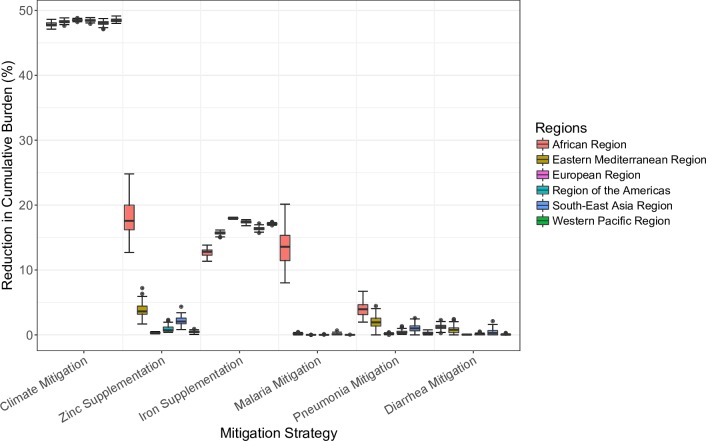
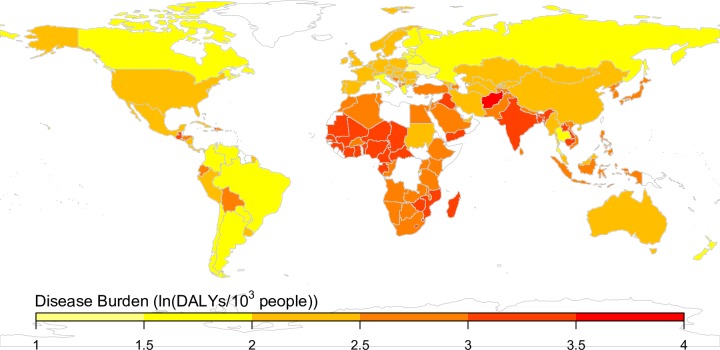
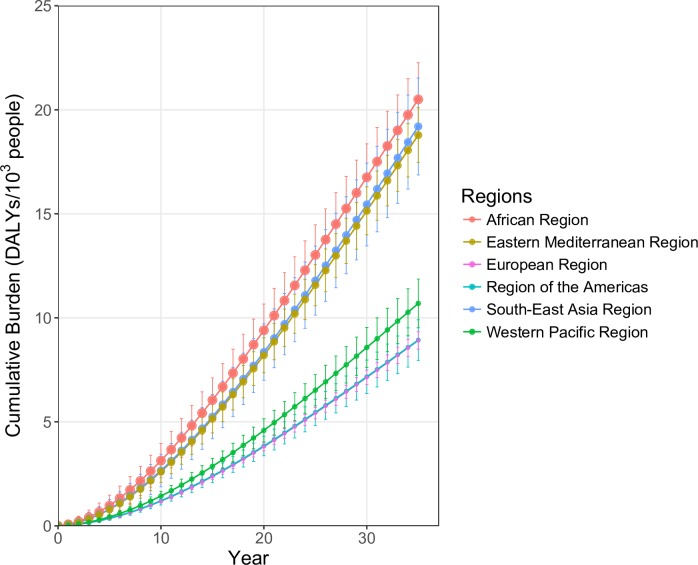
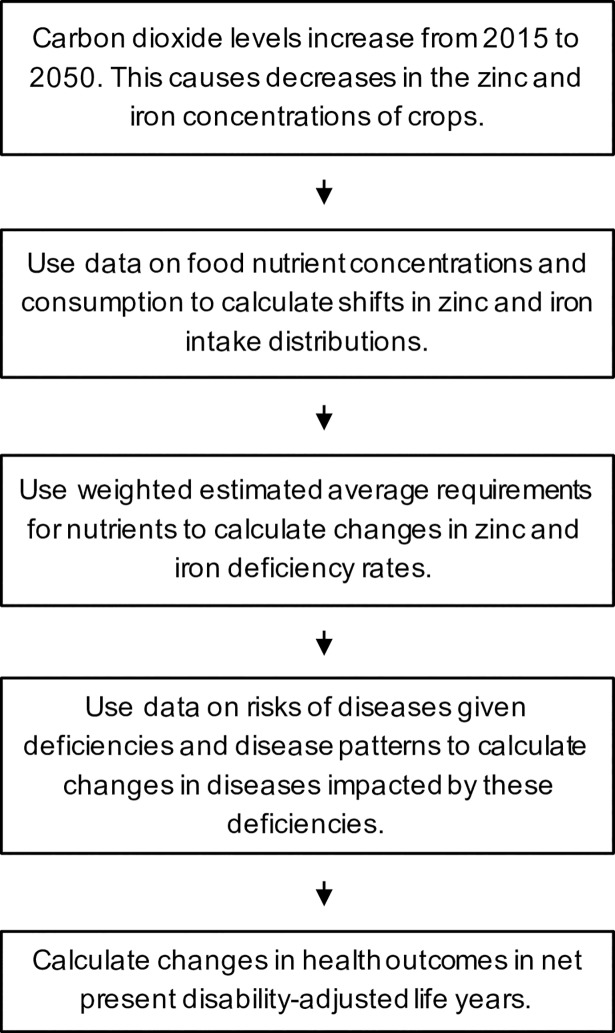
For each of 137 countries, we incorporated estimates of climate change, crop nutrient concentrations, dietary patterns, and disease risk into a microsimulation model of zinc and iron deficiency. These estimates were obtained from the Intergovernmental Panel on Climate Change, US Department of Agriculture, Statistics Division of the Food and Agriculture Organization of the United Nations, and Global Burden of Disease Project, respectively. In the absence of increasing carbon dioxide concentrations, we estimated that zinc and iron deficiencies would induce 1,072.9 million disability-adjusted life years (DALYs) globally over the period 2015 to 2050 (95% credible interval [CrI]: 971.1-1,167.7). In the presence of increasing carbon dioxide concentrations, we estimated that decreasing zinc and iron concentrations of crops would induce an additional 125.8 million DALYs globally over the same period (95% CrI: 113.6-138.9). This carbon-dioxide-induced disease burden is projected to disproportionately affect nations in the World Health Organization's South-East Asia and African Regions (44.0 and 28.5 million DALYs, respectively), which already have high existing disease burdens from zinc and iron deficiencies (364.3 and 299.5 million DALYs, respectively), increasing global nutritional inequalities. A climate mitigation strategy such as the Paris Agreement (an international agreement to keep global temperatures within 2°C of pre-industrial levels) would be expected to avert 48.2% of this burden (95% CrI: 47.8%-48.5%), while traditional public health interventions including nutrient supplementation and disease control programs would be expected to avert 26.6% of the burden (95% CrI: 23.8%-29.6%). Of the traditional public health interventions, zinc supplementation would be expected to avert 5.5%, iron supplementation 15.7%, malaria mitigation 3.2%, pneumonia mitigation 1.6%, and diarrhea mitigation 0.5%. The primary limitations of the analysis include uncertainty regarding how food consumption patterns may change with climate, how disease mortality rates will change over time, and how crop zinc and iron concentrations will decline from those at present to those in 2050.
Effects of increased carbon dioxide on crop nutrient concentrations are anticipated to exacerbate inequalities in zinc and iron deficiencies by 2050. Proposed Paris Agreement strategies are expected to be more effective than traditional public health measures to avert the increased inequality.
预计大气中二氧化碳浓度的升高将降低作物的锌和铁浓度。相关疾病负担和最佳缓解策略仍不清楚。我们试图了解在何处以及在何种程度上,由于作物养分浓度的变化,二氧化碳浓度的增加可能会通过增加全球营养缺乏症的负担,以及潜在缓解策略的影响。
对于 137 个国家中的每一个,我们将气候变化、作物养分浓度、饮食模式和疾病风险的估计纳入到一个锌和铁缺乏症的微观模拟模型中。这些估计分别来自政府间气候变化专门委员会、美国农业部、联合国粮食及农业组织统计司和全球疾病负担项目。在没有增加二氧化碳浓度的情况下,我们估计,在 2015 年至 2050 年期间,全球将有 10.729 亿残疾调整生命年(DALY)因锌和铁缺乏而导致(95%可信区间[CrI]:971.1-1167.7)。在二氧化碳浓度增加的情况下,我们估计,在同一时期,全球因作物锌和铁浓度降低而导致的疾病负担将额外增加 1.258 亿 DALY(95%CrI:113.6-138.9)。预计这种由二氧化碳引起的疾病负担将不成比例地影响世界卫生组织东南亚和非洲区域的国家(分别为 4400 万和 2850 万 DALY),这些国家已经因锌和铁缺乏而承受着较高的现有疾病负担(分别为 3.643 亿和 2.995 亿 DALY),从而加剧了全球营养不平等。《巴黎协定》(一项将全球气温保持在工业化前水平以下 2°C 的国际协议)等气候缓解战略预计将避免 48.2%的负担(95%CrI:47.8%-48.5%),而包括营养补充和疾病控制计划在内的传统公共卫生干预措施预计将避免 26.6%的负担(95%CrI:23.8%-29.6%)。在传统的公共卫生干预措施中,锌补充预计将避免 5.5%,铁补充将避免 15.7%,疟疾缓解将避免 3.2%,肺炎缓解将避免 1.6%,腹泻缓解将避免 0.5%。分析的主要局限性包括对气候变化如何影响食物消费模式、疾病死亡率随时间如何变化以及作物锌和铁浓度将如何从目前降至 2050 年的不确定性。
预计到 2050 年,二氧化碳增加对作物养分浓度的影响将加剧锌和铁缺乏症的不平等。拟议的《巴黎协定》战略预计将比传统的公共卫生措施更能有效避免这种不平等的加剧。