Zhejiang Province Center for Disease Control and Prevention, Hangzhou, Zhejiang Province, China.
Key Laboratory for Vaccine, Prevention and Control of Infectious Disease of Zhejiang Province, Hangzhou, Zhejiang Province, China.
Sci Rep. 2018 Jul 6;8(1):10244. doi: 10.1038/s41598-018-28610-8.
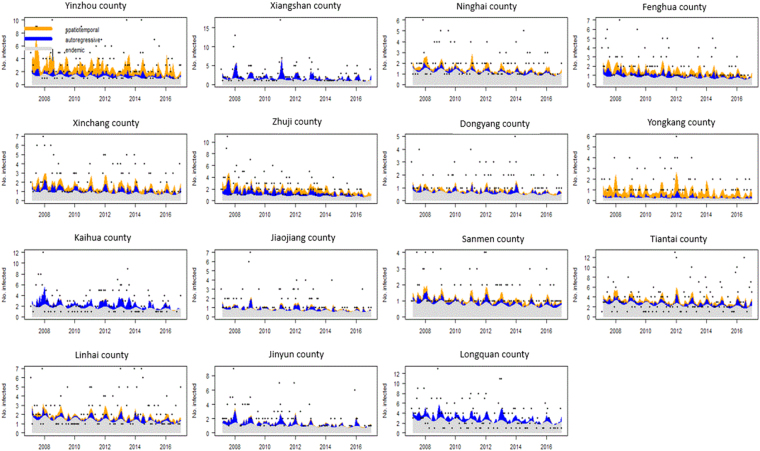
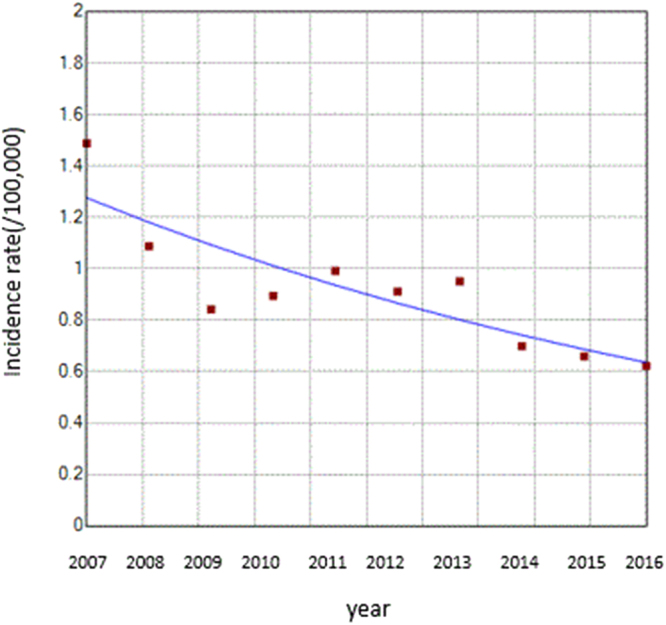
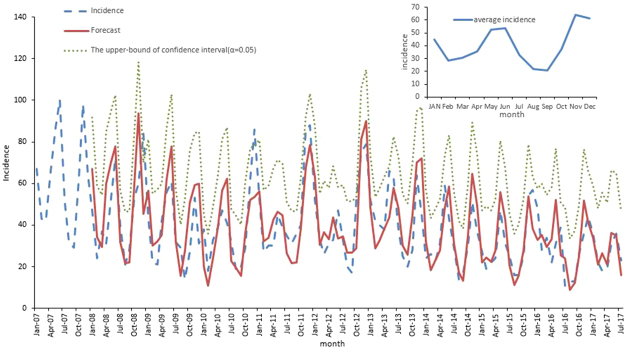
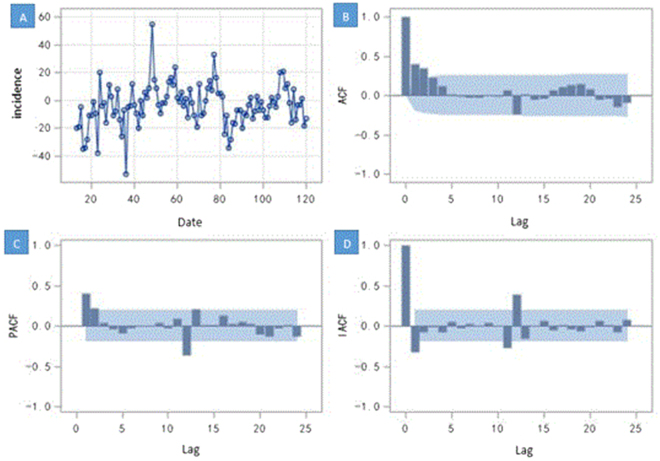
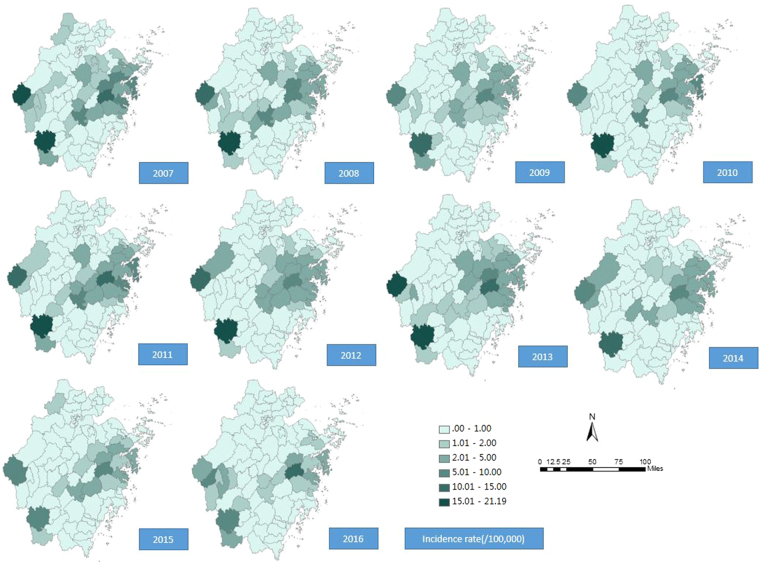
Zhejiang Province is one of the six provinces in China that has the highest incidence of haemorrhagic fever with renal syndrome (HFRS). Data on HFRS cases in Zhejiang Province from January 2007 to July 2017 were obtained from the China Information Network System of Disease Prevention and Control. Joinpoint regression analysis was used to observe the trend of the incidence rate of HFRS. The monthly incidence rate was predicted by autoregressive integrated moving average(ARIMA) models. Spatial autocorrelation analysis was performed to detect geographic clusters. A multivariate time series model was employed to analyze heterogeneous transmission of HFRS. There were a total of 4,836 HFRS cases, with 15 fatal cases reported in Zhejiang Province, China in the last decade. Results show that the mean absolute percentage error (MAPE) of the modelling performance and the forecasting performance of the ARIMA model were 27.53% and 16.29%, respectively. Male farmers and middle-aged patients account for the majority of the patient population. There were 54 high-high clusters and 1 high-low cluster identified at the county level. The random effect variance of the autoregressive component is 0.33; the spatio-temporal component is 1.30; and the endemic component is 2.45. According to the results, there was obvious spatial heterogeneity in the endemic component and spatio-temporal component but little spatial heterogeneity in the autoregressive component. A significant decreasing trend in the incidence rate was identified, and obvious clusters were discovered. Spatial heterogeneity in the factors driving HFRS transmission was discovered, which suggested that a targeted preventive effort should be considered in different districts based on their own main factors that contribute to the epidemics.
浙江省是中国六个肾综合征出血热(HFRS)发病率最高的省份之一。本研究从中国疾病预防控制信息系统中获取了 2007 年 1 月至 2017 年 7 月浙江省 HFRS 病例数据,采用 Joinpoint 回归分析观察 HFRS 发病率的变化趋势,采用自回归求和移动平均(ARIMA)模型预测其月发病率,采用空间自相关分析检测地理聚集性,采用多变量时间序列模型分析 HFRS 的异质性传播。共报告了 4836 例 HFRS 病例,其中 15 例死亡。结果表明,ARIMA 模型的建模性能和预测性能的平均绝对百分比误差(MAPE)分别为 27.53%和 16.29%。男性农民和中年患者是主要的患者群体。县级有 54 个高-高聚集区和 1 个高-低聚集区。自回归分量的随机效应方差为 0.33;时空分量为 1.30;地方分量为 2.45。结果表明,地方分量和时空分量存在明显的空间异质性,自回归分量的空间异质性较小。发病率呈显著下降趋势,存在明显聚集性。发现 HFRS 传播的驱动因素存在空间异质性,提示应根据不同地区的主要流行因素,有针对性地在不同地区开展预防工作。