Koefoed Nikolaj, Lerche Mads, Jensen Bjørn K, Kjær Pia, Dam Sebastian, Horslev Rasmus, Hansen Ernst A
Sport Sciences, Department of Health Science and Technology, Aalborg University, DENMARK.
Int J Exerc Sci. 2018 Jun 1;11(1):776-784. doi: 10.70252/QNBF7275. eCollection 2018.
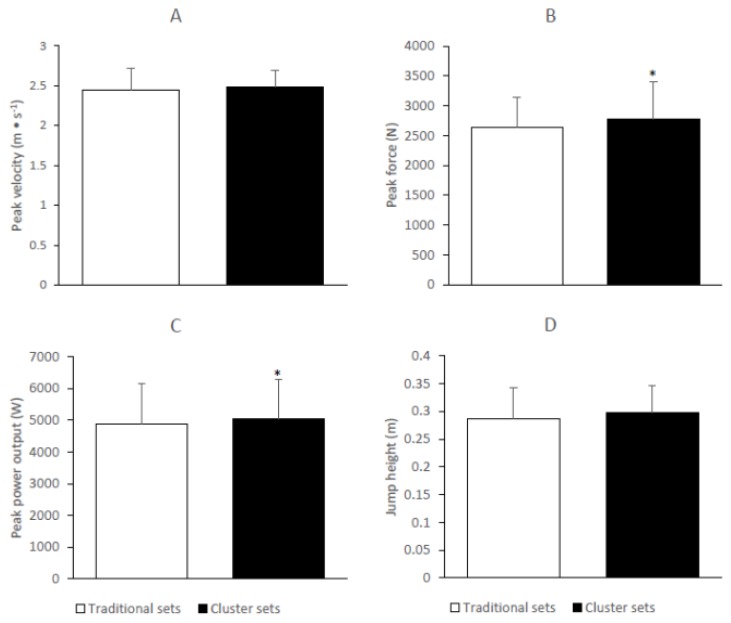
A priority in strength and power exercise might be to train with as high quality as possible for the shortest possible duration. In this context, peak power output could reflect quality. Designing an exercise session as a cluster set structure, as compared to a traditional set structure, may be a way to obtain higher peak power output in the session. But it is unknown whether that is obtainable for non-elite individuals performing loaded jump squat exercise. The aim of the present study was therefore to test the hypothesis that peak power output would be highest in a jump squat exercise session, which was structured with cluster sets, as compared to traditional sets. Ten individuals (2 women, 8 men; 26.5 ± 4.8 years, 1.81 ± 0.08 m, 90.9 ± 13.2 kg) performed two loaded jump squat exercise sessions structured with cluster sets and traditional sets, respectively. The sessions were performed on two separate days, in counterbalanced order. The position of the barbell was used to calculate derived values including peak power output. Values calculated as averages across the entire exercise sessions showed peak power output to be 178 ± 181 W, corresponding to 4.1% ± 4.9%, higher in the session with cluster set structure, as compared to the session with traditional set structure ( = 0.005). It was concluded that for non-elite individuals, peak power output was approximately 4% higher in a loaded jump squat exercise session structured with cluster sets as compared to an exercise session structured with traditional sets.
力量与功率训练的一个重点可能是在尽可能短的时间内进行尽可能高质量的训练。在这种情况下,峰值功率输出可以反映训练质量。与传统组结构相比,将训练课设计为成组训练结构可能是在训练课中获得更高峰值功率输出的一种方法。但对于进行负重深蹲跳训练的非精英个体而言,是否能达到这一点尚不清楚。因此,本研究的目的是检验以下假设:与传统组结构相比,在以成组训练结构进行的深蹲跳训练课中,峰值功率输出最高。10名个体(2名女性,8名男性;年龄26.5±4.8岁,身高1.81±0.08米,体重90.9±13.2千克)分别进行了两次负重深蹲跳训练课,一次采用成组训练结构,另一次采用传统组结构。这两次训练课在两天分别进行,顺序采用平衡法。通过杠铃的位置来计算包括峰值功率输出在内的派生值。以整个训练课的平均值计算得出,与采用传统组结构的训练课相比,采用成组训练结构的训练课中峰值功率输出为178±181瓦,高出4.1%±4.9%(P = 0.005)。得出的结论是,对于非精英个体,与采用传统组结构的训练课相比,采用成组训练结构的负重深蹲跳训练课中的峰值功率输出高出约4%。