Department of Medicine, Beth Israel Deaconess Medical Center, Harvard Medical School, Boston, Massachusetts, USA.
Department of Health Care Quality, Beth Israel Deaconess Medical Center, Boston, Massachusetts, USA.
BMJ Qual Saf. 2018 Nov;27(11):928-936. doi: 10.1136/bmjqs-2017-007525. Epub 2018 Jul 12.
Little is known about patient/family comfort voicing care concerns in real time, especially in the intensive care unit (ICU) where stakes are high and time is compressed. Experts advocate patient and family engagement in safety, which will require that patients/families be able to voice concerns. Data on patient/family attitudes and experiences regarding speaking up are sparse, and mostly include reporting events retrospectively, rather than pre-emptively, to try to prevent harm. We aimed to (1) assess patient/family comfort speaking up about common ICU concerns; (2) identify patient/family-perceived barriers to speaking up; and (3) explore factors associated with patient/family comfort speaking up.
In collaboration with patients/families, we developed a survey to evaluate speaking up attitudes and behaviours. We surveyed current ICU families in person at an urban US academic medical centre, supplemented with a larger national internet sample of individuals with prior ICU experience.
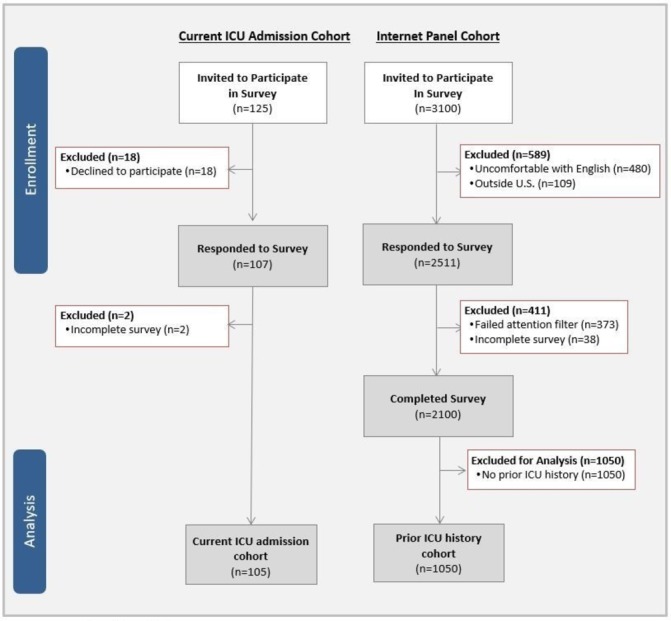
105/125 (84%) of current families and 1050 internet panel participants with ICU history completed the surveys. Among the current ICU families, 50%-70% expressed hesitancy to voice concerns about possible mistakes, mismatched care goals, confusing/conflicting information and inadequate hand hygiene. Results among prior ICU participants were similar. Half of all respondents reported at least one barrier to voicing concerns, most commonly not wanting to be a 'troublemaker', 'team is too busy' or 'I don't know how'. Older, female participants and those with personal or family employment in healthcare were more likely to report comfort speaking up.
Speaking up may be challenging for ICU patients/families. Patient/family education about how to speak up and assurance that raising concerns will not create 'trouble' may help promote open discussions about care concerns and possible errors in the ICU.
对于患者/家属在实时情况下表达护理关切的舒适度,人们知之甚少,尤其是在重症监护病房(ICU)中,情况危急且时间紧迫。专家提倡患者和家属参与安全工作,这将要求患者/家属能够表达关切。关于患者/家属在表达意见方面的态度和经验的数据很少,并且大多包括回顾性报告事件,而不是预先采取措施以试图防止伤害。我们旨在:(1)评估患者/家属对常见 ICU 关注点表达意见的舒适度;(2)确定患者/家属认为表达意见存在的障碍;(3)探讨与患者/家属表达意见舒适度相关的因素。
我们与患者/家属合作,开发了一项调查评估表达意见的态度和行为。我们在一家美国城市学术医疗中心对当前的 ICU 家属进行了现场调查,并通过更大的全国性互联网样本对有 ICU 既往经历的个人进行了补充调查。
当前 ICU 家属中,有 105/125(84%)名家属和有 1050 名有 ICU 既往经历的互联网小组参与者完成了调查。在当前的 ICU 家属中,50%-70%的人表示对可能的错误、不匹配的护理目标、混淆/冲突的信息和不充分的手卫生表示有表达意见的顾虑。有 ICU 既往经历的参与者的结果也相似。半数受访者报告至少存在一个表达意见的障碍,最常见的原因是不想成为“麻烦制造者”、“团队太忙”或“我不知道怎么做”。年龄较大、女性参与者以及个人或家庭从事医疗保健工作的参与者更有可能报告感到舒适并能够表达意见。
对于 ICU 患者/家属来说,表达意见可能具有挑战性。对患者/家属进行关于如何表达意见的教育,并保证提出关切不会引起“麻烦”,可能有助于促进 ICU 中关于护理关切和可能出现的错误的公开讨论。