Insect-Virus Interactions Group, Department of Genomes and Genetics, Institut Pasteur, Paris, France.
Unité de Parasitologie et Entomologie, Département des Maladies Infectieuses, Institut de Recherche Biomédicale des Armées, Marseille, France.
PLoS Pathog. 2018 Jul 13;14(7):e1007187. doi: 10.1371/journal.ppat.1007187. eCollection 2018 Jul.
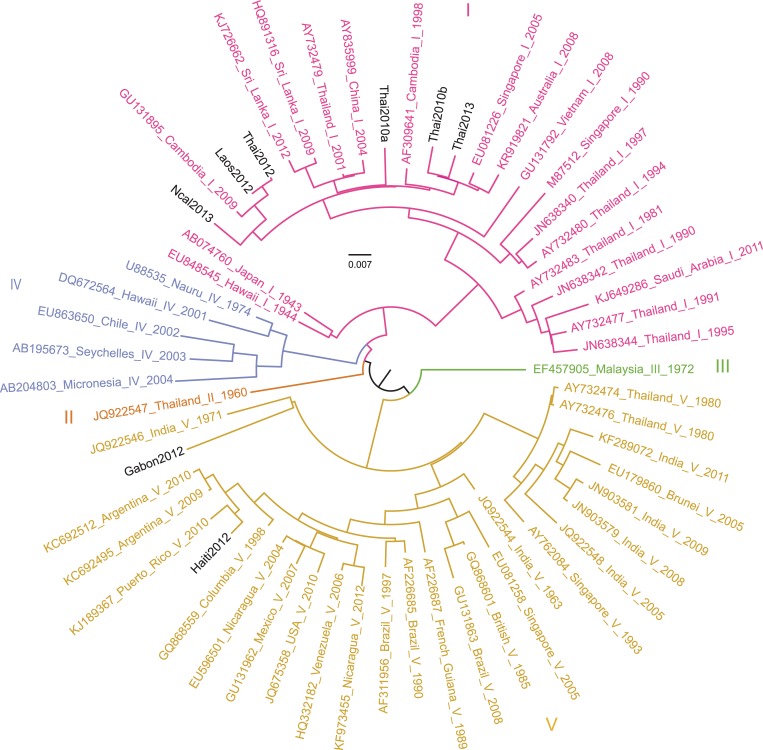
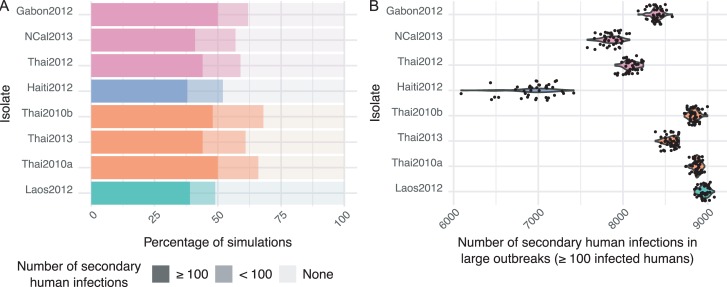
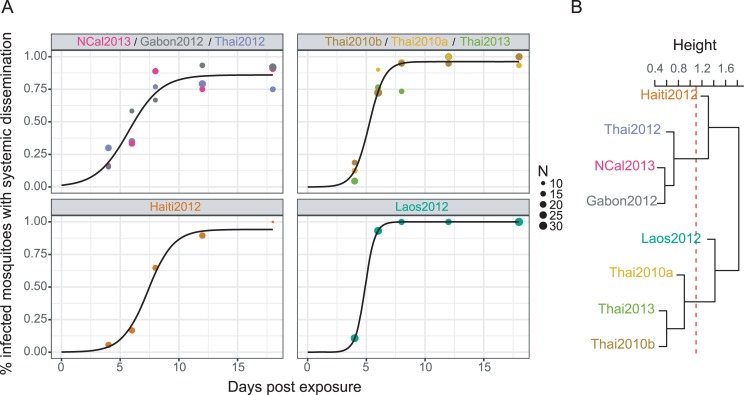
The kinetics of arthropod-borne virus (arbovirus) transmission by their vectors have long been recognized as a powerful determinant of arbovirus epidemiology. The time interval between virus acquisition and transmission by the vector, termed extrinsic incubation period (EIP), combines with vector mortality rate and vector competence to determine the proportion of infected vectors that eventually become infectious. However, the dynamic nature of this process, and the amount of natural variation in transmission kinetics among arbovirus strains, are poorly documented empirically and are rarely considered in epidemiological models. Here, we combine newly generated empirical measurements in vivo and outbreak simulations in silico to assess the epidemiological significance of genetic variation in dengue virus (DENV) transmission kinetics by Aedes aegypti mosquitoes. We found significant variation in the dynamics of systemic mosquito infection, a proxy for EIP, among eight field-derived DENV isolates representing the worldwide diversity of recently circulating type 1 strains. Using a stochastic agent-based model to compute time-dependent individual transmission probabilities, we predict that the observed variation in systemic mosquito infection kinetics may drive significant differences in the probability of dengue outbreak and the number of human infections. Our results demonstrate that infection dynamics in mosquitoes vary among wild-type DENV isolates and that this variation potentially affects the risk and magnitude of dengue outbreaks. Our quantitative assessment of DENV genetic variation in transmission kinetics contributes to improve our understanding of heterogeneities in arbovirus epidemiological dynamics.
节肢动物传播的病毒(虫媒病毒)通过其媒介的传播动力学一直被认为是虫媒病毒流行病学的一个有力决定因素。从病毒获得到媒介传播的时间间隔,称为外潜伏期(EIP),与媒介死亡率和媒介感染力相结合,决定了最终具有感染性的感染媒介的比例。然而,这个过程的动态性质以及虫媒病毒株之间传播动力学的自然变异程度,在经验上记录很少,在流行病学模型中也很少被考虑。在这里,我们结合体内新生成的经验测量值和计算机模拟的暴发情况,评估埃及伊蚊传播登革热病毒(DENV)动力学的遗传变异的流行病学意义。我们发现,在代表最近流行的 1 型毒株的全球多样性的 8 个野外分离株中,系统性蚊子感染(EIP 的替代指标)的动态存在显著差异。我们使用随机基于代理的模型来计算随时间变化的个体传播概率,预测观察到的系统性蚊子感染动力学的变化可能会导致登革热暴发的概率和感染人数出现显著差异。我们的结果表明,野生型 DENV 分离株中的蚊子感染动力学存在差异,这种差异可能会影响登革热暴发的风险和规模。我们对 DENV 传播动力学遗传变异的定量评估有助于提高我们对虫媒病毒流行病学动态异质性的理解。