Ortells Juan J, De Fockert Jan W, Romera Nazaret, Fernández Sergio
Department of Psychology, University of Almería, Almería, Spain.
Department of Psychology, Goldsmiths, University of London, London, United Kingdom.
Front Psychol. 2018 Jul 17;9:1239. doi: 10.3389/fpsyg.2018.01239. eCollection 2018.
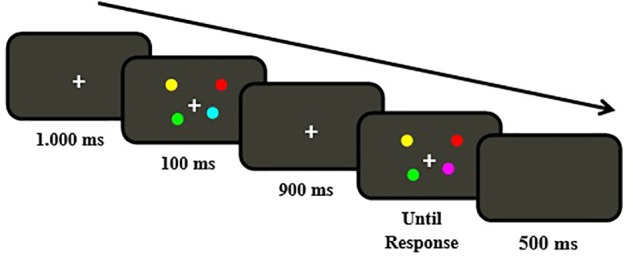
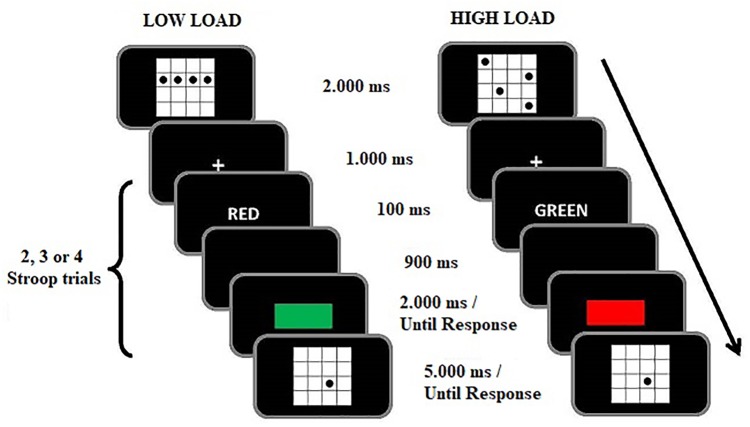
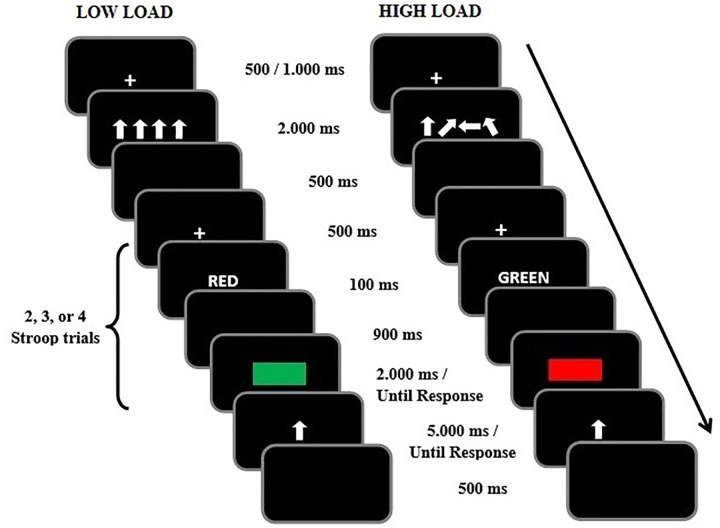
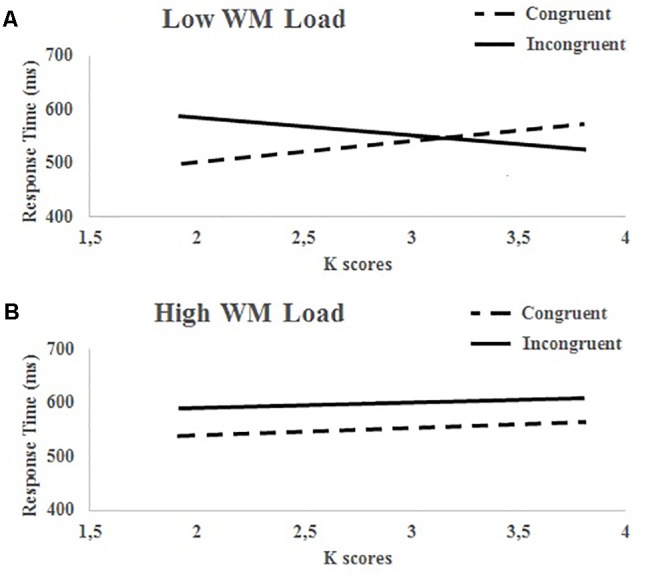
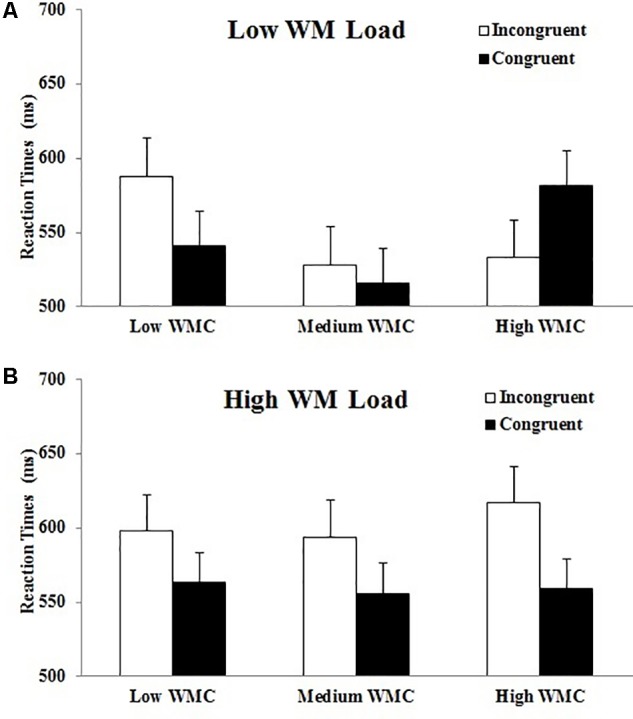
The present research examined whether imposing a high (or low) working memory (WM) load in different types of non-verbal WM tasks could affect the implementation of expectancy-based strategic processes in a sequential verbal Stroop task. Participants had to identify a colored (green vs. red) target patch that was preceded by a prime word (GREEN or RED), which was either incongruent or congruent with the target color on 80% and 20% of the trials, respectively. Previous findings have shown that participants can strategically use this information to predict the upcoming target color, and avoid the standard Stroop interference effect. The Stroop task was combined with different types of non-verbal WM tasks. In Experiment 1, participants had to retain sets of four arrows that pointed either in the same (low WM load) or in different directions (high WM load). In Experiment 2, they had to remember the spatial locations of four dots which either formed a straight line (low load) or were randomly scattered in a square grid (high load). In addition, participants in the two experiments performed a change localization task to assess their WM capacity (WMC). The results in both experiments showed a reliable congruency by WM load interaction. When the Stroop task was performed under a high WM load, participants were unable to efficiently ignore the incongruence of the prime, as they consistently showed a standard Stroop effect, regardless of their WMC. Under a low WM load, however, a strategically dependent effect (reversed Stroop) emerged. This ability to ignore the incongruence of the prime was modulated by WMC, such that the reversed Stroop effect was mainly found in higher WMC participants. The findings that expectancy-based strategies on a verbal Stroop task are modulated by load on different types of spatial WM tasks point at a domain-general effect of WM on strategic processing. The present results also suggest that the impact of loading WM on expectancy-based strategies can be modulated by individual differences in WMC.
本研究考察了在不同类型的非言语工作记忆(WM)任务中施加高(或低)工作记忆负荷是否会影响顺序言语Stroop任务中基于预期的策略过程的实施。参与者必须识别一个彩色(绿色与红色)目标色块,该目标色块之前会出现一个启动词(绿色或红色),在80%和20%的试验中,启动词分别与目标颜色不一致或一致。先前的研究结果表明,参与者可以策略性地利用这些信息来预测即将出现的目标颜色,并避免标准的Stroop干扰效应。Stroop任务与不同类型的非言语WM任务相结合。在实验1中,参与者必须记住四组指向相同方向(低WM负荷)或不同方向(高WM负荷)的箭头。在实验2中,他们必须记住四个点的空间位置,这些点要么形成一条直线(低负荷),要么随机散布在一个方格网中(高负荷)。此外,两个实验中的参与者都执行了一个变化定位任务来评估他们的工作记忆容量(WMC)。两个实验的结果都显示了WM负荷交互作用下可靠的一致性。当在高WM负荷下执行Stroop任务时,参与者无法有效地忽略启动词的不一致性,因为他们始终表现出标准的Stroop效应,无论其WMC如何。然而,在低WM负荷下,出现了一种策略依赖效应(反向Stroop)。这种忽略启动词不一致性的能力受到WMC的调节,使得反向Stroop效应主要出现在WMC较高的参与者中。言语Stroop任务中基于预期的策略受到不同类型空间WM任务负荷调节的研究结果表明,WM对策略加工具有领域一般性影响。目前的结果还表明,WM负荷对基于预期策略的影响可以通过WMC的个体差异来调节。