Via Christopher W, Glukhov Evgenia, Costa Samuel, Zimba Paul V, Moeller Peter D R, Gerwick William H, Bertin Matthew J
Department of Biomedical and Pharmaceutical Sciences, College of Pharmacy, University of Rhode Island, Kingston, RI, United States.
Center for Marine Biotechnology and Biomedicine, Skaggs School of Pharmacy and Pharmaceutical Sciences, Scripps Institution of Oceanography, University of California at San Diego, La Jolla, CA, United States.
Front Chem. 2018 Jul 26;6:316. doi: 10.3389/fchem.2018.00316. eCollection 2018.
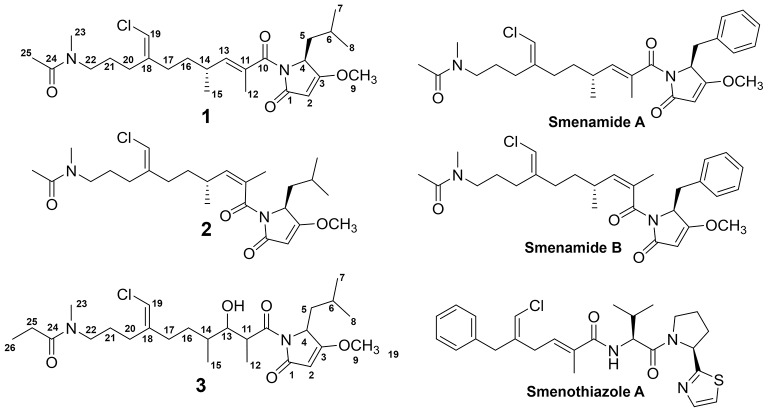
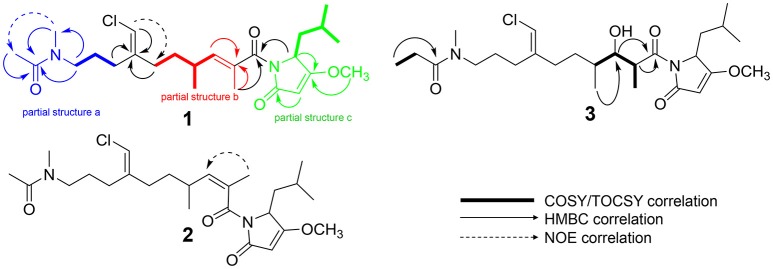
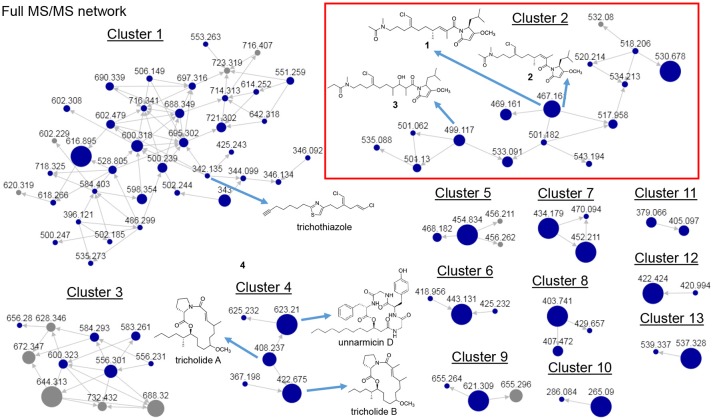
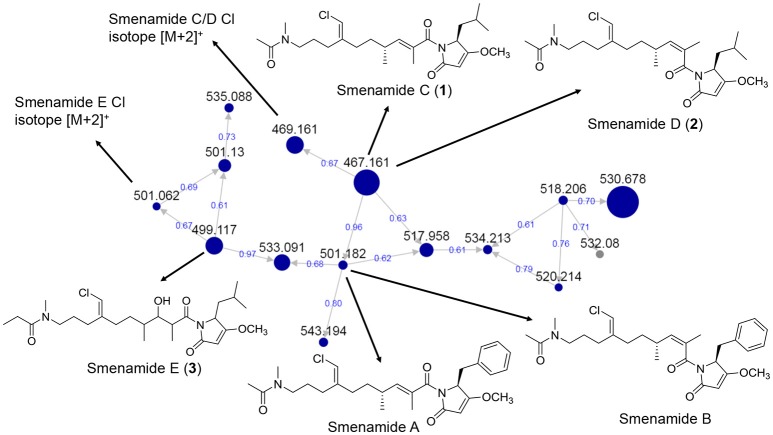
Members of the cyanobacterial genus are well known for their substantial impact on nitrogen influx in ocean ecosystems and the enormous surface blooms they form in tropical and subtropical locations. However, the secondary metabolite composition of these complex environmental bloom events is not well known, nor the possibility of the production of potent toxins that have been observed in other bloom-forming marine and freshwater cyanobacteria species. In the present work, we aimed to characterize the metabolome of a bloom utilizing MS/MS-based molecular networking. Furthermore, we integrated cytotoxicity assays in order to identify and ultimately isolate potential cyanotoxins from the bloom. These efforts led to the isolation and identification of several members of the smenamide family, including three new smenamide analogs () as well as the previously reported smenothiazole A-hybrid polyketide-peptide compounds. Two of these new smenamides possessed cytotoxicity to neuro-2A cells ( and ) and their presence elicits further questions as to their potential ecological roles. HPLC profiling and molecular networking of chromatography fractions from the bloom revealed an elaborate secondary metabolome, generating hypotheses with respect to the environmental role of these metabolites and the consistency of this chemical composition across genera, space and time.
蓝藻属成员因其对海洋生态系统中氮流入的重大影响以及在热带和亚热带地区形成的巨大表面水华而闻名。然而,这些复杂的环境水华事件的次生代谢物组成尚不清楚,在其他形成水华的海洋和淡水蓝藻物种中观察到的产生强效毒素的可能性也不清楚。在本研究中,我们旨在利用基于MS/MS的分子网络对一种水华的代谢组进行表征。此外,我们整合了细胞毒性测定,以便从水华中鉴定并最终分离潜在的蓝藻毒素。这些努力导致了smenamide家族几个成员的分离和鉴定,包括三种新的smenamide类似物()以及先前报道的smenothiazole A-杂合聚酮-肽化合物。其中两种新的smenamides对神经-2A细胞具有细胞毒性(和),它们的存在引发了关于其潜在生态作用的进一步问题。对水华色谱馏分的HPLC分析和分子网络揭示了一个复杂的次生代谢组,产生了关于这些代谢物的环境作用以及这种化学成分在属、空间和时间上的一致性的假设。