Department of Biomedical Sciences, Faculty of Health and Medical Sciences, University of Copenhagen, 2100 Copenhagen, Denmark.
Department of Production, Research, and Innovation, Region Zealand, 4180 Sorø, Denmark.
Nutrients. 2018 Aug 9;10(8):1049. doi: 10.3390/nu10081049.
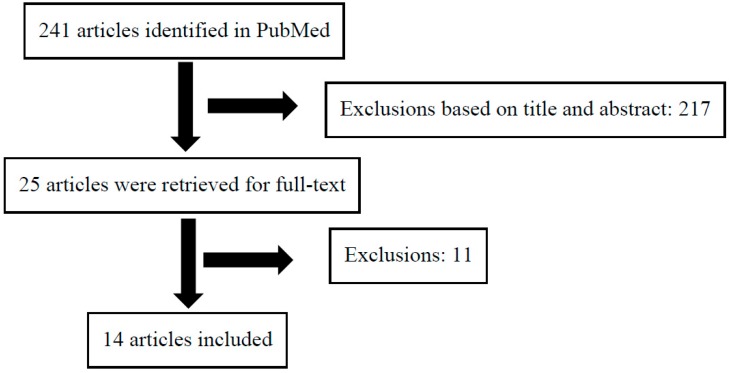
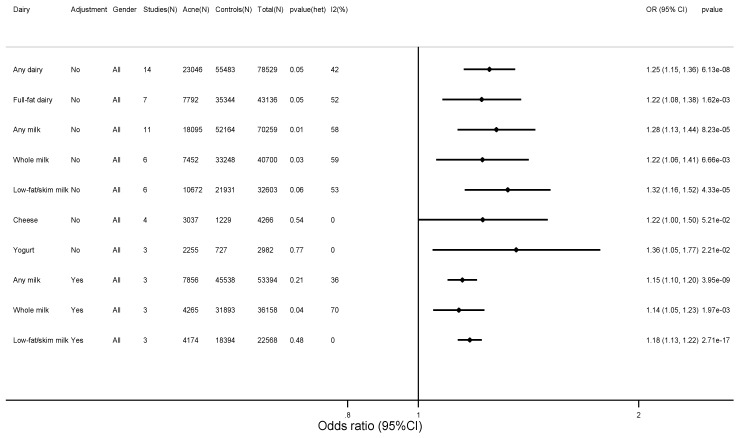
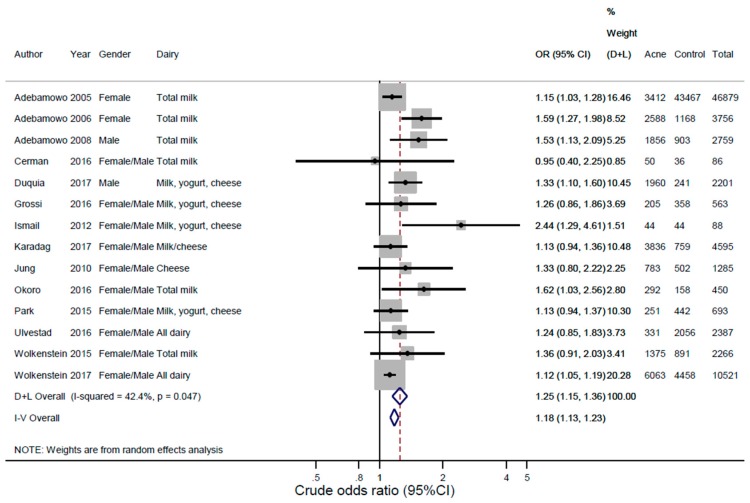
A meta-analysis can help inform the debate about the epidemiological evidence on dairy intake and development of acne. A systematic literature search of PubMed from inception to 11 December 2017 was performed to estimate the association of dairy intake and acne in children, adolescents, and young adults in observational studies. We estimated the pooled random effects odds ratio (OR) (95% CI), heterogeneity (²-statistics, -statistics), and publication bias. We included 14 studies ( = 78,529; 23,046 acne-cases/55,483 controls) aged 7⁻30 years. ORs for acne were 1.25 (95% CI: 1.15⁻1.36; 6.13 × 10) for any dairy, 1.22 (1.08⁻1.38; 1.62 × 10) for full-fat dairy, 1.28 (1.13⁻1.44; 8.23 × 10) for any milk, 1.22 (1.06⁻1.41; 6.66 × 10) for whole milk, 1.32 (1.16⁻1.52; 4.33 × 10) for low-fat/skim milk, 1.22 (1.00⁻1.50; 5.21 × 10) for cheese, and 1.36 (1.05⁻1.77; 2.21 × 10) for yogurt compared to no intake. ORs per frequency of any milk intake were 1.24 (0.95⁻1.62) by 2⁻6 glasses per week, 1.41 (1.05⁻1.90) by 1 glass per day, and 1.43 (1.09⁻1.88) by ≥2 glasses per day compared to intake less than weekly. Adjusted results were attenuated and compared unadjusted. There was publication bias ( 4.71 × 10), and heterogeneity in the meta-analyses were explained by dairy and study characteristics. In conclusion, any dairy, such as milk, yogurt, and cheese, was associated with an increased OR for acne in individuals aged 7⁻30 years. However, results should be interpreted with caution due to heterogeneity and bias across studies.
一项荟萃分析可以帮助了解关于乳制品摄入与痤疮发病的流行病学证据的争论。从创建到 2017 年 12 月 11 日,我们对 PubMed 进行了系统的文献检索,以评估观察性研究中儿童、青少年和年轻人乳制品摄入与痤疮之间的关联。我们估计了乳制品摄入与痤疮的汇总随机效应比值比(OR)(95%CI)、异质性(²统计量,-统计量)和发表偏倚。我们纳入了 14 项研究(=78529 人;23046 例痤疮病例/55483 例对照),年龄为 7⁻30 岁。任何乳制品的 OR 为 1.25(95%CI:1.15⁻1.36;6.13×10),全脂乳制品为 1.22(1.08⁻1.38;1.62×10),任何牛奶为 1.28(1.13⁻1.44;8.23×10),全脂牛奶为 1.22(1.06⁻1.41;6.66×10),低脂/脱脂牛奶为 1.32(1.16⁻1.52;4.33×10),奶酪为 1.22(1.00⁻1.50;5.21×10),酸奶为 1.36(1.05⁻1.77;2.21×10)与不摄入相比。每周摄入任何牛奶 2⁻6 杯的 OR 为 1.24(0.95⁻1.62),每天摄入 1 杯的 OR 为 1.41(1.05⁻1.90),每天摄入≥2 杯的 OR 为 1.43(1.09⁻1.88)与每周摄入少于一次相比。调整后的结果减弱,与未调整的结果相比。存在发表偏倚(4.71×10),荟萃分析中的异质性可由乳制品和研究特征来解释。总之,任何乳制品,如牛奶、酸奶和奶酪,与 7⁻30 岁人群的痤疮发病 OR 增加有关。然而,由于研究之间存在异质性和偏倚,结果应谨慎解释。