School of Health Studies, University of Memphis, Memphis, 106 Roane Fieldhouse, TN 38152, USA.
Department of Kinesiology & Dance, New Mexico State University, Las Cruces, NM 88003, USA.
Nutrients. 2018 Aug 17;10(8):1109. doi: 10.3390/nu10081109.
Humans consuming a purified vegan diet known as the "Daniel Fast" realize favorable changes in blood lipids, oxidative stress, and inflammatory biomarkers, with subjective reports of improved physical capacity.
We sought to determine if this purified vegan diet was synergistic with exercise in male rats.
Long⁻Evans rats ( = 56) were assigned to be exercise trained (+E) by running on a treadmill three days per week at a moderate intensity or to act as sedentary controls with normal activity. After the baseline physical performance was evaluated by recording run time to exhaustion, half of the animals in each group were fed ad libitum for three months a purified diet formulated to mimic the Daniel Fast (DF) or a Western Diet (WD). Physical performance was evaluated again at the end of month 3, and body composition was assessed using dual-energy x-ray absorptiometry. Blood was collected for measurements of lipids, oxidative stress, and inflammatory biomarkers.
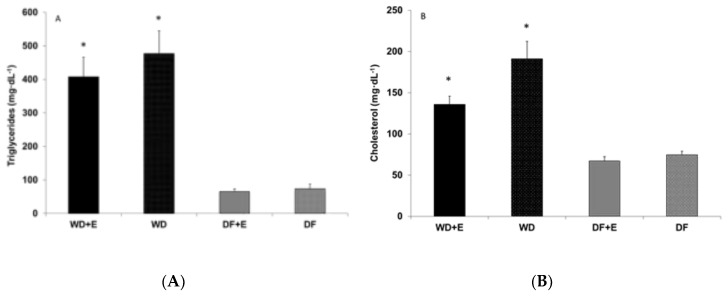
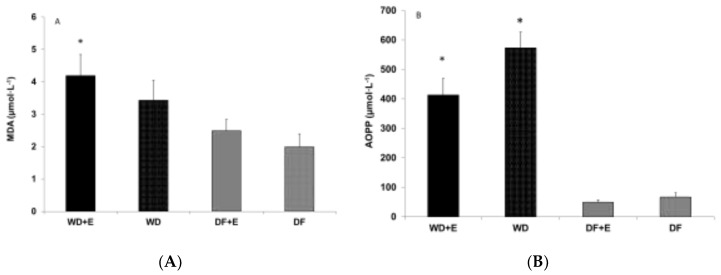
Physical performance at the end of month 3 was higher compared to baseline for both exercise groups ( < 0.05), with a greater percent increase in the DF + E group (99%) than in the WD + E group (51%). Body fat was lower in DF than in WD groups at the end of month 3 ( < 0.05). Blood triglycerides, cholesterol, malondialdehyde, and advanced oxidation protein products were significantly lower in the DF groups than in the WD groups ( < 0.05). No significant differences were noted in cytokines levels between the groups ( > 0.05), although IL-1β and IL-10 were elevated three-fold and two-fold in the rats fed the WD compared to the DF rats, respectively.
Compared to a WD, a purified diet that mimics the vegan Daniel Fast provides significant anthropometric and metabolic benefits to rats, while possibly acting synergistically with exercise training to improve physical performance. These findings highlight the importance of macronutrient composition and quality in the presence of ad libitum food intake.
食用一种名为“丹尼尔禁食”的纯净素食的人会发现血液脂质、氧化应激和炎症生物标志物发生有利变化,同时主观报告身体机能得到改善。
我们试图确定这种纯净素食是否与雄性大鼠的运动具有协同作用。
长爪沙鼠(n=56)被分为运动训练组(+E),每周在跑步机上运动三天,运动强度适中,或作为对照组,正常活动。在基线体力表现通过记录力竭跑步时间进行评估后,每组一半的动物被喂食三个月的纯净饮食,该饮食模仿了丹尼尔禁食(DF)或西方饮食(WD)。在第 3 个月结束时再次评估体力表现,并使用双能 X 射线吸收仪评估身体成分。收集血液以测量脂质、氧化应激和炎症生物标志物。
与基线相比,第 3 个月结束时两组的体力表现都有所提高(<0.05),DF+E 组的提高幅度(99%)大于 WD+E 组(51%)。与 WD 组相比,第 3 个月结束时 DF 组的体脂含量较低(<0.05)。DF 组的血液甘油三酯、胆固醇、丙二醛和晚期氧化蛋白产物明显低于 WD 组(<0.05)。两组之间的细胞因子水平没有显著差异(>0.05),尽管与 DF 组相比,WD 组的大鼠血液中 IL-1β和 IL-10 分别升高了三倍和两倍。
与 WD 相比,模仿纯素食的丹尼尔禁食饮食为大鼠提供了显著的人体测量和代谢益处,同时可能与运动训练协同作用,提高体力表现。这些发现强调了在自由进食的情况下,宏量营养素组成和质量的重要性。