Unit of Epidemiology and Medical Statistics, Department of Diagnostics and Public Health, University of Verona, Verona, Italy.
Department of Public Health and Pediatrics, University of Turin, Turin, Italy.
PLoS One. 2018 Aug 22;13(8):e0201881. doi: 10.1371/journal.pone.0201881. eCollection 2018.
Tobacco consumption is the largest avoidable health risk. Understanding changes of smoking over time and across populations is crucial to implementing health policies. We evaluated trends in smoking initiation between 1970 and 2009 in random samples of European populations.
We pooled data from six multicentre studies involved in the Ageing Lungs in European Cohorts consortium, including overall 119,104 subjects from 17 countries (range of median ages across studies: 33-52 years). We estimated retrospectively trends in the rates of smoking initiation (uptake of regular smoking) by age group, and tested birth cohort effects using Age-Period-Cohort (APC) modelling. We stratified all analyses by sex and region (North, East, South, West Europe).
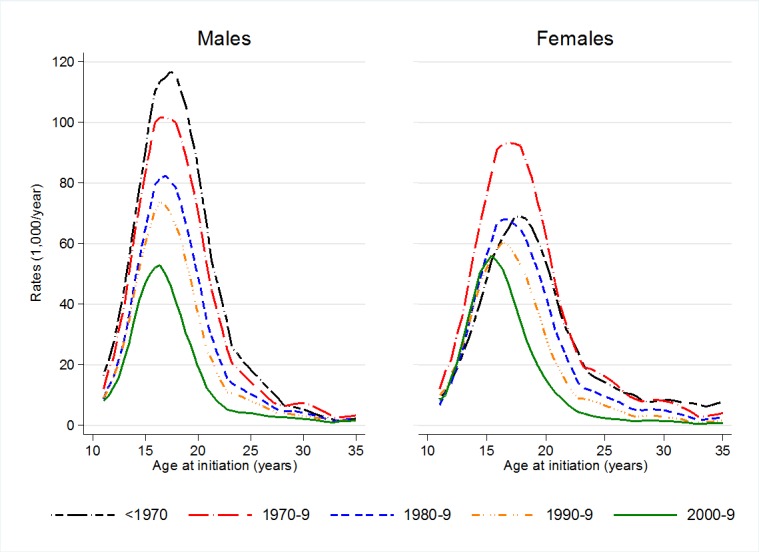
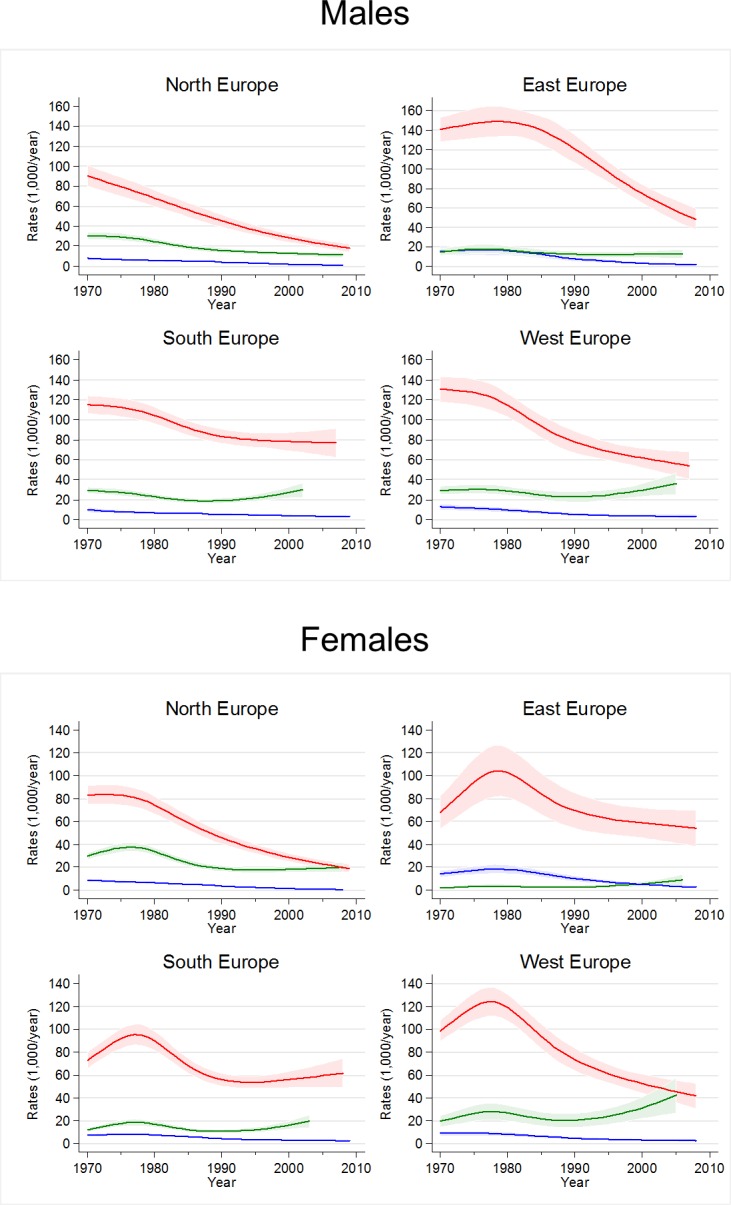
Smoking initiation during late adolescence (16-20 years) declined for both sexes and in all regions (except for South Europe, where decline levelled off after 1990). By the late 2000s, rates of initiation during late adolescence were still high (40-80 per 1000/year) in East, South, and West Europe compared to North Europe (20 per 1000/year). Smoking initiation rates during early adolescence (11-15 years) showed a marked increase after 1990 in all regions (except for North European males) but especially in West Europe, where they reached 40 per 1000/year around 2005. APC models supported birth cohort effects in the youngest cohorts.
Smoking initiation is still unacceptably high among European adolescents, and increasing rates among those aged 15 or less deserve attention. Reducing initiation in adolescents is fundamental, since youngsters are particularly vulnerable to nicotine addiction and tobacco adverse effects.
吸烟是最大的可避免健康风险。了解吸烟在时间和人群中的变化对于实施卫生政策至关重要。我们评估了 1970 年至 2009 年间欧洲人群中吸烟开始的趋势。
我们汇总了参与欧洲队列老龄化肺部研究的六个多中心研究的数据,包括来自 17 个国家的 119104 名受试者(各研究的中位年龄范围:33-52 岁)。我们回顾性地估计了按年龄组划分的吸烟开始率(常规吸烟的使用率)趋势,并使用年龄-时期-队列(APC)模型检验了出生队列的影响。我们对所有分析按性别和地区(北欧、东欧、南欧、西欧)进行分层。
青少年晚期(16-20 岁)的吸烟开始率下降,所有性别和地区都下降(南欧除外,1990 年后下降趋于平稳)。到 2000 年代后期,与北欧相比,东欧、南欧和西欧的青少年晚期吸烟开始率仍然很高(40-80/1000/年)。1990 年后,所有地区(北欧男性除外)的青少年早期(11-15 岁)的吸烟开始率都有明显增加,但在西欧尤为明显,到 2005 年左右达到 40/1000/年。APC 模型支持最年轻队列中的出生队列效应。
欧洲青少年的吸烟开始率仍然高得令人无法接受,尤其是 15 岁以下人群的吸烟率不断上升,值得关注。减少青少年吸烟是至关重要的,因为年轻人特别容易受到尼古丁成瘾和烟草不良影响的影响。