Coenen Ashley R, Weitz Joshua S
School of Physics, Georgia Institute of Technology, Atlanta, Georgia, USA.
School of Biological Sciences, Georgia Institute of Technology, Atlanta, Georgia, USA.
mSystems. 2018 Aug 28;3(4). doi: 10.1128/mSystems.00084-18. eCollection 2018 Jul-Aug.
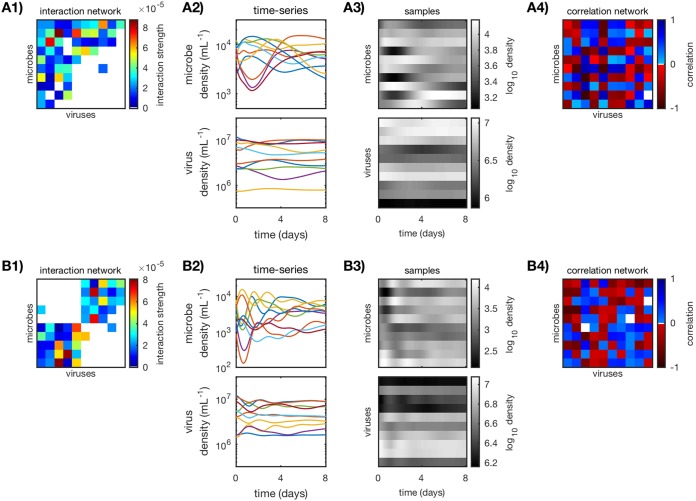
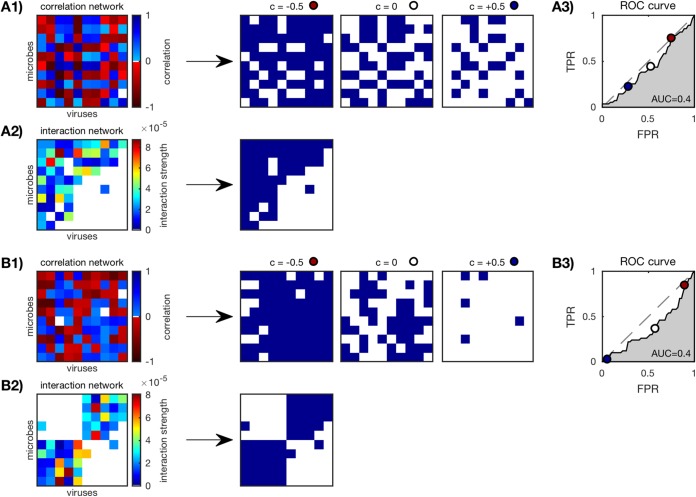
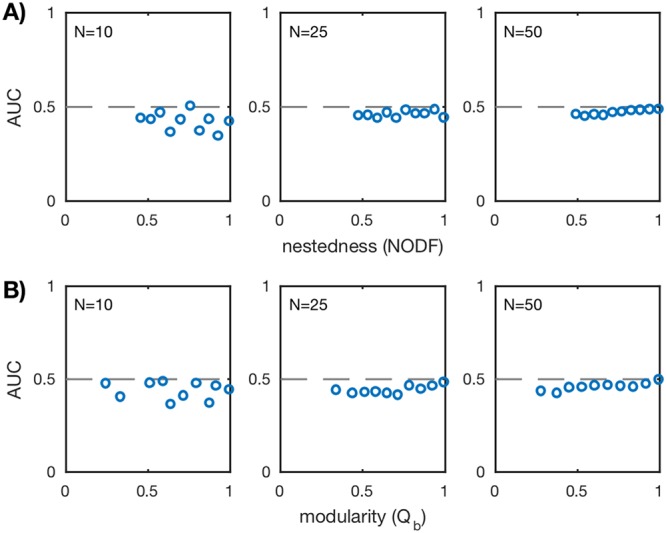
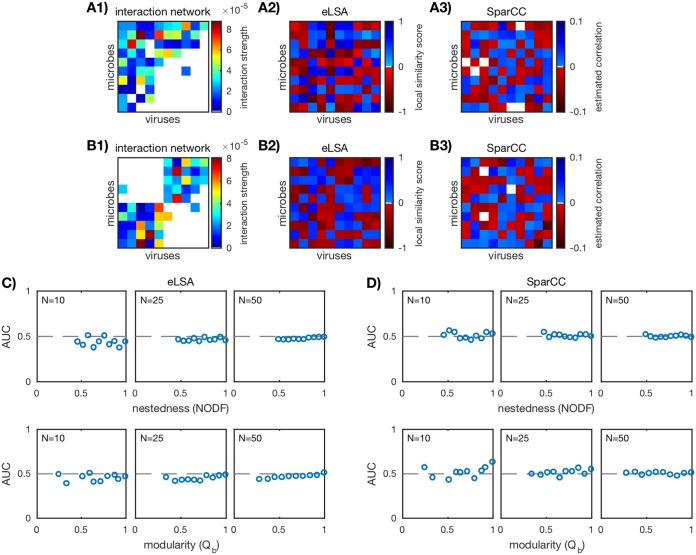
Microbes are present in high abundances in the environment and in human-associated microbiomes, often exceeding 1 million per ml. Viruses of microbes are present in even higher abundances and are important in shaping microbial populations, communities, and ecosystems. Given the relative specificity of viral infection, it is essential to identify the functional linkages between viruses and their microbial hosts, particularly given dynamic changes in virus and host abundances. Multiple approaches have been proposed to infer infection networks from time series of communities, among which correlation-based approaches have emerged as the standard. In this work, we evaluate the accuracy of correlation-based inference methods using an approach. In doing so, we compare predicted networks to actual networks to assess the self-consistency of correlation-based inference. At odds with assumptions underlying its widespread use, we find that correlation is a poor predictor of interactions in the context of viral infection and lysis of microbial hosts. The failure to predict interactions holds for methods that leverage product-moment, time-lagged, and relative-abundance-based correlations. In closing, we discuss alternative inference methods, particularly model-based methods, as a means to infer interactions in complex microbial communities with viruses. Inferring interactions from population time series is an active and ongoing area of research. It is relevant across many biological systems-particularly in virus-microbe communities, but also in gene regulatory networks, neural networks, and ecological communities broadly. Correlation-based inference-using correlations to predict interactions-is widespread. However, it is well-known that "correlation does not imply causation." Despite this, many studies apply correlation-based inference methods to experimental time series without first assessing the potential scope for accurate inference. Here, we find that several correlation-based inference methods fail to recover interactions within virus-microbe communities, raising questions on their relevance when applied .
微生物在环境和与人类相关的微生物群落中大量存在,通常每毫升超过100万个。微生物病毒的丰度甚至更高,并且在塑造微生物种群、群落和生态系统方面起着重要作用。鉴于病毒感染的相对特异性,确定病毒与其微生物宿主之间的功能联系至关重要,特别是考虑到病毒和宿主丰度的动态变化。已经提出了多种方法来从群落时间序列推断感染网络,其中基于相关性的方法已成为标准方法。在这项工作中,我们使用一种方法评估基于相关性的推断方法的准确性。在此过程中,我们将预测网络与实际网络进行比较,以评估基于相关性的推断的自洽性。与广泛使用所基于的假设不同,我们发现相关性在病毒感染和微生物宿主裂解的背景下是相互作用的较差预测指标。对于利用乘积矩、时间滞后和基于相对丰度的相关性的方法,无法预测相互作用。最后,我们讨论了替代推断方法,特别是基于模型的方法,作为推断复杂微生物群落中病毒相互作用的一种手段。从种群时间序列推断相互作用是一个活跃且正在进行的研究领域。它在许多生物系统中都具有相关性——特别是在病毒-微生物群落中,但在基因调控网络、神经网络和广义的生态群落中也如此。基于相关性的推断——利用相关性来预测相互作用——很普遍。然而,众所周知,“相关性并不意味着因果关系”。尽管如此,许多研究在没有首先评估准确推断的潜在范围的情况下,就将基于相关性的推断方法应用于实验时间序列。在这里,我们发现几种基于相关性的推断方法无法恢复病毒-微生物群落内的相互作用,这引发了对其应用相关性的质疑。