Institute for Mummy Studies, EURAC Research, Viale Druso 1, 39100 Bolzano, Italy.
Max Planck Institute for the Science of Human History, Kahlaische Strasse 10, 07745 Jena, Germany.
Sci Adv. 2018 Sep 5;4(9):eaao1262. doi: 10.1126/sciadv.aao1262. eCollection 2018 Sep.
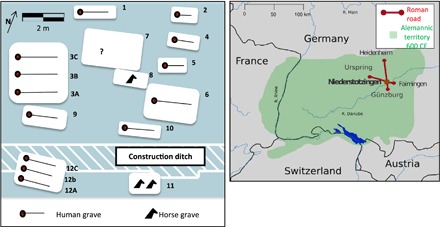
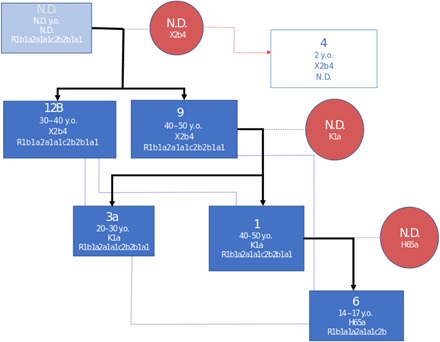
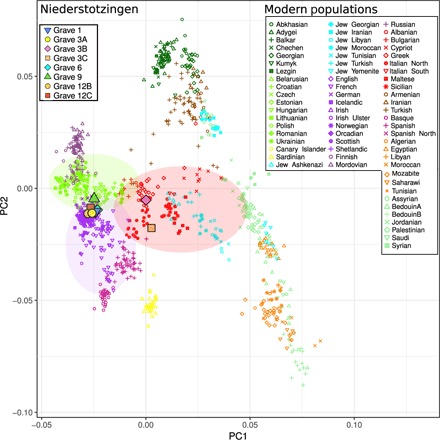
From historical and archeological records, it is posited that the European medieval household was a combination of close relatives and recruits. However, this kinship structure has not yet been directly tested at a genomic level on medieval burials. The early 7th century CE burial at Niederstotzingen, discovered in 1962, is the most complete and richest example of Alemannic funerary practice in Germany. Excavations found 13 individuals who were buried with an array of inscribed bridle gear, jewelry, armor, and swords. These artifacts support the view that the individuals had contact with France, northern Italy, and Byzantium. This study analyzed genome-wide sequences recovered from the remains, in tandem with analysis of the archeological context, to reconstruct kinship and the extent of outside contact. Eleven individuals had sufficient DNA preservation to genetically sex them as male and identify nine unique mitochondrial haplotypes and two distinct Y chromosome lineages. Genome-wide analyses were performed on eight individuals to estimate genetic affiliation to modern west Eurasians and genetic kinship at the burial. Five individuals were direct relatives. Three other individuals were not detectably related; two of these showed genomic affinity to southern Europeans. The genetic makeup of the individuals shares no observable pattern with their orientation in the burial or the cultural association of their grave goods, with the five related individuals buried with grave goods associated with three diverse cultural origins. These findings support the idea that not only were kinship and fellowship held in equal regard: Diverse cultural appropriation was practiced among closely related individuals as well.
从历史和考古记录来看,欧洲中世纪的家庭是由近亲与招募者组成的混合体。然而,这种亲属结构尚未在中世纪墓葬的基因组水平上得到直接验证。1962 年发现的公元 7 世纪早期的尼德施托青根(Niederstotzingen)墓葬是德国阿勒曼尼人丧葬习俗最完整、最丰富的范例。发掘出的 13 具遗骸随葬有一系列刻字马具、珠宝、盔甲和剑,这些文物表明墓主人与法国、意大利北部和拜占庭有过接触。本研究从遗骸中提取了全基因组序列,并结合考古背景分析,以重建亲属关系和外部接触程度。11 具遗骸的 DNA 保存状况足以对其进行性别鉴定(均为男性),并鉴定出 9 个独特的线粒体单倍型和 2 个不同的 Y 染色体谱系。对 8 具遗骸进行了全基因组分析,以评估其与现代欧亚西部人群的遗传关联和墓葬中的遗传亲属关系。其中 5 人是直接亲属,另外 3 人没有明显的亲缘关系,其中 2 人具有与南欧人相似的基因组亲和力。这些个体的基因构成与他们在墓葬中的方位或随葬品的文化关联没有明显的关系,5 名有亲属关系的个体与来自 3 个不同文化起源的随葬品一同下葬。这些发现支持了以下观点,即不仅亲属关系和友谊受到同等重视,而且在密切相关的个体中也存在着多样化的文化认同。