Nakić Radoš Sandra, Tadinac Meri, Herman Radoslav
Department of Psychology, Catholic University of Croatia, Zagreb, Croatia.
Department of Psychology, Faculty of Humanities and Social Sciences, University of Zagreb, Zagreb, Croatia.
Acta Clin Croat. 2018 Mar;57(1):39-51. doi: 10.20471/acc.2017.56.04.05.
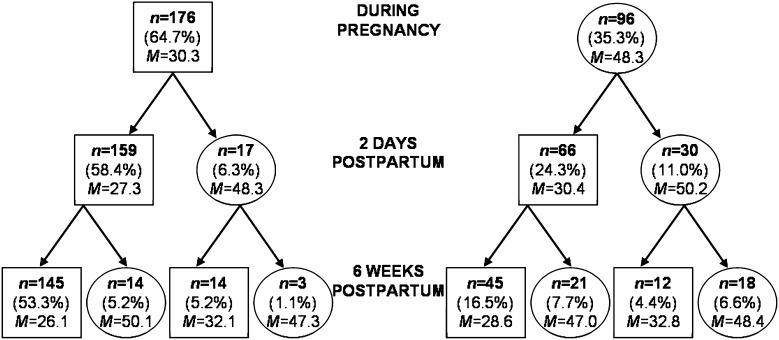
Previous findings on peripartum anxiety are inconsistent in respect to the prevalence and course of peripartum anxiety with comorbidity of depression. Our aim was threefold: (1) to examine the course of elevated anxiety during pregnancy, immediately after childbirth, and six weeks postpartum; (2) to establish comorbidity of postpartum anxiety and postpartum depression (PPD); and (3) to examine predictors of anxiety 6 weeks postpartum. A sample of women (N=272) who were below the cut-off score for clinical depression during pregnancy were assessed in the third trimester of pregnancy, then 2 days and 6 weeks postpartum. Questionnaires on anxiety, pregnancy specific distress, stress, coping styles, social support, and depression were administered at each assessment. Obstetric data were collected from the participants' medical records. The estimated rate of high anxiety was 35% during pregnancy, 17% immediately after childbirth, and 20% six weeks postpartum, showing a decrease in anxiety levels after childbirth. Comorbidity of anxiety and PPD was 75%. Trait anxiety and early postpartum state anxiety are significant predictors of postpartum anxiety. Anxiety is a common peripartum psychological disturbance. Anxiety symptoms overlap with PPD, but not com-pletely, indicating that screening for postpartum mental difficulties should include both depression and anxiety.
先前关于围产期焦虑的研究结果在围产期焦虑的患病率、病程以及与抑郁症共病方面并不一致。我们的目标有三个:(1)研究孕期、产后即刻以及产后六周焦虑水平升高的病程;(2)确定产后焦虑与产后抑郁症(PPD)的共病情况;(3)研究产后六周焦虑的预测因素。对孕期临床抑郁筛查分数低于临界值的女性样本(N = 272)在妊娠晚期、产后2天和产后6周进行评估。每次评估时均发放关于焦虑、孕期特定困扰、压力、应对方式、社会支持和抑郁的问卷。从参与者的病历中收集产科数据。孕期高焦虑估计发生率为35%,产后即刻为17%,产后六周为20%,表明产后焦虑水平有所下降。焦虑与PPD的共病率为75%。特质焦虑和产后早期状态焦虑是产后焦虑的重要预测因素。焦虑是一种常见的围产期心理障碍。焦虑症状与PPD有重叠,但并不完全重叠,这表明产后心理问题筛查应同时包括抑郁和焦虑。