Research School of Population Health, The Australian National University, Canberra, Australia.
School of Business, University of Queensland, Brisbane, Australia.
PLoS Negl Trop Dis. 2018 Oct 11;12(10):e0006857. doi: 10.1371/journal.pntd.0006857. eCollection 2018 Oct.
Leptospirosis is a zoonotic disease responsible for over 1 million severe cases and 60,000 deaths annually. The wide range of animal hosts and complex environmental drivers of transmission make targeted interventions challenging, particularly when restricted to regression-based analyses which have limited ability to deal with complexity. In Fiji, important environmental and socio-demographic factors include living in rural areas, poverty, and livestock exposure. This study aims to examine drivers of transmission under different scenarios of environmental and livestock exposures.
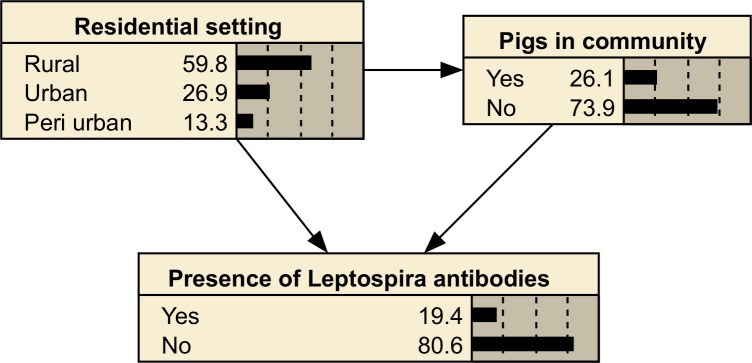
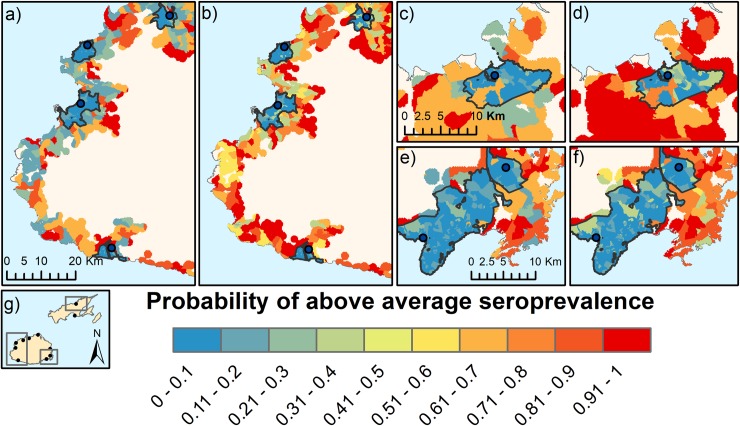
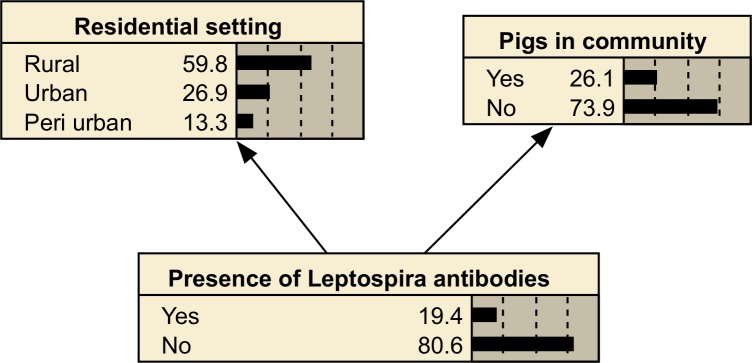
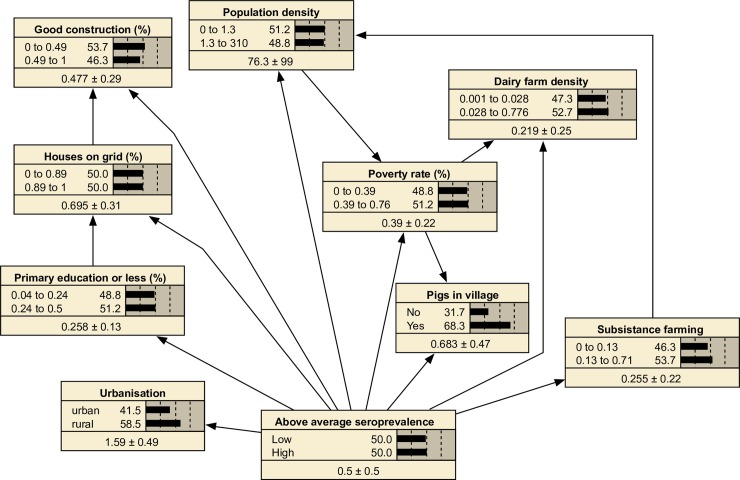
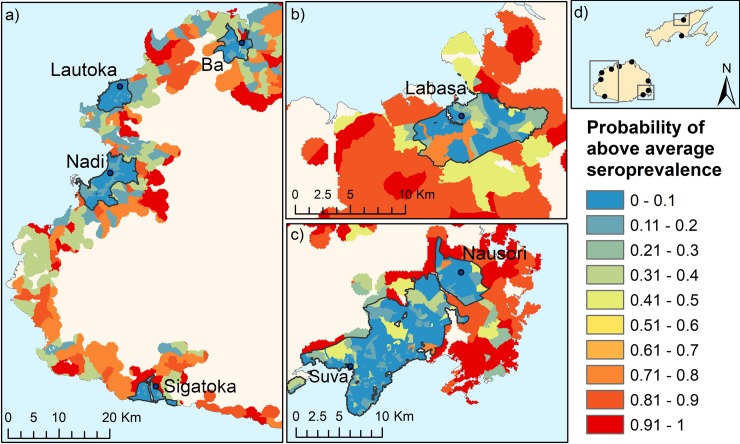
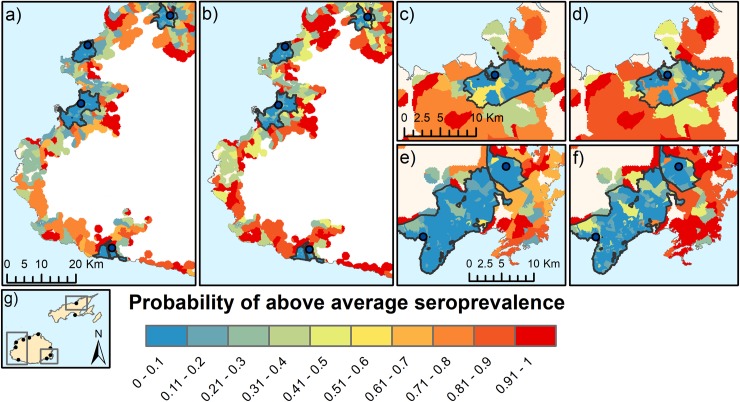
Spatial Bayesian networks (SBN) were used to analyse the influence of livestock and poverty on the risk of leptospirosis infection in urban compared to rural areas. The SBN models used a combination of spatially-explicit field data from previous work and publically available census information. Predictive risk maps were produced for overall risk, and for scenarios related to poverty, livestock, and urban/rural setting.
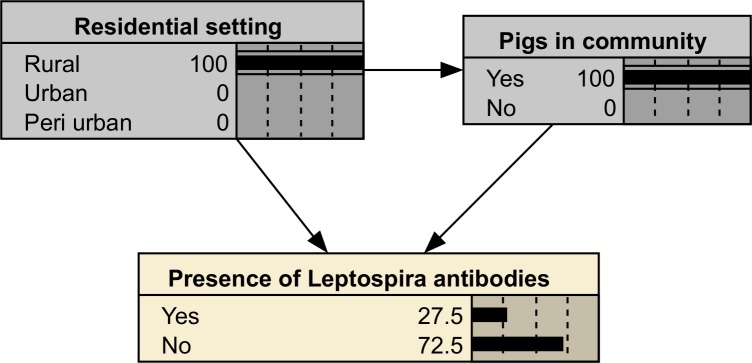
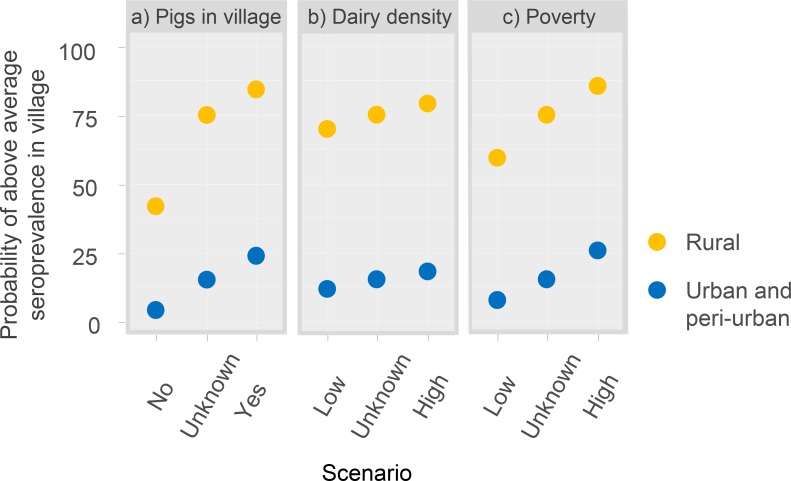
While high, rather than low, commercial dairy farm density similarly increased the risk of infection in both urban (12% to 18%) and rural areas (70% to 79%), the presence of pigs in a village had different impact in rural (43% to 84%) compared with urban areas (4% to 24%). Areas with high poverty rates were predicted to have 26.6% and 18.0% higher probability of above average seroprevalence in rural and urban areas, respectively. In urban areas, this represents >300% difference between areas of low and high poverty, compared to 43% difference in rural areas.
Our study demonstrates the use of SBN to provide valuable insights into the drivers of leptospirosis transmission under complex scenarios. By estimating the risk of leptospirosis infection under different scenarios, such as urban versus rural areas, these subgroups or areas can be targeted with more precise interventions that focus on the most relevant key drivers of infection.
钩端螺旋体病是一种人畜共患疾病,每年导致超过 100 万例严重病例和 6 万人死亡。动物宿主范围广泛,以及传播的复杂环境驱动因素使得有针对性的干预措施具有挑战性,特别是当仅限于基于回归的分析时,这些分析方法处理复杂性的能力有限。在斐济,重要的环境和社会人口因素包括居住在农村地区、贫困和牲畜接触。本研究旨在检查在不同的环境和牲畜暴露情景下的传播驱动因素。
空间贝叶斯网络(SBN)用于分析牲畜和贫困对城市地区与农村地区钩端螺旋体病感染风险的影响。SBN 模型使用了以前工作的空间显式现场数据和公开的人口普查信息的组合。为总体风险以及与贫困、牲畜和城乡环境相关的情景制作了预测风险图。
虽然高而不是低的商业奶牛场密度同样增加了城市(12%至 18%)和农村地区(70%至 79%)的感染风险,但村庄中存在猪对农村地区(43%至 84%)的影响与城市地区(4%至 24%)不同。高贫困率地区预计农村和城市地区的平均血清阳性率分别高出 26.6%和 18.0%。在城市地区,这代表了低贫困地区和高贫困地区之间差异的 300%以上,而农村地区的差异为 43%。
我们的研究表明,SBN 可用于在复杂情况下提供有关钩端螺旋体病传播驱动因素的有价值的见解。通过在不同情景下(例如城市与农村地区)估计钩端螺旋体病感染的风险,可以针对这些亚组或地区进行更精确的干预,重点关注感染的最相关关键驱动因素。