Department of Chemistry , University of Wisconsin-Madison , Madison , Wisconsin 53706 , United States.
J Proteome Res. 2019 Jan 4;18(1):349-358. doi: 10.1021/acs.jproteome.8b00651. Epub 2018 Oct 31.
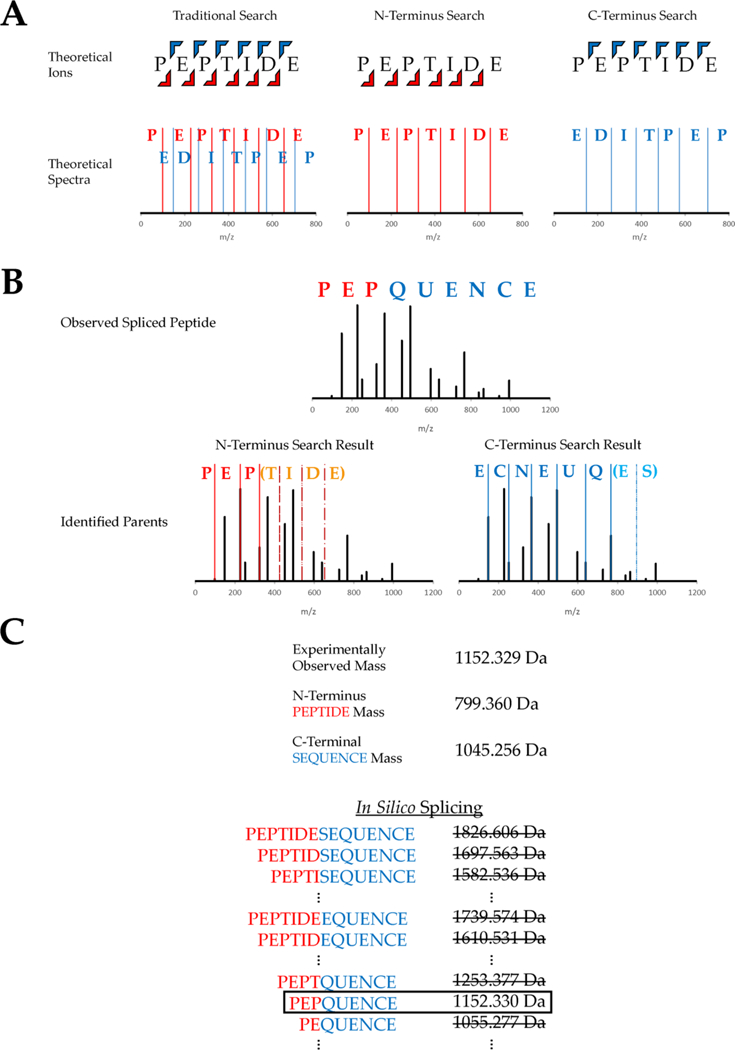
Post-translationally spliced peptides have recently garnered significant interest as potential targets for cancer immunotherapy and as contributors to autoimmune diseases such as type 1 diabetes, yet feasible identification methods for spliced peptides have yet to be developed. Here we present Neo-Fusion, a search program for discovering spliced peptides in tandem mass spectrometry data. Neo-Fusion utilizes two separated ion database searches to identify the two halves of each spliced peptide, and then it infers the full spliced sequence. This strategy allows for the identification of spliced peptides without peptide length constraints, providing a broadly applicable tool suitable for identification of spliced peptides in a variety of systems, such as the HLA-I and HLA-II immunopeptidomes and in vitro digested protein samples obtained from organelles, cells, or tissues of interest. Using simulated spliced peptides to benchmark Neo-Fusion, 25% of all simulated spliced peptides were identified at a measured false-discovery rate of 5% for HLA-I. Neo-Fusion provides the research community with a powerful new tool to aid in the study of the prevalence and biological significance of post-translationally spliced peptides.
最近,经过翻译后剪接的肽引起了人们的极大兴趣,它们可能成为癌症免疫治疗的潜在靶点,并可能导致 1 型糖尿病等自身免疫性疾病,但可行的剪接肽鉴定方法尚未开发。在这里,我们介绍了 Neo-Fusion,这是一种用于在串联质谱数据中发现剪接肽的搜索程序。Neo-Fusion 利用两个独立的离子数据库搜索来识别每个剪接肽的两半,然后推断出完整的剪接序列。该策略允许在没有肽长度限制的情况下鉴定剪接肽,提供了一种广泛适用的工具,适用于鉴定各种系统中的剪接肽,如 HLA-I 和 HLA-II 免疫肽组以及从感兴趣的细胞器、细胞或组织中体外消化的蛋白质样品。使用模拟剪接肽对 Neo-Fusion 进行基准测试,在 HLA-I 的测量假发现率为 5%的情况下,所有模拟剪接肽中有 25%被鉴定出来。Neo-Fusion 为研究界提供了一个强大的新工具,以帮助研究翻译后剪接肽的普遍性和生物学意义。