Oxford Martin Programme on the Future of Food, University of Oxford, Oxford, United Kingdom.
Centre on Population Approaches for Non-Communicable Disease Prevention, Nuffield Department of Population Health, University of Oxford, Oxford, United Kingdom.
PLoS One. 2018 Nov 6;13(11):e0204139. doi: 10.1371/journal.pone.0204139. eCollection 2018.
The consumption of red and processed meat has been associated with increased mortality from chronic diseases, and as a result, it has been classified by the World Health Organization as carcinogenic (processed meat) and probably carcinogenic (red meat) to humans. One policy response is to regulate red and processed meat consumption similar to other carcinogens and foods of public health concerns. Here we describe a market-based approach of taxing red and processed meat according to its health impacts.
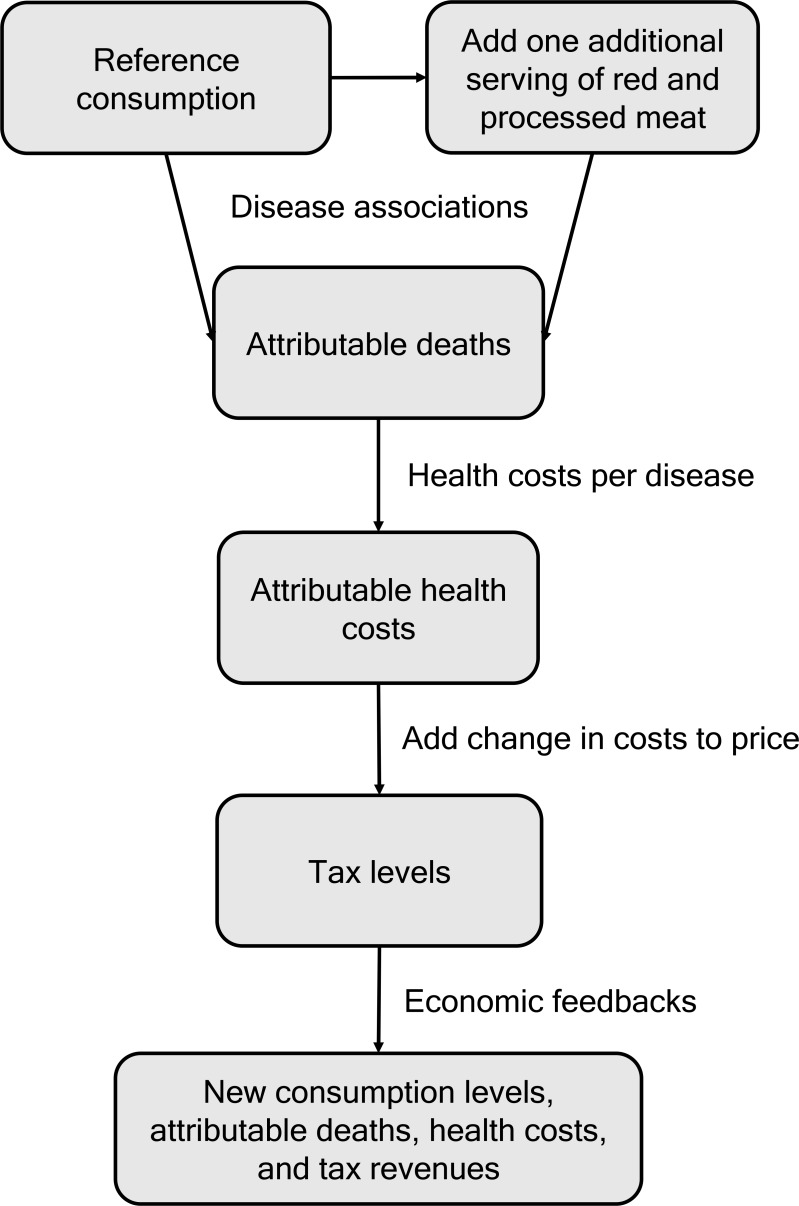
We calculated economically optimal tax levels for 149 world regions that would account for (internalize) the health costs associated with ill-health from red and processed meat consumption, and we used a coupled modelling framework to estimate the impacts of optimal taxation on consumption, health costs, and non-communicable disease mortality. Health impacts were estimated using a global comparative risk assessment framework, and economic responses were estimated using international data on health costs, prices, and price elasticities.
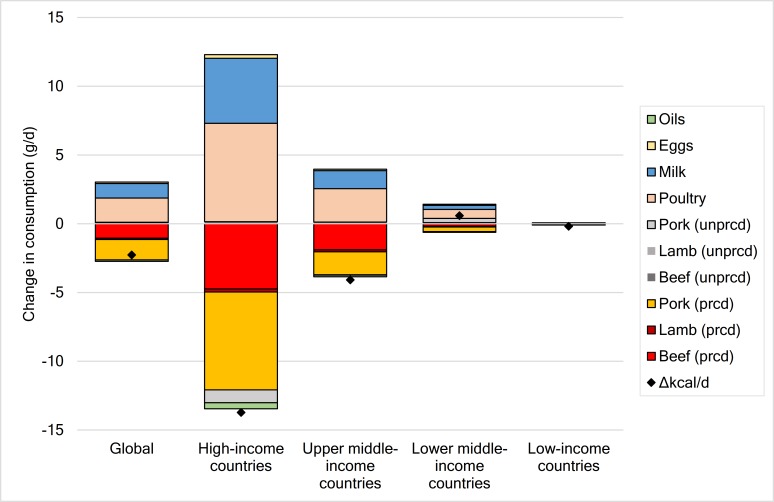
The health-related costs to society attributable to red and processed meat consumption in 2020 amounted to USD 285 billion (sensitivity intervals based on epidemiological uncertainty (SI), 93-431), three quarters of which were due to processed meat consumption. Under optimal taxation, prices for processed meat increased by 25% on average, ranging from 1% in low-income countries to over 100% in high-income countries, and prices for red meat increased by 4%, ranging from 0.2% to over 20%. Consumption of processed meat decreased by 16% on average, ranging from 1% to 25%, whilst red meat consumption remained stable as substitution for processed meat compensated price-related reductions. The number of deaths attributable to red and processed meat consumption decreased by 9% (222,000; SI, 38,000-357,000), and attributable health costs decreased by 14% (USD 41 billion; SI, 10-57) globally, in each case with greatest reductions in high and middle-income countries.
Including the social health cost of red and processed meat consumption in the price of red and processed meat could lead to significant health and environmental benefits, in particular in high and middle-income countries. The optimal tax levels estimated in this study are context-specific and can complement the simple rules of thumb currently used for setting health-motivated tax levels.
食用红色肉类和加工肉类与慢性病死亡率的增加有关,因此,世界卫生组织已将其归类为对人类致癌(加工肉类)和可能致癌(红色肉类)。应对政策之一是对红色肉类和加工肉类的消费进行类似于其他致癌物和公众健康关注食品的监管。在这里,我们描述了一种根据其健康影响对红色肉类和加工肉类征税的基于市场的方法。
我们计算了 149 个世界区域的经济最优税收水平,这些水平将考虑到与食用红色肉类和加工肉类导致的健康不良相关的健康成本,并使用耦合模型框架来估计最优税收对消费、健康成本和非传染性疾病死亡率的影响。健康影响是使用全球比较风险评估框架来估计的,而经济反应是使用国际健康成本、价格和价格弹性数据来估计的。
2020 年,社会因食用红色肉类和加工肉类而产生的相关健康成本为 2850 亿美元(基于流行病学不确定性的敏感区间(SI),93-431),其中四分之三归因于加工肉类的消费。在最优税收下,加工肉类的价格平均上涨 25%,范围从低收入国家的 1%到高收入国家的 100%以上,而红色肉类的价格上涨 4%,范围从 0.2%到 20%以上。加工肉类的消费平均下降 16%,范围从 1%到 25%,而红色肉类的消费保持稳定,因为对加工肉类的价格相关减少进行了替代。归因于红色肉类和加工肉类消费的死亡人数减少了 9%(222,000;SI,38,000-357,000),归因于红色肉类和加工肉类消费的健康成本减少了 14%(410 亿美元;SI,10-57),在高收入和中等收入国家中,情况最为显著。
将红色肉类和加工肉类的社会健康成本纳入红色肉类和加工肉类的价格中,可能会带来重大的健康和环境效益,特别是在高收入和中等收入国家。本研究中估计的最优税率是具体情况的具体情况,可以补充目前用于设定健康动机税收水平的简单经验法则。