Heo SunJin, Kim Hyun-Joo, Joo Ji-Young, Lee Juyoun, Kim Sung-Jo, Choi Jeomil
Department of Periodontology, Pusan National University Dental Hospital, Dental Research Institute, Yangsan, Korea.
Department of Periodontology, Pusan National University School of Dentistry, Yangsan, Korea.
J Periodontal Implant Sci. 2018 Oct 29;48(5):326-333. doi: 10.5051/jpis.2018.48.5.326. eCollection 2018 Oct.
The present study investigated the outcomes of a newly-developed, simple, and practical nonsurgical treatment modality suitable for most forms of intrabony defects around failing dental implants using intrasulcular delivery of chlorhexidine solution and minocycline hydrochloride (HCl).
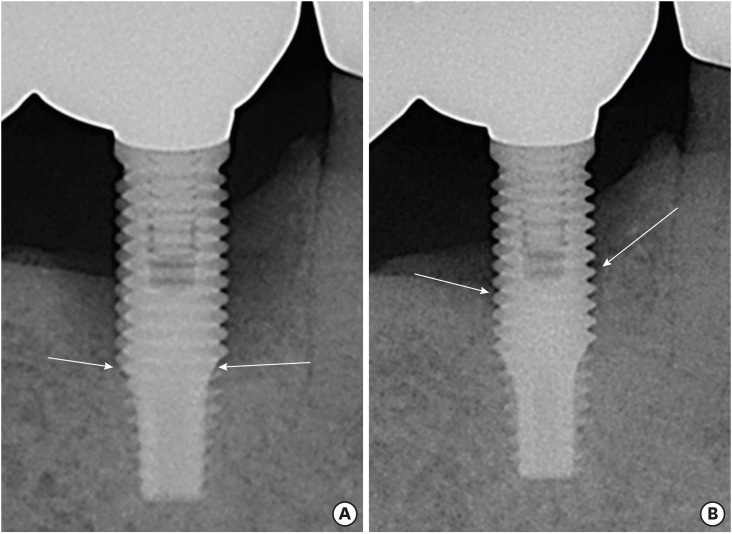
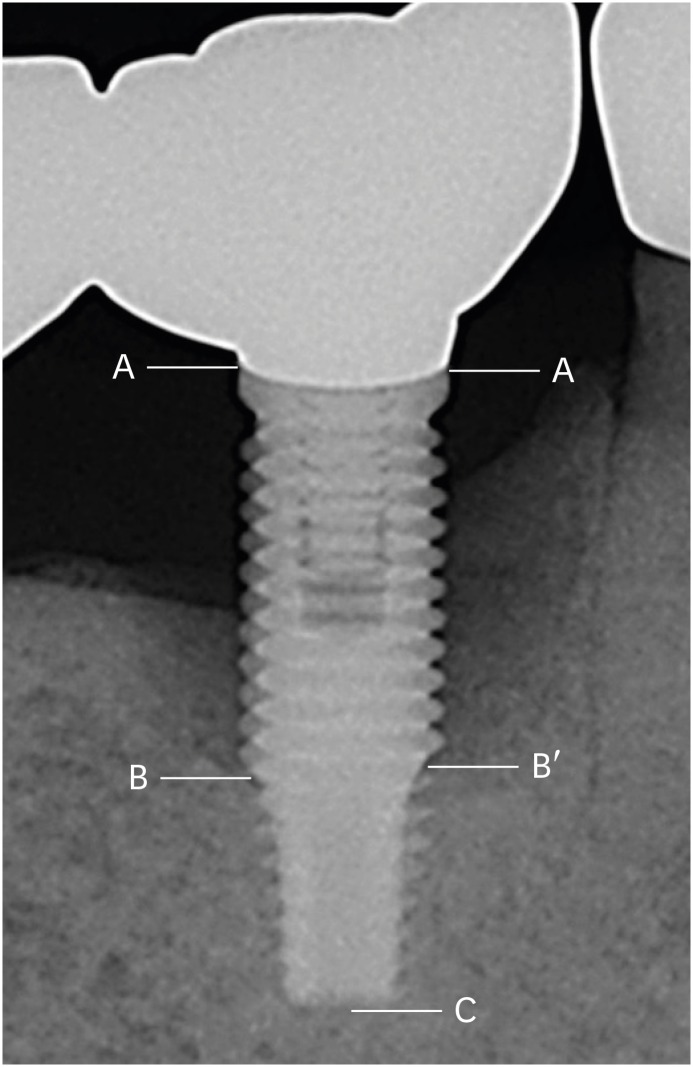
Forty-five dental implants in 20 patients diagnosed with peri-implantitis were included. At baseline and the study endpoint, the probing pocket depth (PPD), clinical attachment level (CAL), and the presence of bleeding on probing (BOP) at 6 sites around each implant were recorded. The radiographic osseous defect morphology at the mesial or distal proximal aspect of each implant was classified as 1) narrow or wide and 2) shallow or deep. For a comparative analysis of bone changes according to the defect morphology, the distance from the implant shoulder to the most coronal bone-to-implant contact point (DIB) at the mesial and distal aspects of each implant was measured at baseline and the endpoint. Patients were scheduled to visit the clinic every 2-4 weeks for intrasulcular irrigation of chlorhexidine and delivery of minocycline HCl.
We observed statistically significant decreases in PPD, CAL, and BOP after treatment. At the endpoint, bone levels increased in all defects, regardless of the osseous morphology of the intrabony defect. The mean DIB change in deep defects was significantly greater than that in shallow defects. Although the mean bone gain in narrow defects was greater than in wide defects, the difference was not statistically significant.
We propose that significant and sustainable improvements in both clinical and radiographic parameters can be expected when intrabony defects around dental implants are managed through a simple nonsurgical approach involving combined intrasulcular chlorhexidine irrigation and local delivery of minocycline HCl.
本研究探讨一种新开发的、简单实用的非手术治疗方式的效果,该方式适用于大多数围绕失败牙种植体的骨内缺损,采用龈沟内递送洗必泰溶液和盐酸米诺环素。
纳入20例诊断为种植体周围炎患者的45颗牙种植体。在基线和研究终点,记录每个种植体周围6个位点的探诊袋深度(PPD)、临床附着水平(CAL)以及探诊出血(BOP)情况。将每个种植体近中或远中近中面的影像学骨缺损形态分为1)窄或宽和2)浅或深。为了根据缺损形态对骨变化进行比较分析,在基线和终点测量每个种植体近中及远中面从种植体肩部到最冠方骨与种植体接触点的距离(DIB)。患者每2 - 4周安排到诊所进行龈沟内洗必泰冲洗和盐酸米诺环素递送。
治疗后我们观察到PPD、CAL和BOP有统计学意义的下降。在终点时,所有缺损的骨水平均升高,无论骨内缺损的骨质形态如何。深缺损的平均DIB变化显著大于浅缺损。虽然窄缺损的平均骨增量大于宽缺损,但差异无统计学意义。
我们提出,当通过一种简单的非手术方法管理牙种植体周围的骨内缺损时,包括联合龈沟内洗必泰冲洗和局部递送盐酸米诺环素,可以预期临床和影像学参数会有显著且可持续的改善。