Hiester Brian G, Becker Matthew I, Bowen Aaron B, Schwartz Samantha L, Kennedy Matthew J
Department of Pharmacology, University of Colorado School of Medicine, Aurora, CO, United States.
Department of Physiology and Biophysics, University of Colorado School of Medicine, Aurora, CO, United States.
Front Cell Neurosci. 2018 Oct 30;12:391. doi: 10.3389/fncel.2018.00391. eCollection 2018.
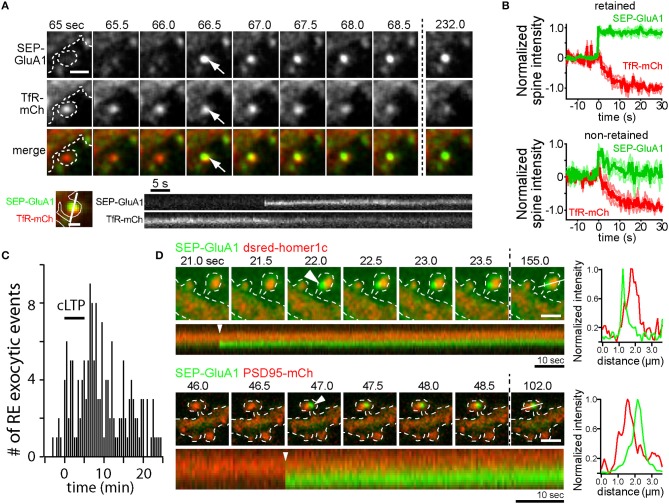
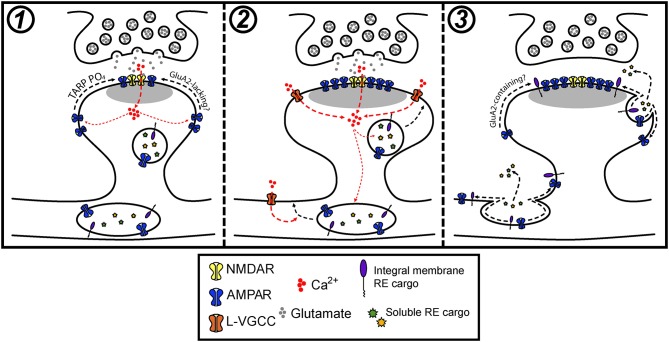
Long-term potentiation (LTP) of excitatory synapses is a major form of plasticity for learning and memory in the central nervous system. While the molecular mechanisms of LTP have been debated for decades, there is consensus that LTP induction activates membrane trafficking pathways within dendrites that are essential for synapse growth and strengthening. Current models suggest that key molecules for synaptic potentiation are sequestered within intracellular organelles, which are mobilized by synaptic activity to fuse with the plasma membrane following LTP induction. While the identity of the factors mobilized to the plasma membrane during LTP remain obscure, the field has narrowly focused on AMPA-type glutamate receptors. Here, we review recent literature and present new experimental data from our lab investigating whether AMPA receptors trafficked from intracellular organelles directly contribute to synaptic strengthening during LTP. We propose a modified model where membrane trafficking delivers distinct factors that are required to maintain synapse growth and AMPA receptor incorporation following LTP. Finally, we pose several fundamental questions that may guide further inquiry into the role of membrane trafficking for synaptic plasticity.
兴奋性突触的长时程增强(LTP)是中枢神经系统学习和记忆可塑性的主要形式。尽管LTP的分子机制已争论了数十年,但人们普遍认为,LTP诱导会激活树突内的膜运输途径,这对突触的生长和增强至关重要。目前的模型表明,突触增强的关键分子被隔离在细胞内细胞器中,在LTP诱导后,这些分子会被突触活动动员起来与质膜融合。虽然在LTP期间被动员到质膜的因子的身份仍不清楚,但该领域一直狭义地聚焦于AMPA型谷氨酸受体。在这里,我们回顾了最近的文献,并展示了我们实验室的新实验数据,这些数据研究了从细胞内细胞器运输来的AMPA受体是否在LTP期间直接促进突触增强。我们提出了一个修改后的模型,即膜运输会传递维持LTP后突触生长和AMPA受体整合所需的不同因子。最后,我们提出了几个基本问题,这些问题可能会指导对膜运输在突触可塑性中的作用进行进一步探究。