Epidemiology Unit, Faculty of Medicine, Prince of Songkla University, Hat Yai, Songkhla, Thailand.
Kunming Medical University, Kunming, Yunnan Province, China.
BMC Public Health. 2018 Nov 20;18(1):1272. doi: 10.1186/s12889-018-6205-z.
Alcohol and drug use and other health-risk behaviors tend to cluster together among adolescents and contribute a large amount of harm to both themselves and to others. This paper aims to characterize secondary school students based on their clusters of health-risk behaviors and identify factors determining class membership to these behavior-clusters.
Data from a national school survey was used to identify clusters of alcohol and drug use and other health-risk behaviors among secondary school students aged 12-15 years using a latent class regression model. A multinomial logistic regression model was used to identify predictors of the cluster membership.
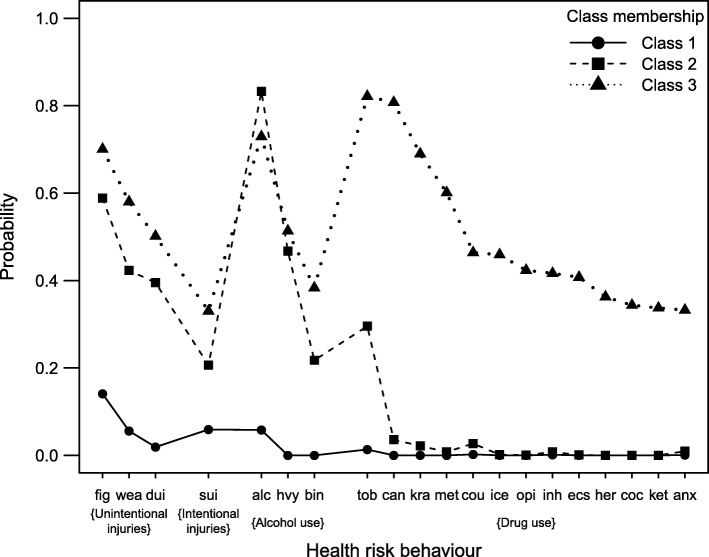
A total of 25,566 students were included in the analysis, of which 88% were classified as having low-risk behaviors reporting only moderate alcohol use; 11% as having moderate-risk behaviors, such as driving under the influence of alcohol, fighting, carrying a weapon, and alcohol and tobacco use; and 0.6% as having high-risk behaviors, such as use of illicit drugs, particularly kratom and cannabis. Males, older students, those with a poor school performance, not living with parents, drug use by family members and peers, and having a low level of perceived disdain from their friends if they used drugs were significant risk factors for being in the moderate- and high-risk behavior classes.
Alcohol, tobacco and drug use, as well as other health-risk behaviors such as fighting, are clustered in Thai secondary school students. This result highlights the importance of comprehensive prevention and education strategies, particularly for moderate to high-risk groups.
青少年的饮酒、吸毒和其他健康风险行为往往集中出现,对自身和他人造成大量伤害。本文旨在根据健康风险行为聚类对中学生进行特征描述,并确定决定这些行为聚类的因素。
使用潜在类别回归模型,利用全国性学校调查数据,对 12-15 岁中学生的饮酒和吸毒及其他健康风险行为进行聚类分析。使用多项逻辑回归模型确定聚类成员的预测因素。
共纳入 25566 名学生,其中 88%被归类为低风险行为,仅报告中度饮酒;11%为中度风险行为,如酒后驾车、打架、携带武器以及烟酒使用;0.6%为高风险行为,如使用非法药物,特别是冰毒和大麻。男性、年龄较大的学生、学业成绩较差的学生、与父母同住的学生、家庭成员和同伴的药物使用以及如果他们使用药物会被朋友轻视的程度较低,这些都是处于中高危行为类别的显著风险因素。
在泰国中学生中,酒精、烟草和药物使用以及其他健康风险行为(如打架)是集中出现的。这一结果强调了综合预防和教育策略的重要性,特别是针对中高危群体。