Malafeev Alexander, Laptev Dmitry, Bauer Stefan, Omlin Ximena, Wierzbicka Aleksandra, Wichniak Adam, Jernajczyk Wojciech, Riener Robert, Buhmann Joachim, Achermann Peter
Chronobiology and Sleep Research, Institute of Pharmacology and Toxicology, University of Zurich, Zurich, Switzerland.
Neuroscience Center Zurich, University of Zurich and ETH Zurich, Zurich, Switzerland.
Front Neurosci. 2018 Nov 6;12:781. doi: 10.3389/fnins.2018.00781. eCollection 2018.
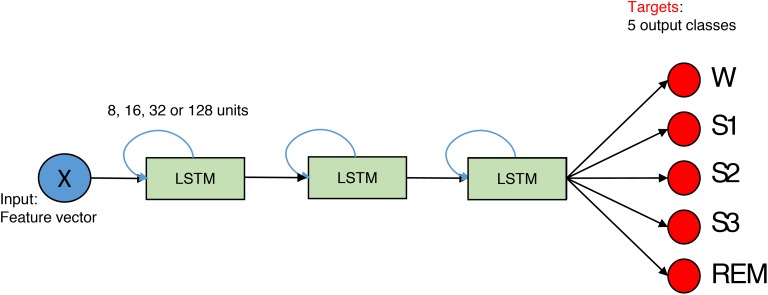
The classification of sleep stages is the first and an important step in the quantitative analysis of polysomnographic recordings. Sleep stage scoring relies heavily on visual pattern recognition by a human expert and is time consuming and subjective. Thus, there is a need for automatic classification. In this work we developed machine learning algorithms for sleep classification: random forest (RF) classification based on features and artificial neural networks (ANNs) working both with features and raw data. We tested our methods in healthy subjects and in patients. Most algorithms yielded good results comparable to human interrater agreement. Our study revealed that deep neural networks (DNNs) working with raw data performed better than feature-based methods. We also demonstrated that taking the local temporal structure of sleep into account a priori is important. Our results demonstrate the utility of neural network architectures for the classification of sleep.
睡眠阶段分类是多导睡眠图记录定量分析的首要且重要的一步。睡眠阶段评分严重依赖人类专家的视觉模式识别,既耗时又主观。因此,需要进行自动分类。在这项工作中,我们开发了用于睡眠分类的机器学习算法:基于特征的随机森林(RF)分类以及同时使用特征和原始数据的人工神经网络(ANN)。我们在健康受试者和患者中测试了我们的方法。大多数算法产生的结果与人类评分者间的一致性相当。我们的研究表明,处理原始数据的深度神经网络(DNN)比基于特征的方法表现更好。我们还证明了先验地考虑睡眠的局部时间结构很重要。我们的结果证明了神经网络架构在睡眠分类中的实用性。