Department of Epidemiology and Health Statistics, School of Public Health, Capital Medical University, Beijing, China.
Beijing Municipal Key Laboratory of Clinical Epidemiology, Capital Medical University, Beijing, China.
Environ Health. 2018 Nov 26;17(1):82. doi: 10.1186/s12940-018-0429-3.
Evidence focused on exposure to ambient carbon monoxide (CO) and the risk of hospitalizations for cardiovascular diseases (CVD) is lacking in developing countries. This study aimed to examine the effect of CO exposure on hospitalizations for CVD in Beijing, China.
A total of 460,938 hospitalizations for cardiovascular diseases were obtained from electronic hospitalization summary reports from 2013 to 2017. A time-stratified case-crossover design was conducted to investigate the association between CO exposure and hospitalizations for total and cause-specific CVD, including coronary heart disease (CHD), atrial fibrillation (AF), and heart failure (HF). Stratified analysis was also conducted by age group (18-64 years and ≥ 65 years) and sex.
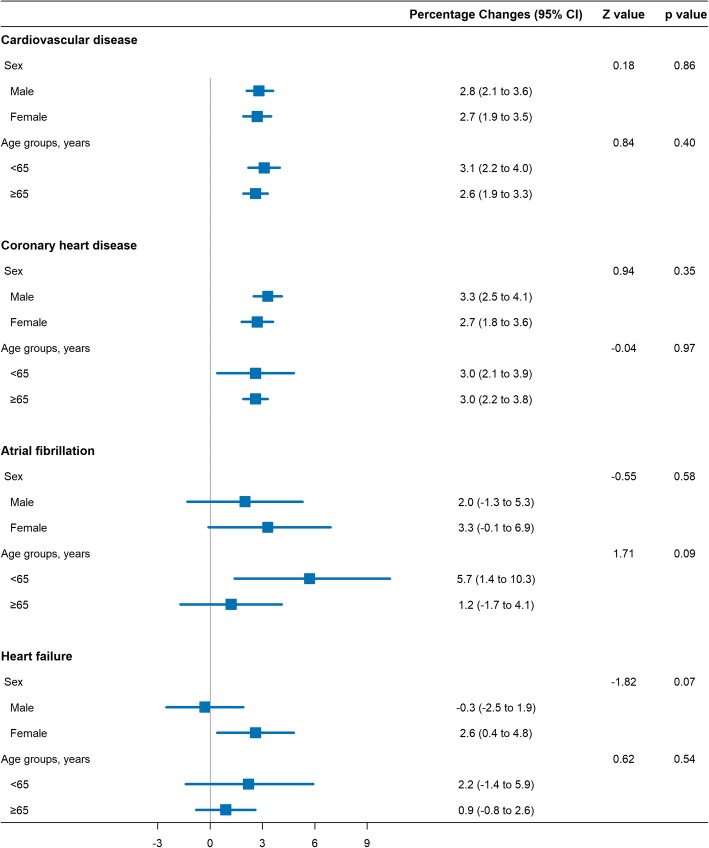
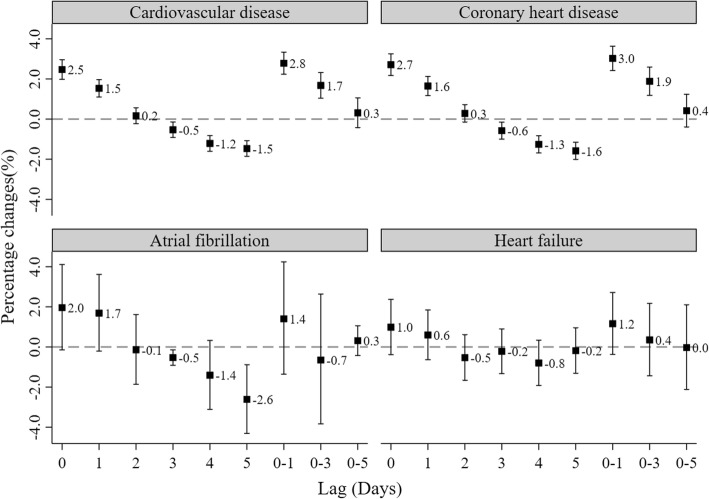
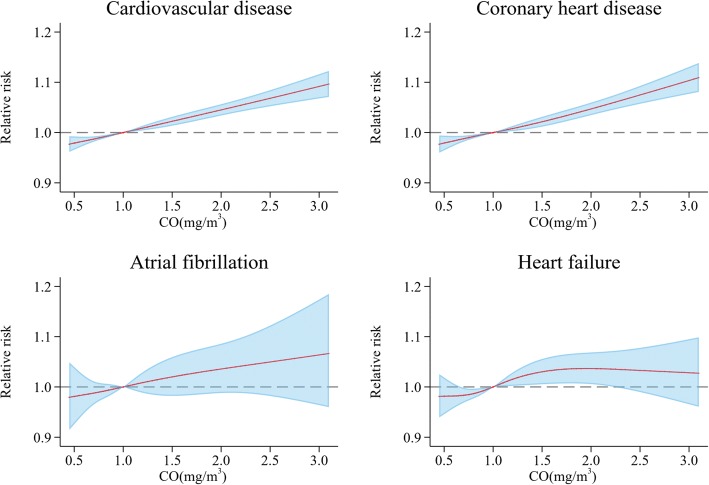
Linear exposure-response curves for the association between ambient CO exposure and hospitalizations for CVD was observed. Ambient CO was positively associated with hospitalizations for total CVD and CHD. However, the observed increased risk was not statistically significant for hospitalizations for AF and HF. The strongest effect of CO concentration was observed on the current- and previous-day of exposure (lag day). For a 1 mg/m increase in a 2-day moving average CO concentration, an increase of 2.8% [95% confidence interval (CI): 2.2 to 3.3%] and 3.0% (95% CI: 2.4 to 3.6%) in daily hospital admissions for CVD and CHD were estimated, respectively. This association was robust after adjusting for other copollutants and did not vary by age group and sex.
Ambient CO exposure increased the risk of hospitalizations for CVD, especially for CHD in Beijing. Further studies are warranted to explore the association between ambient CO and hospitalizations for AF and HF.
缺乏有关环境一氧化碳(CO)暴露与心血管疾病(CVD)住院风险的证据,尤其是在发展中国家。本研究旨在探讨 CO 暴露对中国北京 CVD 住院的影响。
本研究从 2013 年至 2017 年的电子住院摘要报告中获得了 460938 例心血管疾病住院病例。采用时间分层病例交叉设计,调查 CO 暴露与 CVD 总住院和病因特异性住院(包括冠心病、心房颤动和心力衰竭)之间的关联。还按年龄组(18-64 岁和≥65 岁)和性别进行分层分析。
观察到环境 CO 暴露与 CVD 住院之间呈线性暴露反应关系。环境 CO 与总 CVD 和冠心病住院呈正相关。然而,对于心房颤动和心力衰竭住院,观察到的风险增加没有统计学意义。CO 浓度的最强效应发生在暴露的当前日和前一日(滞后日)。对于 2 天移动平均 CO 浓度增加 1mg/m,估计 CVD 和冠心病的每日住院人数分别增加 2.8%(95%置信区间:2.2-3.3%)和 3.0%(95%置信区间:2.4-3.6%)。在调整其他共污染物后,该关联仍然稳健,且不受年龄组和性别影响。
环境 CO 暴露增加了 CVD 住院的风险,尤其是北京的冠心病住院风险。需要进一步研究来探讨环境 CO 与心房颤动和心力衰竭住院之间的关系。