Püttmann Sophie, Koch Janina, Steinacker Jochen Paul, Schmidt Stefan Andreas, Seufferlein Thomas, Kratzer Wolfgang, Schmidberger Julian, Manfras Burkhard
Department of Internal Medicine I, University Hospital Ulm, Albert-Einstein-Allee 23, 89081, Ulm, Germany.
Department of Diagnostic and Interventional Radiology, University Hospital Ulm, Albert-Einstein-Allee 23, 89081, Ulm, Germany.
BMC Med Imaging. 2018 Dec 13;18(1):52. doi: 10.1186/s12880-018-0295-z.
The aims of this study were to establish shear wave elastography of the pancreas by comparing measurements in patients with type 1 diabetes (T1D) and healthy volunteers and to consider whether this method could contribute to the screening or prevention of T1D.
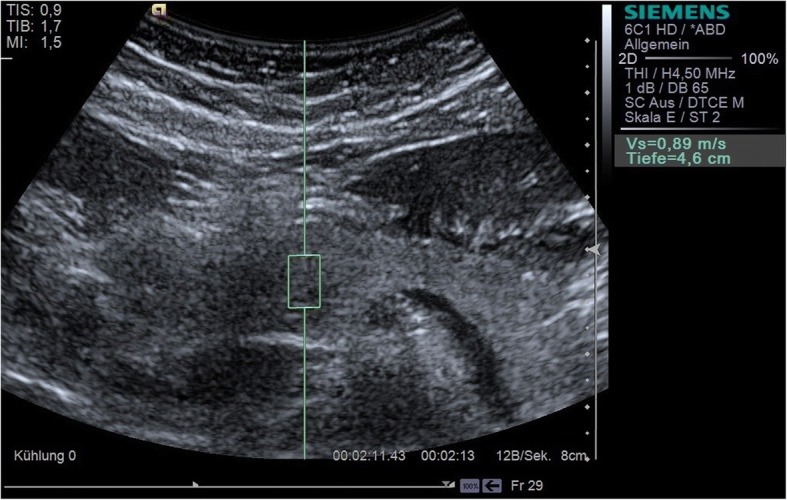
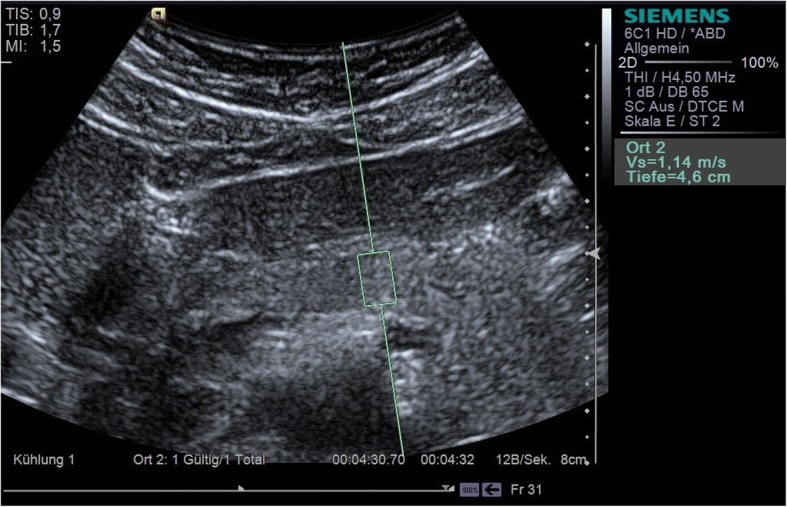
This pilot study included 15 patients with T1D (10 men, 5 women) and 15 healthy volunteers (10 men, 5 women) as controls. Measurements were performed with a Siemens Acuson S3000 (Siemens Healthcare, Erlangen, Germany) using a 6C1 convex transducer and the Virtual Touch™ tissue quantification (VTQ) method.
The mean shear wave velocity of the head of the pancreas was 1.0 ± 0.2 m/s (median: 1.1 m/s) for the study group and likewise 1.0 ± 0.2 m/s (median: 0.9 m/s) for the control group. Velocities of 1.2 ± 0.2 m/s (median: 1.2 m/s) were measured in the body of the pancreas in both groups. There was a significant difference between the values obtained in the tail of the pancreas: patients 1.1 ± 0.1 m/s (median: 1.0 m/s) versus controls 0.9 ± 0.1 m/s (median: 0.8 m/s) (p = 0.0474). The mean value in the whole pancreas of the study group was not significantly above that of the control group: 1.1 ± 0.1 m/s (median: 1.0 m/s) versus 1.0 ± 0.1 m/s (median: 1.0 m/s) (p = 0.2453).
Sonoelastography of the pancreas revealed no overall difference between patients with T1D and healthy volunteers. Patients with T1D showed higher values only in the tail segment. Future studies need to determine whether specific regional differences can be found in a larger study population.
本研究的目的是通过比较1型糖尿病(T1D)患者和健康志愿者的测量结果来建立胰腺的剪切波弹性成像,并考虑该方法是否有助于T1D的筛查或预防。
这项初步研究纳入了15例T1D患者(10例男性,5例女性)和15名健康志愿者(10例男性,5例女性)作为对照。使用西门子Acuson S3000(德国埃尔兰根西门子医疗公司),通过6C1凸阵探头和虚拟触诊组织定量(VTQ)方法进行测量。
研究组胰腺头部的平均剪切波速度为1.0±0.2 m/s(中位数:1.1 m/s),对照组同样为1.0±0.2 m/s(中位数:0.9 m/s)。两组胰腺体部的测量速度均为1.2±0.2 m/s(中位数:1.2 m/s)。胰腺尾部获得的值存在显著差异:患者为1.1±0.1 m/s(中位数:1.0 m/s),而对照组为0.9±0.1 m/s(中位数:0.8 m/s)(p = 0.0474)。研究组整个胰腺的平均值并未显著高于对照组:1.1±0.1 m/s(中位数:1.0 m/s)对1.0±0.1 m/s(中位数:1.0 m/s)(p = 0.2453)。
胰腺的超声弹性成像显示T1D患者与健康志愿者之间无总体差异。T1D患者仅在尾部节段显示出较高的值。未来的研究需要确定在更大的研究人群中是否能发现特定的区域差异。