Shi Si-Ya, Wang Liqin, Peng Zhenpeng, Wang Yangdi, Lin Zhi, Hu Xuefang, Yuan Jiaxin, Huang Li, Feng Shi-Ting, Luo Yanji
Department of Radiology, The First Affiliated Hospital, Sun Yat-sen University, Guangzhou, Guangdong, P. R. China.
Gastroenterol Rep (Oxf). 2022 Jul 29;10:goac033. doi: 10.1093/gastro/goac033. eCollection 2022.
Patients with chronic pancreatitis often have irreversible pancreatic insufficiency before a clinical diagnosis. Pancreatic cancer is a fatal malignant tumor in the advanced stages. Patients having high risk of pancreatic diseases must be screened early to obtain better outcomes using new imaging modalities. Therefore, this study aimed to investigate the reproducibility of tomoelastography measurements for assessing pancreatic stiffness and fluidity and the variance among healthy volunteers.
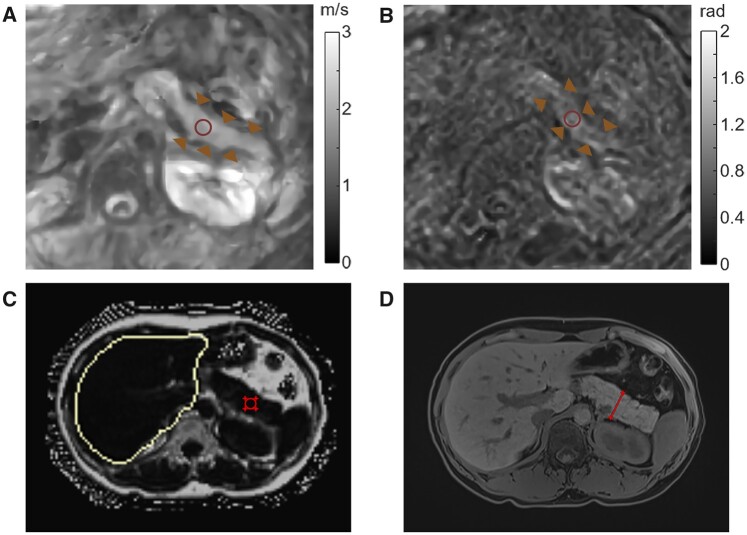
Forty-seven healthy volunteers were prospectively enrolled and underwent two tomoelastography examinations at a mean interval of 7 days. Two radiologists blindly and independently measured the pancreatic stiffness and fluidity at the first examination to determine the reproducibility between readers. One radiologist measured the adjacent pancreatic slice at the first examination to determine the reproducibility among slices and measured the pancreas at the second examination to determine short-term repeatability. The stiffness and fluidity of the pancreatic head, body, and tail were compared to determine anatomical differences. The pancreatic stiffness and fluidity were compared based on sex, age, and body mass index (BMI).
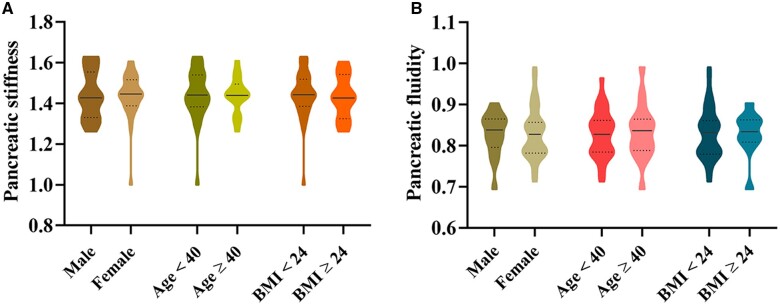
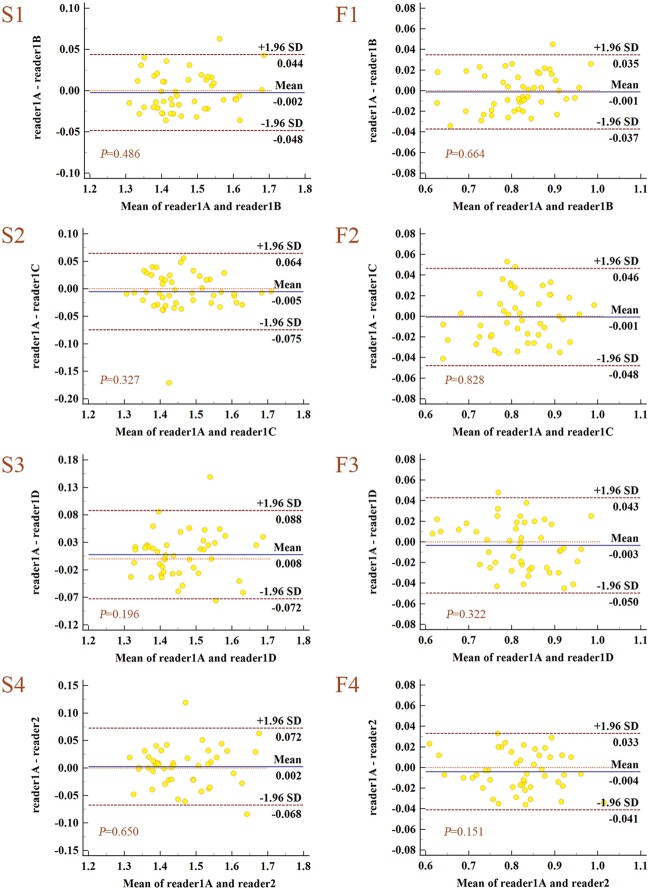
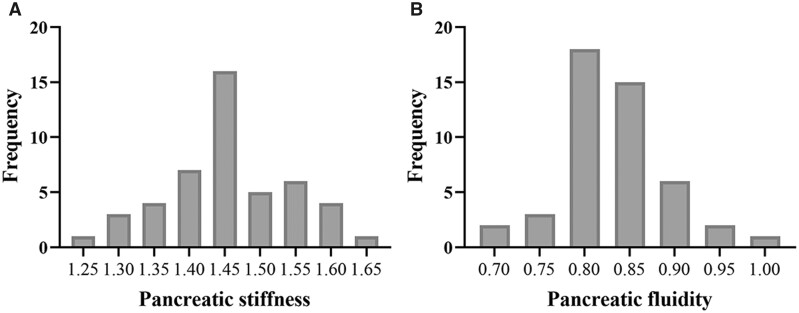
Bland-Altman analyses (all >0.05) and intraclass correlation coefficients (all >0.9) indicated near perfect reproducibility among readers, slices, and examinations at short intervals. Neither stiffness (=0.477) nor fluidity (=0.368) differed among the pancreatic anatomical regions. The mean pancreatic stiffness was 1.45 ± 0.09 m/s; the mean pancreatic fluidity was 0.83 ± 0.06 rad. Stiffness and fluidity did not differ by sex, age, or BMI.
Tomoelastography is a promising and reproducible tool for assessing pancreatic stiffness and fluidity in healthy volunteers.
慢性胰腺炎患者在临床诊断之前往往就已出现不可逆的胰腺功能不全。胰腺癌在晚期是一种致命的恶性肿瘤。必须对胰腺疾病高危患者进行早期筛查,以便使用新的成像方式获得更好的治疗效果。因此,本研究旨在探讨弹性成像测量评估胰腺硬度和流动性的可重复性以及健康志愿者之间的差异。
前瞻性纳入47名健康志愿者,平均间隔7天接受两次弹性成像检查。两名放射科医生在首次检查时对胰腺硬度和流动性进行盲法独立测量,以确定阅片者之间的可重复性。一名放射科医生在首次检查时对相邻胰腺切片进行测量,以确定切片间的可重复性,并在第二次检查时对胰腺进行测量,以确定短期重复性。比较胰头、胰体和胰尾的硬度和流动性,以确定解剖学差异。根据性别、年龄和体重指数(BMI)比较胰腺硬度和流动性。
Bland-Altman分析(均>0.05)和组内相关系数(均>0.9)表明,在阅片者、切片和短时间间隔检查之间具有近乎完美的可重复性。胰腺各解剖区域的硬度(=0.477)和流动性(=0.368)均无差异。胰腺平均硬度为1.45±0.09m/s;胰腺平均流动性为0.83±0.06弧度。硬度和流动性在性别、年龄或BMI方面无差异。
弹性成像对于评估健康志愿者的胰腺硬度和流动性是一种有前景且可重复的工具。