Bhagavata Srinivasan Shyam Prakaash, Raipuria Mukesh, Bahari Hasnah, Kaakoush Nadeem O, Morris Margaret J
School of Medical Sciences, Faculty of Medicine, UNSW Sydney, Sydney, NSW, Australia.
Front Endocrinol (Lausanne). 2018 Nov 29;9:716. doi: 10.3389/fendo.2018.00716. eCollection 2018.
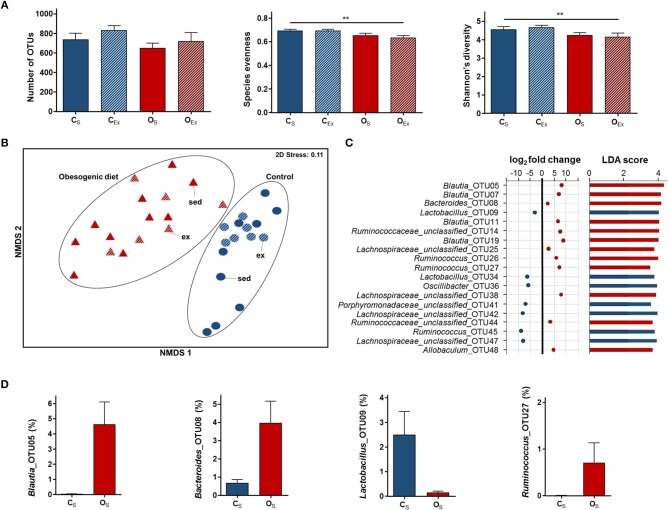
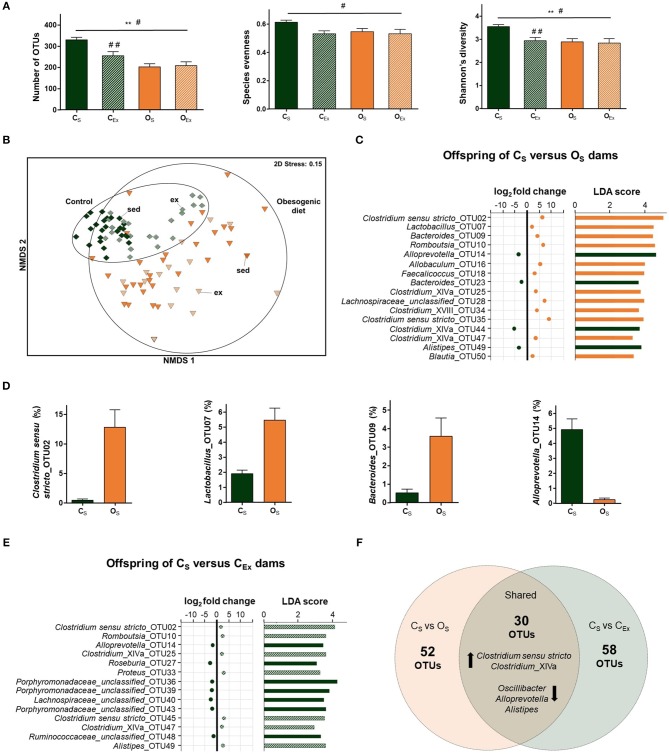
It is well established that maternal exercise during pregnancy improves metabolic outcomes associated with obesity in mothers and offspring, however, its effects on the gut microbiota of both mother and offspring, are unknown. Here, we investigated whether wheel running exercise prior to and during pregnancy and prolonged feeding of an obesogenic diet were associated with changes in the gut microbiomes of Sprague-Dawley rat dams and their offspring. Female rats were fed either chow or obesogenic diet, and half of each diet group were given access to a running wheel 10 days before mating until delivery, while others remained sedentary. 16S rRNA gene amplicon sequencing was used to assess gut microbial communities in dams and their male and female offspring around the time of weaning. Statistical analyses at the operational taxonomic unit (OTU) level revealed that maternal obesogenic diet decreased gut microbial alpha diversity and altered abundances of bacterial taxa previously associated with obesity such as and in dams, and their offspring of both sexes. Distance based linear modeling revealed that the relative abundances of OTUs were associated with adiposity measures in both dams and offspring. We identified no marked effects of maternal exercise on the gut microbiota of obesogenic diet dams or their offspring. In contrast, maternal exercise decreased gut microbial alpha diversity and altered the abundance of 88 microbial taxa in offspring of control dams. Thirty of these taxa were altered in a similar direction in offspring of sedentary obesogenic vs. control diet dams. In particular, the relative abundances of OTUs were decreased in offspring of both exercised control dams and sedentary obesogenic diet dams, and associated with blood glucose concentrations and adiposity measures. Analyses of predicted bacterial metabolic pathways inferred decreased indole alkaloid biosynthesis in offspring of both obesogenic diet and exercised control dams. Our data suggest that maternal exercise prior to and during pregnancy resulted in gut dysbiosis in offspring of control dams. Importantly, alterations in the maternal gut microbiota by obesogenic diet or obesity were transferred to their offspring.
众所周知,孕期母亲运动可改善母亲和后代与肥胖相关的代谢结果,然而,其对母亲和后代肠道微生物群的影响尚不清楚。在此,我们研究了怀孕前和怀孕期间的轮转运动以及长期喂食致肥胖饮食是否与斯普拉格-道利大鼠母鼠及其后代肠道微生物群的变化有关。雌性大鼠分别喂食普通饲料或致肥胖饮食,每个饮食组的一半在交配前10天至分娩期间可使用转轮,而其他大鼠保持 sedentary(久坐不动,此处原文可能有误,推测为sedentary,应改为sedentary)。使用16S rRNA基因扩增子测序评估母鼠及其雄性和雌性后代在断奶时的肠道微生物群落。在操作分类单元(OTU)水平的统计分析表明,母鼠的致肥胖饮食降低了肠道微生物的α多样性,并改变了先前与肥胖相关的细菌类群的丰度,如母鼠及其两性后代中的[此处原文缺失相关细菌类群信息]。基于距离的线性模型显示,[此处原文缺失相关OTU信息]OTU的相对丰度与母鼠和后代的肥胖指标相关。我们未发现母鼠运动对致肥胖饮食母鼠或其后代肠道微生物群有显著影响。相反,母鼠运动降低了对照母鼠后代肠道微生物的α多样性,并改变了88种微生物类群的丰度。其中30种在久坐的致肥胖饮食母鼠与对照饮食母鼠的后代中朝着相似方向改变。特别是,[此处原文缺失相关OTU信息]OTU的相对丰度在运动的对照母鼠和久坐的致肥胖饮食母鼠的后代中均降低,并与血糖浓度和肥胖指标相关。对预测的细菌代谢途径的分析推断,致肥胖饮食母鼠和运动的对照母鼠的后代中吲哚生物碱生物合成减少。我们的数据表明,怀孕前和怀孕期间的母鼠运动导致对照母鼠后代肠道生态失调。重要的是,致肥胖饮食或肥胖引起的母鼠肠道微生物群改变会传递给它们的后代。