Computing, Environment and Life Sciences, Argonne National Laboratory, Lemont, IL, USA.
Computation Institute, The University of Chicago, Chicago, IL, USA.
BMC Bioinformatics. 2018 Dec 21;19(Suppl 18):486. doi: 10.1186/s12859-018-2509-3.
The National Cancer Institute drug pair screening effort against 60 well-characterized human tumor cell lines (NCI-60) presents an unprecedented resource for modeling combinational drug activity.
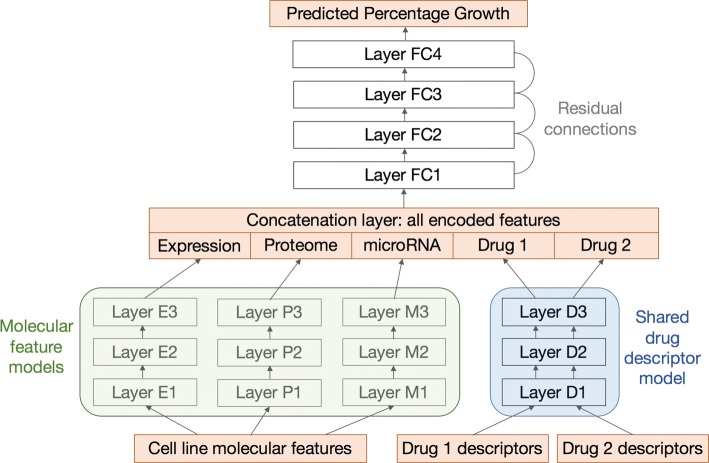
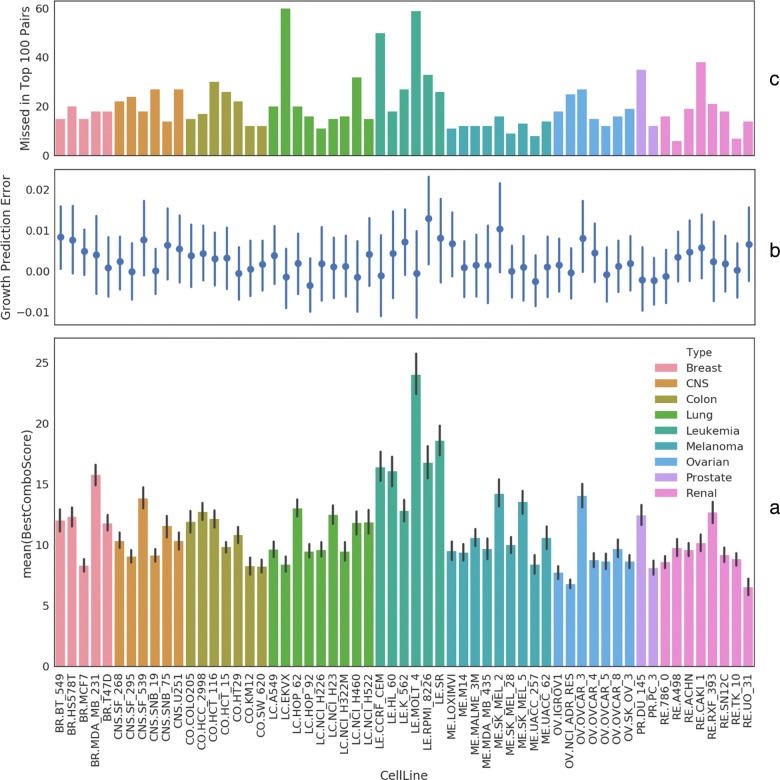
We present a computational model for predicting cell line response to a subset of drug pairs in the NCI-ALMANAC database. Based on residual neural networks for encoding features as well as predicting tumor growth, our model explains 94% of the response variance. While our best result is achieved with a combination of molecular feature types (gene expression, microRNA and proteome), we show that most of the predictive power comes from drug descriptors. To further demonstrate value in detecting anticancer therapy, we rank the drug pairs for each cell line based on model predicted combination effect and recover 80% of the top pairs with enhanced activity.
We present promising results in applying deep learning to predicting combinational drug response. Our feature analysis indicates screening data involving more cell lines are needed for the models to make better use of molecular features.
美国国家癌症研究所(NCI)对 60 种特征明确的人类肿瘤细胞系(NCI-60)进行的药物对筛选工作为模拟组合药物活性提供了前所未有的资源。
我们提出了一种用于预测 NCI-ALMANAC 数据库中药物对亚组的细胞系反应的计算模型。该模型基于残差神经网络对特征进行编码和预测肿瘤生长,解释了 94%的反应方差。虽然我们的最佳结果是通过结合分子特征类型(基因表达、microRNA 和蛋白质组)获得的,但我们表明大部分预测能力来自于药物描述符。为了进一步证明在检测抗癌疗法方面的价值,我们根据模型预测的组合效应对每个细胞系的药物对进行排名,并恢复了 80%具有增强活性的最佳药物对。
我们在应用深度学习预测组合药物反应方面取得了有希望的结果。我们的特征分析表明,模型需要更多的细胞系筛选数据,以便更好地利用分子特征。