Li Zhen, Huang Qi, Sun Li, Bao Tengfei, Dai Zhe
Department of Endocrinology, Zhongnan Hospital of Wuhan University, Wuhan 430071, China.
Int J Endocrinol. 2018 Nov 29;2018:1765835. doi: 10.1155/2018/1765835. eCollection 2018.
This study was designed to investigate risk factors related to atherogenic index of plasma (AIP), as well as the relationship between AIP and chronic microvascular complications in patients with type 2 diabetes (T2DM).
This study included 2523 patients with T2DM who had not been treated with lipid-lowering drugs and were admitted to the Department of Endocrinology at Zhongnan Hospital, Wuhan University, during the period from January 2015 to February 2018. Anthropometric indicators were measured after overnight fasting. Low-density lipoprotein cholesterol (LDL-C), high-density lipoprotein cholesterol (HDL-C), total cholesterol (TC), and triglyceride (TG) were detected by enzymatic analysis. Standard 75 g oral glucose tolerance testing was performed to measure 0 and 2 hr plasma levels of glucose and insulin. Insulin sensitivity was assessed with HOMA-IR.
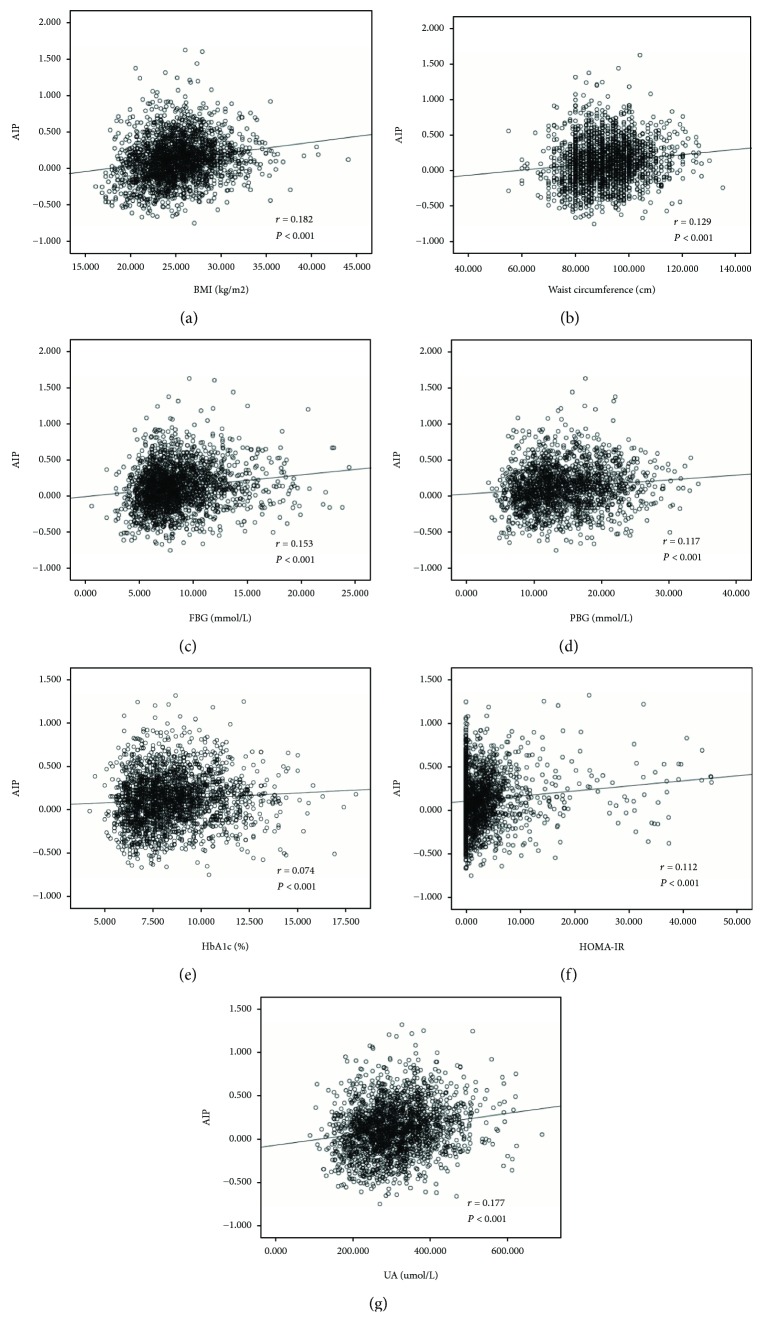
Increase in AIP was associated with an increased risk for hypertension ( < 0.05), HbA ( < 0.05), HOMA-IR ( < 0.05), UA ( < 0.05), and decreased eGFR levels ( < 0.05). Furthermore, AIP values directly correlated with BMI ( = 0.182, < 0.001), waist circumference ( = 0.129, < 0.001), blood glucose index (FBG ( = 0.153, < 0.001), PPBG ( = 0.117, < 0.001), and HbA ( = 0.074, < 0.001)), insulin resistance (HOMA-IR; = 0.112, < 0.001), and uric acid (UA, = 0.177, < 0.001). Multiple logistic regression analysis showed that waist circumference, HOMA-IR, FBG, systolic blood pressure, and UA were independent risk factors for AIP (all < 0.05). The prevalence of diabetic neuropathy and metabolic syndrome was significantly higher among patients with higher AIP.
AIP represents a clinically convenient indicator for the detection of T2DM with high risk of complications and associated diseases and thus is a good predictor and indicator for follow-up monitoring in the treatment of patients with high-risk type 2 diabetes.
本研究旨在探讨与血浆致动脉粥样硬化指数(AIP)相关的危险因素,以及AIP与2型糖尿病(T2DM)患者慢性微血管并发症之间的关系。
本研究纳入了2015年1月至2018年2月期间在武汉大学中南医院内分泌科住院的2523例未接受过降脂药物治疗的T2DM患者。过夜禁食后测量人体测量指标。采用酶法分析检测低密度脂蛋白胆固醇(LDL-C)、高密度脂蛋白胆固醇(HDL-C)、总胆固醇(TC)和甘油三酯(TG)。进行标准75g口服葡萄糖耐量试验,测量0小时和2小时血浆葡萄糖和胰岛素水平。用HOMA-IR评估胰岛素敏感性。
AIP升高与高血压风险增加(<0.05)、糖化血红蛋白(HbA,<0.05)、HOMA-IR(<0.05)、尿酸(UA,<0.05)以及估算肾小球滤过率(eGFR)水平降低(<0.05)相关。此外,AIP值与体重指数(BMI,r = 0.182,<0.001)、腰围(r = 0.129,<0.001)、血糖指数(空腹血糖(FBG,r = 0.153,<0.001)、餐后血糖(PPBG,r = 0.117,<0.001)和糖化血红蛋白(HbA,r = 0.074,<0.001))、胰岛素抵抗(HOMA-IR;r = 0.112,<0.001)以及尿酸(UA,r = 0.177,<0.001)直接相关。多因素logistic回归分析显示,腰围、HOMA-IR、FBG、收缩压和UA是AIP的独立危险因素(均<0.05)。AIP较高的患者中糖尿病神经病变和代谢综合征的患病率显著更高。
AIP是检测具有高并发症和相关疾病风险的T2DM的临床便捷指标,因此是高危2型糖尿病患者治疗中随访监测的良好预测指标和指标。