National Center for Computational Toxicology, Office of Research and Development (ORD), U.S. Environmental Protection Agency (EPA), Research Triangle Park, North Carolina, USA.
National Center for Environmental Assessment (NCEA), ORD, U.S. EPA, Cincinnati, Ohio, USA.
Environ Health Perspect. 2019 Jan;127(1):14501. doi: 10.1289/EHP4555.
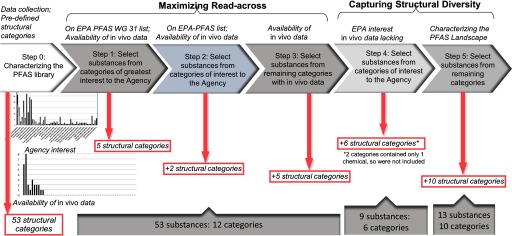
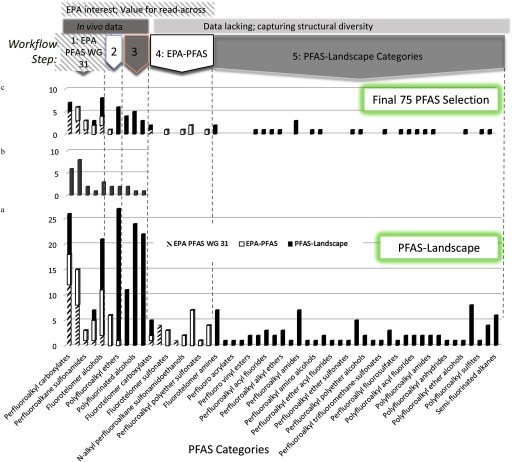
Per- and polyfluoroalkyl substances (PFASs) are a group of fluorinated substances of interest to researchers, regulators, and the public due to their widespread presence in the environment. A few PFASs have comparatively extensive amounts of human epidemiological, exposure, and experimental animal toxicity data (e.g., perfluorooctanoic acid), whereas little toxicity and exposure information exists for much of the broader set of PFASs. Given that traditional approaches to generate toxicity information are resource intensive, new approach methods, including high-throughput toxicity (HTT) testing, are being employed to inform PFAS hazard characterization and further () testing. The U.S. Environmental Protection Agency (EPA) and the National Toxicology Program (NTP) are collaborating to develop a risk-based approach for conducting PFAS toxicity testing to facilitate PFAS human health assessments. This article describes the construction of a PFAS screening library and the process by which a targeted subset of 75 PFASs were selected. Multiple factors were considered, including interest to the U.S. EPA, compounds within targeted categories, structural diversity, exposure considerations, procurability and testability, and availability of existing toxicity data. Generating targeted HTT data for PFASs represents a new frontier for informing priority setting. https://doi.org/10.1289/EHP4555.
全氟和多氟烷基物质(PFASs)是一组引起研究人员、监管机构和公众关注的氟化物质,因为它们广泛存在于环境中。一些 PFASs 具有相对广泛的人类流行病学、暴露和实验动物毒性数据(例如全氟辛酸),而大多数更广泛的 PFASs 的毒性和暴露信息则很少。鉴于传统方法生成毒性信息需要大量资源,因此正在采用新的方法,包括高通量毒性(HTT)测试,为 PFAS 危害特征描述和进一步的()测试提供信息。美国环境保护署(EPA)和国家毒理学计划(NTP)正在合作制定基于风险的 PFAS 毒性测试方法,以促进 PFAS 人类健康评估。本文描述了 PFAS 筛选文库的构建以及选择 75 种 PFAS 目标子集的过程。考虑了多个因素,包括美国 EPA 的关注、目标类别中的化合物、结构多样性、暴露考虑因素、可获得性和可测试性以及现有毒性数据的可用性。为 PFASs 生成有针对性的 HTT 数据代表了为确定优先级提供信息的新前沿。https://doi.org/10.1289/EHP4555.