Zoologisches Institut, Zell- und Neurobiologie, Karlsruhe Institute of Technology (KIT), Fritz-Haber-Weg 4, 76131, Karlsruhe, Germany.
Institut für Angewandte Physik, Karlsruhe Institute of Technology (KIT), Wolfgang-Gaede-Straße 1, 76131, Karlsruhe, Germany.
Nat Commun. 2019 Jan 16;10(1):232. doi: 10.1038/s41467-018-08175-w.
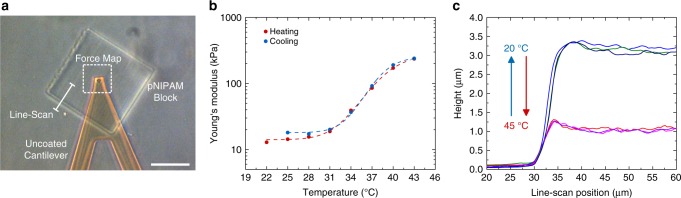
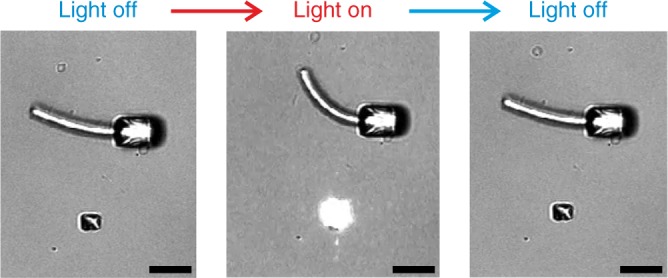
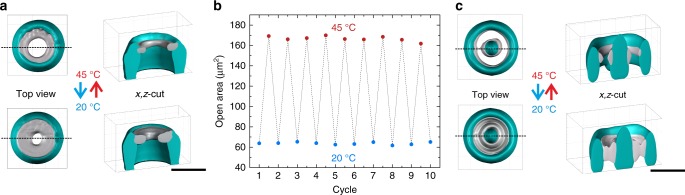
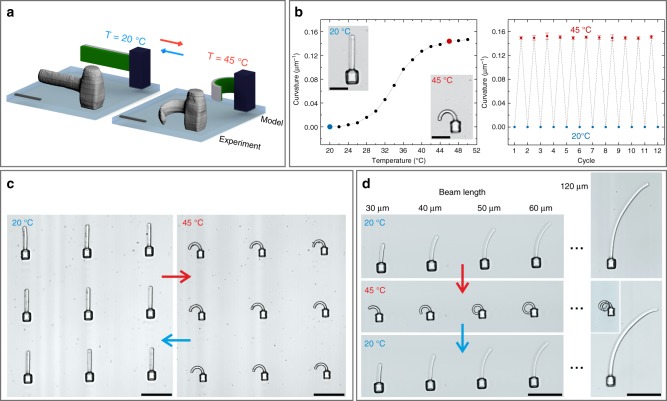
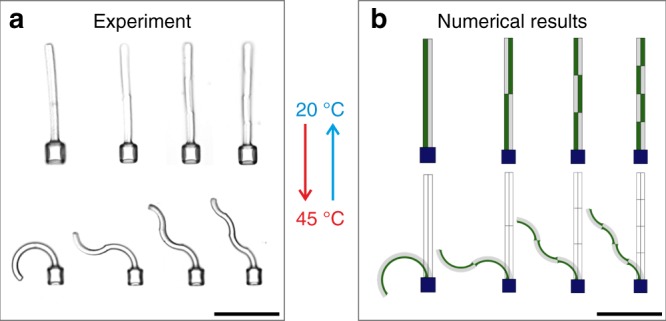
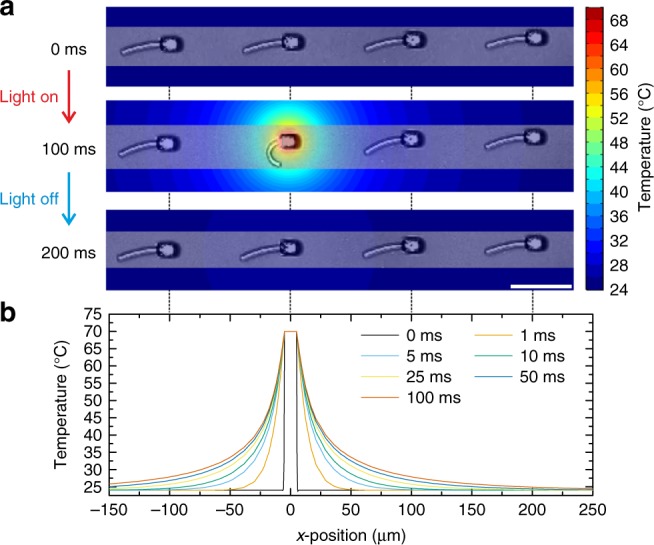
Stimuli-responsive microstructures are critical to create adaptable systems in soft robotics and biosciences. For such applications, the materials must be compatible with aqueous environments and enable the manufacturing of three-dimensional structures. Poly(N-isopropylacrylamide) (pNIPAM) is a well-established polymer, exhibiting a substantial response to changes in temperature close to its lower critical solution temperature. To create complex actuation patterns, materials that react differently with respect to a stimulus are required. Here, we introduce functional three-dimensional hetero-microstructures based on pNIPAM. By variation of the local exposure dose in three-dimensional laser lithography, we demonstrate that the material parameters can be altered on demand in a single resist formulation. We explore this concept for sophisticated three-dimensional architectures with large-amplitude and complex responses. The experimental results are consistent with numerical calculations, able to predict the actuation response. Furthermore, a spatially controlled response is achieved by inducing a local temperature increase by two-photon absorption of focused light.
刺激响应微结构对于在软机器人技术和生物科学中创建自适应系统至关重要。对于此类应用,材料必须与水相环境兼容,并能够制造三维结构。聚(N-异丙基丙烯酰胺)(pNIPAM)是一种成熟的聚合物,在接近其低临界溶液温度时对温度变化表现出显著的响应。为了创建复杂的致动模式,需要使用相对于刺激具有不同反应的材料。在这里,我们介绍了基于 pNIPAM 的功能性三维杂化微结构。通过在三维激光光刻中改变局部曝光剂量,我们证明可以在单个抗蚀剂配方中按需改变材料参数。我们探索了这种概念在具有大振幅和复杂响应的复杂三维结构中的应用。实验结果与能够预测致动响应的数值计算一致。此外,通过双光子吸收聚焦光来局部增加温度,实现了空间控制的响应。