Kuo Yi-Hsuan, Kuo Chao-Hung, Huang Wen-Cheng, Wu Jau-Ching
Department of Neurosurgery, Neurological Institute, Taipei Veterans General Hospital, Taipei, Taiwan.
School of Medicine, National Yang-Ming University, Taipei, Taiwan.
Neurospine. 2019 Sep;16(3):626-630. doi: 10.14245/ns.1836178.089. Epub 2019 Jan 4.
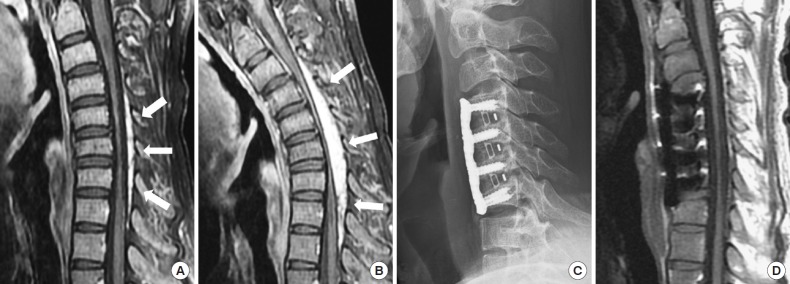
Hirayama disease, a juvenile muscular atrophy of the distal upper extremity, is a rare form of cervical flexion myelopathy characterized by insidiously progressive weakness of the hands and forearm muscles (i.e., painless amyotrophy). The pathognomonic finding is a markedly forward-shifted spinal cord during neck flexion, demonstrated by dynamic magnetic resonance imaging (MRI), as in a young man with muscle atrophy in the bilateral distal upper extremities. In this report, the authors describe a 31-year-old man who had the classic radiological and clinical presentations of Hirayama disease. Since prior medical treatment had been ineffective for years, he underwent multilevel instrumented anterior cervical discectomy and fusion (ACDF) to keep his subaxial cervical spine slightly-lordotic (nonflexion). His motor evoked potential amplitude improved immediately during the operation, and there were improvements of myelopathy and a modest reversal of muscle wasting at 1 year postoperatively. Postoperative dynamic cervical spine MRI also demonstrated minimal cord compression and elimination of the venous plexus engorgement dorsal to the thecal sac. Although Hirayama disease is benign in nature and frequently self-limiting, multilevel instrumented ACDF could be a reasonable management option.
平山病是一种青少年上肢远端肌肉萎缩症,是一种罕见的颈椎屈曲型脊髓病,其特征为手部和前臂肌肉隐匿性进行性无力(即无痛性肌萎缩)。特征性表现是在颈部屈曲时脊髓明显向前移位,这可通过动态磁共振成像(MRI)显示,就像一名双侧上肢远端肌肉萎缩的年轻男性那样。在本报告中,作者描述了一名31岁男性,他具有平山病典型的影像学和临床表现。由于多年来先前的治疗均无效,他接受了多节段前路颈椎间盘切除融合术(ACDF),以使颈椎下段保持轻度前凸(非屈曲)。术中他的运动诱发电位幅度立即改善,术后1年脊髓病有所改善,肌肉萎缩也有一定程度的逆转。术后颈椎动态MRI还显示脊髓压迫轻微,硬膜囊背侧静脉丛充血消失。尽管平山病本质上是良性的且常为自限性,但多节段ACDF可能是一种合理的治疗选择。